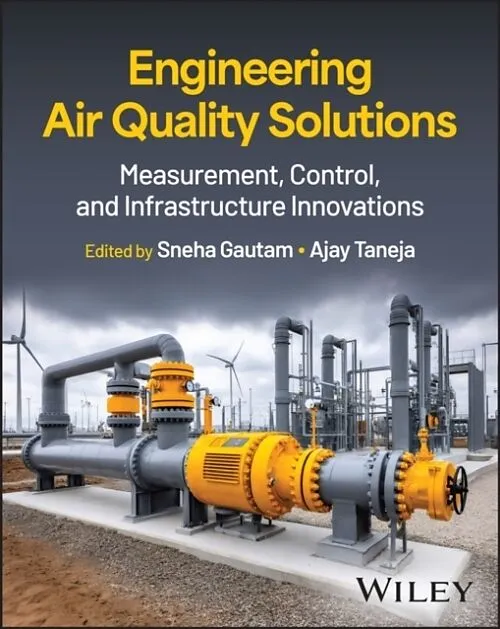
Engineering Air Quality Solutions
Beschreibung
Autorentext Sneha Gautam, PhD, is Associate Professor in the Division of Civil Engineering at Karunya Institute of Technology and Sciences. Dr. Gautam's name has been consecutively listed (2021-2025) among the Top 2% Scientists of the World by Stanford Univers...Format auswählen
- Fester EinbandCHF 165.20

Wird oft zusammen gekauft
Andere Kunden kauften auch
Beschreibung
Autorentext
Sneha Gautam, PhD, is Associate Professor in the Division of Civil Engineering at Karunya Institute of Technology and Sciences. Dr. Gautam's name has been consecutively listed (2021-2025) among the Top 2% Scientists of the World by Stanford University. He has received several prestigious recognitions, including the Young Scientist Award (2023) by the Academy of Sciences, Chennai, Young Scientist Award (2022), IEI Special Appreciation Award (2021), IEI Young Achiever Award (2020), and the IEI Young Scientist Award (2019). He has published 180+ papers spanning environmental monitoring, air quality, and climate interactions and serves on multiple editorial boards. Ajay Taneja, PhD, is Professor at Dr B.R Ambedkar University Agra and Vice Chancellor at Khwaja Moinuddin Chishti Language University, Lucknow, India. He has more than 175 research articles to his credit. His research portfolio spans indoor/outdoor exposure science, health effects, and mitigation strategies. He is widely cited for contributions that bridge measurement, risk, and policy for air-pollution management.
Klappentext
A rigorous blueprint for designing, monitoring, and governing cleaner urban atmospheres with engineering-first precision Engineering Air Quality Solutions: Measurement, Control, and Infrastructure Innovations by Sneha Gautam and Ajay Taneja offers up-to-date solutions for many of the hardest problems at the nexus of pollution science, civil systems, and policy. Drs. Gautam and Taneja draw on their extensive expertise in environmental science to offer an authoritative playbook that spans sensors, models, materials, and regulatory practice. The result is a technically exacting guide to measuring, predicting, and reducing pollution across buildings, industry, and cities. Across nine tightly edited chapters, the book progresses from problem framing to implementation: the health and infrastructure stakes of polluted air, the climate-air nexus and design responses, remote and ground-based monitoring architectures, high-performance ventilation and IAQ engineering, pollution-resistant materials, CFD and data-driven dispersion modeling, AI/IoT for smart-city control loops, industrial emissions engineering, and compliance with global regulatory standards. Each chapter combines methods, algorithms, and case evidence, culminating in a practitioner-ready set of tools you can deploy today in planning, design, and operations. The book also:
- Quantifies climate impacts on urban pollutant behavior, including heat islands, weather variability, and risk from extreme events, and translates them into infrastructure design criteria
- Compares satellite, UAV, and ground networks, specifies deployment strategies, and applies AI/ML to automate QA/QC and interpretation at scale
- Delivers IAQ engineering guidance, like filtration and air exchange design to smart building telemetry, grounded in material emissions and real-time control
- Details materials and technologies for passive and active mitigation, including photocatalytic coatings, nanomaterials, and green infrastructure performance
- Aligns engineering practice with global policy, addressing design for compliance, evidence-based standards, and governance frameworks that actually reduce exposures Engineering Air Quality Solutions is perfect for civil, environmental, and transportation engineers, air-quality specialists, urban planners, infrastructure designers, and policy professionals who need technically defensible strategies that link sensing, modeling, and mitigation to measurable health and compliance outcomes. It will also benefit graduate researchers and advanced students seeking a definitive survey of relevant methods and implementations.
Inhalt
List of Contributors ix
Preface xiii
Acknowledgments xv
1 Introduction-Engineering Solutions for Air Pollution Control 1
Raju Ramrao Kulkarni
2 Quantifying the Effects of Climate Change on Urban Air Quality-Implications for Infrastructure Design 11
Surat Dewan and Anita Lakhani
3 Development of Machine Learning Models for Prediction of PM2.5 Concentration Based on MERRA-2 Reanalysis Data 27
Parminder Kaur, Chaitanya B. Pande, and Atar Singh Pipal
4 Environmental Impact and Waste Management Challenges for Air Quality Management in Smart Cities 49
Rahul Tiwari, Komal Daal, Sanjar Ali, Vandana Tyagi, Bhavay Sharma, Sree Kumar Kumaraswamy, and Prakash Doraiswamy
5 Research on the Impact of Factors Related to PM2.5 Concentration in Hanoi City, Vietnam 59
Anh The Hoang
6 Commuters' Exposure to Air Pollutants in a Subway Metro System 71
Amit Passi, Yaparla Deepthi, Chithra VS, Lekshmi Mohan V, Shiva Nagendra SM, and Maiya MP
7 Formulation and Implementation of Indoor Air Quality Monitoring Protocol in Urban India 83
Priyanka Kulshreshtha, Rakesh Kumar, and Mukesh Khare
8 Green Nanoparticles: A Sustainable Approach to Air Pollutant Remediation 101
Sonam Tripathi and Anindita Bhattacharya
9 Road Dust Management Technique for Opencast Coal Mines 113
Swades Kumar Chaulya
10 Air Pollution Dispersion Modeling and Simulation in Urban Environments 125
Lorraine Tellis, Sachin Gupta, Khatija Atthar, Reetika Swamy, Sameer Jadhav, and Jamson Masih
11 The Role of IoT in Air Pollution Research: A Bibliometric Analysis from 1975 to 2025 139
Niveditha Muruganandam and Surendar Kumar AV
12 Development of Air Pollutants Emission Inventory of Urban Anthropogenic Sources in the Tier-II Non-attainment City of India: A Case Study of Vijayawada City, India 151
Manuj Sharma and Suresh Jain
13 Data-driven Engineering Approaches to Air Pollution Control: Insights from PM2.5 Seasonal Trends, Trace Elements, and Health Impact Assessment-A Case Study 165
Somvir Singh, Vishnu Kumar, Shikha, Mudit Yadav, and Archana Sharma
14 Convergence of Policy and Precision: Engineering Standards and Regulatory Frameworks for Sustainable Air Quality Solutions 181
Vaishnav Bartaria, Ashok Jangid, and Ranjit Kumar
Index 203