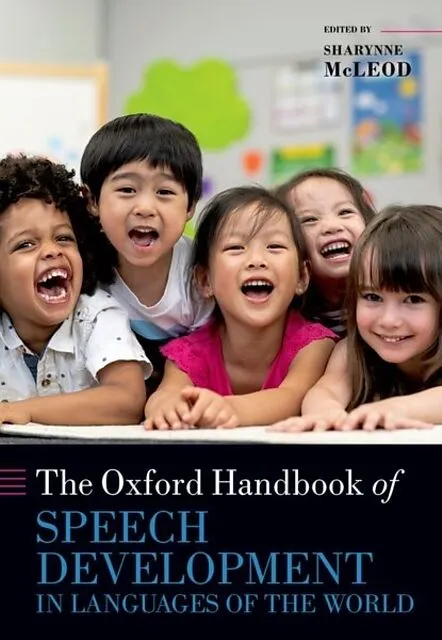
The Oxford Handbook of Speech Development in Languages of the World
Beschreibung
Informationen zum Autor Sharynne McLeod is a Distinguished Professor at Charles Sturt University, specializing in children's speech and language acquisition. She has a legacy of leading interdisciplinary teams that undertake impactful and international researc...Format auswählen
- Fester EinbandCHF 299.20
Wird oft zusammen gekauft
Andere Kunden kauften auch
Beschreibung
Informationen zum Autor Sharynne McLeod is a Distinguished Professor at Charles Sturt University, specializing in children's speech and language acquisition. She has a legacy of leading interdisciplinary teams that undertake impactful and international research into multilingual children's speech, and her transformative work has reframed the speech-language pathology profession by foregrounding communication rights and social justice. She has received Honors of the AmericanSpeech-Language-Hearing Association and Life Membership of Speech Pathology Australia, and is President of the International Clinical Phonetics and Linguistics Association. Her many publications include Introductionto Speech, Language, and Literacy (co-edited with Jane McCormack; OUP, 2015) and Interventions for Speech Sound Disorders in Children (2nd ed., co-edited with A. Lynn Williams and Rebecca J. McCauley; Brookes Publishing, 2021). Klappentext This volume presents a paradigm shift in the world's knowledge about children's speech development, with 80 chapters covering 75 languages and language varieties or dialects from across the globe. Each of the chapters follows the same structure, facilitating comparison across languages and dialects. Researchers and students can identify relationships between common and unique elements of children's speech to develop new theories and enhance understanding. Crucially, the curated data in the chapters can be used by communication specialists to collaborate with families and communities, in order to support children's home language maintenance and speech development, including in languages not spoken by the specialists. The Oxford Handbook of Speech Development in Languages of the World outlines a transformative approach by which the discipline can overcome traditional English- and Western-centric biases by respecting and acknowledging longstanding traditions of research, theories, and knowledge from a wide range of countries and cultures - including knowledge not previously translated into English. Languages spoken by First Nations people and traditionally marginalized groups are given equivalent status to majority languages, and the language maps, resources, and pronunciation guides have been created using a rights-based, social justice approach, acknowledging the impact of colonization. Inhaltsverzeichnis 1: Sharynne McLeod: Children's speech development around the world: A transformative paradigm shift 2: Sarah Verdon: Cultural considerations regarding children's speech development 3: Martin J. Ball and Nicole Müller: Articulatory and phonological foundations of speech acquisition 4: Kate Margetson and Sharynne McLeod: Speech Assessment of Children's Home Language(s) (SACHL): A clinical protocol 5: Kathryn Crowe and Sharynne McLeod: Researching children's speech development 6: Brenda Louw, Mia le Roux, and Salomé Geertsema: Afrikaans speech development 7: Wendy Kwakye Amoako, Joseph Paul Stemberger, and Andrea A. N. MacLeod: Akan speech development 8: Tamer Abou-Elsaad, Omayma Afsah, Maii Saad, and Amira Mansour: Arabic (Egyptian) speech development 9: Hadeel Ayyad, Shaima AlQattan, and Barbara May Bernhardt: Arabic (Kuwaiti) speech development 10: Ghada Khattab: Arabic (Lebanese) speech development 11: Talieh Zarifian, Akram Ahmadi, and Fatemeh Fekar-Gharamaleki: Azerbaijani/Azeri Turkish speech development 12: Diana Ignatova, Barbara May Bernhardt, and Stefka H. Marinova-Todd: Bulgarian speech development 13: Carol Kit Sum To and Pamela Sau Ping Cheung: Cantonese speech development 14: Marit Carolin Clausen: Danish speech development 15: Anniek Van Doornik, Ellen Gerrits, Paula Fikkert, Mieke Beers, and Hayo Terband: Dutch speech development 16: Ida J. Stockman: English (African American) speech development 17: Peter Flipsen Jr.: English (Appalachian) speech development 18: Sharynne McLeod and Helen L. Blake:...
Autorentext
Sharynne McLeod is a Distinguished Professor at Charles Sturt University, specializing in children's speech and language acquisition. She has a legacy of leading interdisciplinary teams that undertake impactful and international research into multilingual children's speech, and her transformative work has reframed the speech-language pathology profession by foregrounding communication rights and social justice. She has received Honors of the American Speech-Language-Hearing Association and Life Membership of Speech Pathology Australia, and is President of the International Clinical Phonetics and Linguistics Association. Her many publications include Introduction to Speech, Language, and Literacy (co-edited with Jane McCormack; OUP, 2015) and Interventions for Speech Sound Disorders in Children (2nd ed., co-edited with A. Lynn Williams and Rebecca J. McCauley; Brookes Publishing, 2021).
Klappentext
This volume presents a paradigm shift in the world's knowledge about children's speech development, with 80 chapters covering 75 languages and language varieties or dialects from across the globe. Each of the chapters follows the same structure, facilitating comparison across languages and dialects. Researchers and students can identify relationships between common and unique elements of children's speech to develop new theories and enhance understanding. Crucially, the curated data in the chapters can be used by communication specialists to collaborate with families and communities, in order to support children's home language maintenance and speech development, including in languages not spoken by the specialists.
The Oxford Handbook of Speech Development in Languages of the World outlines a transformative approach by which the discipline can overcome traditional English- and Western-centric biases by respecting and acknowledging longstanding traditions of research, theories, and knowledge from a wide range of countries and cultures - including knowledge not previously translated into English. Languages spoken by First Nations people and traditionally marginalized groups are given equivalent status to majority languages, and the language maps, resources, and pronunciation guides have been created using a rights-based, social justice approach, acknowledging the impact of colonization.
Inhalt
1: Sharynne McLeod: Children's speech development around the world: A transformative paradigm shift
2: Sarah Verdon: Cultural considerations regarding children's speech development
3: Martin J. Ball and Nicole Müller: Articulatory and phonological foundations of speech acquisition
4: Kate Margetson and Sharynne McLeod: Speech Assessment of Children's Home Language(s) (SACHL): A clinical protocol
5: Kathryn Crowe and Sharynne McLeod: Researching children's speech development
6: Brenda Louw, Mia le Roux, and Salomé Geertsema: Afrikaans speech development
7: Wendy Kwakye Amoako, Joseph Paul Stemberger, and Andrea A. N. MacLeod: Akan speech development
8: Tamer Abou-Elsaad, Omayma Afsah, Maii Saad, and Amira Mansour: Arabic (Egyptian) speech development
9: Hadeel Ayyad, Shaima AlQattan, and Barbara May Bernhardt: Arabic (Kuwaiti) speech development
10: Ghada Khattab: Arabic (Lebanese) speech development
11: Talieh Zarifian, Akram Ahmadi, and Fatemeh Fekar-Gharamaleki: Azerbaijani/Azeri Turkish speech development
12: Diana Ignatova, Barbara May Bernhardt, and Stefka H. Marinova-Todd: Bulgarian speech development
13: Carol Kit Sum To and Pamela Sau Ping Cheung: Cantonese speech development
14: Marit Carolin Clausen: Danish speech development
15: Anniek Van Doornik, Ellen Gerrits, Paula Fikkert, Mieke Beers, and Hayo Terband: Dutch speech development
16: Ida J. Stockman: English (African American) speech development
17: Peter Flipsen Jr.: English (Appalachian) speech development
18: Sharynne McLeod and Helen L. Blake: English (Australian) speech development
19: H…