
IHR WARENKORB IST AKTUELL LEER.
Haben Sie noch nichts passendes gefunden? Stöbern Sie durch unser komplettes Sortiment.
Oder melden Sie sich an bzw. registrieren Sie sich.
- Kostenlose Lieferung
- Kauf auf Rechnung
- Ex Libris Tiefpreis
- Filiallieferung und 650+ Abholorte
- Rabatt-Bons als Club-Mitglied
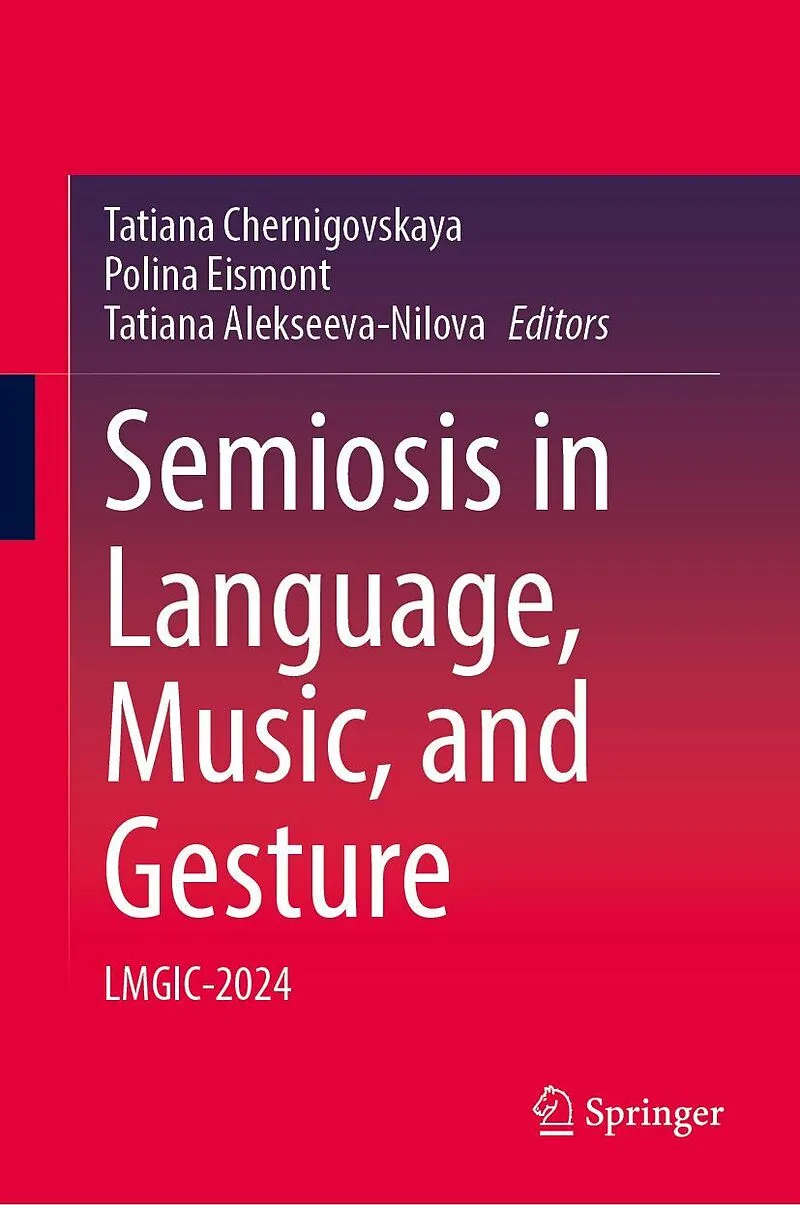
Semiosis in Language, Music, and Gesture
Beschreibung
Following the tradition of previous conferences, this book brings together selected revised papers representing an interdisciplinary approach to the study of language, music and gesture. The collection presents researches devoted to the study of music, langua...
Format auswählen
- Fester EinbandCHF 178.80

Wird oft zusammen gekauft
Andere Kunden kauften auch
Beschreibung
Following the tradition of previous conferences, this book brings together selected revised papers representing an interdisciplinary approach to the study of language, music and gesture. The collection presents researches devoted to the study of music, language and gesture as three basic human semiotic systems. The volume includes articles distributed across six sections, which examine the cognitive mechanisms of music and language acquisition and their processing at different levels, rhythmic and prosodic interrelations between music and language, the role of gesture in the perception of music and in communication in general, as well as issues of representation of emotions in music. A unique feature of the presented collection is that the papers, combined into one volume, allow researchers and professional readers to get an idea of the diverse spectrum of interdisciplinary cognitive studies of the main semiotic systems in Russia and beyond. The book would be of great interest to a wide range of scholars and postgraduate students in a specific research area of basic human cognitive processes.
Brings together scholars from several disciplines, discussing various systems of verbal and non-verbal communication Presents new approaches to the music and gesture on stage, based on contemporary practice Discusses cognitive and neurophysiological basis for human abilities as a crossroad of Science, Humanities, and Arts
Autorentext
Tatiana Chernigovskaya is full professor at St Petersburg University, Head of the Department of the Problems of Convergence in Natural Sciences and Humanities, Director of Institute for Cognitive research, Doctor of Science in Human Physiology, Member of Russian Academy of Education, Member of the Norwegian Academy of Science and Letters, Honorary member of the Semiotic Society of Finland. Invited lecturer in many European and North American Universities. The author of more than 380 publications. Gold medal of Russian Academy of Sciences for propagation of scientific knowledge winner (2017).
Polina Eismont is an Associate Professor at the Department of General Linguistics, St. Petersburg State University. Her research interests include Language Acquisition and Psycholinguistics, Text Linguistics, Cognitive Linguistics, Event Structure, Music Semantics, Syntax of Nulls. She obtained her Ph.D. from St. Petersburg State University in 2008. She is the author of more than 60 papers in domestic and international journals and the co-editor of two CCIS volumes Language, Music, and Computing (Springer Verlag, 2015, 2019).
Tatiana Alekseeva-Nilova is an Associate Professor at the Department of Theory and Methodology for Teaching Arts and Humanities, St. Petersburg State University. Her research interests include Psycholinguistics, Text Processing, Second Language Acquisition, Context Predictability, Reading and Visual Recognition. She obtained her Ph.D. from St. Petersburg State University in 2000. She is the author of more than 130 papers in domestic and international journals and the co-author of two online courses on Coursera. In the past 15 years, she has been coordinating the work of the St. Petersburg Seminar on Cognitive Research. She also organizes St. Petersburg Winter Workshops on Experimental Studies of Speech and Language, serving as a member of Program Committee.
Inhalt
Preface.- Chapter 1. Semiosis in Human Evolution (Tatiana Chernigovskaya).- Part I: Language and Music Through the Prism of Cognitive Science.- Chapter 2. Supra-Individual Mechanisms of Music and Language: Three Steps to Formulate a Hypothesis (Giula Shamilli).- Chapter 3. Perception of Poetic Text With and Without Music: An Experimental Study in the Tradition of Conceptual Integration Theory (Polina Eismont and Anastassiia Garasimyuk).- Chapter 4. Vocal vs. Instrumental Music Training Discourse: Comparative Analysis of Metaphorical Spaes (Leonid Pakhomov, Daria Pavlova, Elena Erofeeva, Tatiana Alekseeva-Nilova).- Part II: Music and Language Acquisition.- Chapter 5. The Interaction of Linguistic and Musical Competencies: a Mini-Review (Anzhalika Dubasova).- Chapter 6. Simulated Musical Gestures in Beginner and Professional Violinists (Annamaria Minafra).- Chapter 7. Colored Music as a Basis for Developing Software to Be Used in the Musical Notation Teaching Process (Rodmonga Potapova, Vsevolod Potapov and Nikita Pomerantsev).- Chapter 8. Word as Gesture: Pronouns in the Speech of Children with Different Ways of Language Acquisition (Olga Sizova).- Part III: Phonetics in Language and Music.- Chapter 9. Realization of Basic Melodic Contours in Russian, English, and French (Pavel Kholyavin).- Chapter 10. Absorbing the Tabla: Intermedial Fusion in the Music of Georges Aperghis (Tatiana Yakovleva).- Chapter 11. Development of a Corpus of Interfered Russian Speech with Rhythm Labeling (Polina Lyapina, Daria Guseva, Ivan Gurkov and Mikhail Dolgushin).- Chapter 12. Processing Facial Expression and Intonation in Ironic Speech (Uliana Kochetkova and Pavel Scherbakov).- Part IV: Emotions in Language and Music.- Chapter 13. Movement, Gestures, and Embodied Cognition in Music (Marina Korsakova-Kreyn).- Chapter 14. Language of Emotions in Music (Ksenia Sapozhnikova and Roald Taymanov).- Part V. Multimodal View of Music and Gesture.- Chapter 15. Delsarte's Semiotic System in the Unity of Theory and Practice: from Gesture to Tune (Elena Pridanova).- Chapter 16. Kyriakides' Music-Text-Film Multimedia Concept as a New Aspect in the Perception of Music (Anastasiia Tsukanova and Anna Merkusheva Yannis).- Chapter 17. The Head Gestures in the Flamenco Performance Art of the Choreographer Antonio Najarro (Alexandra Evdokimova).- Chapter 18. Death of the Author and Death of the Subject: Artificial Intelligence in Composition as an Intellectual Gesture of Musical Conceptualism (Svetlana Lavrova).- Part VI: Multimodal View of Communication.- Chapter 19. Companion Robot Supporting Primary Communicative Contact with a Human (. Artemy Kotov, Anna Zinina, Nikita Arinkin).- Chapter 20. The Session Is Declared Open: Institutional Roles and Speech Interaction in the Russian Courtroom (Olga Blinova).