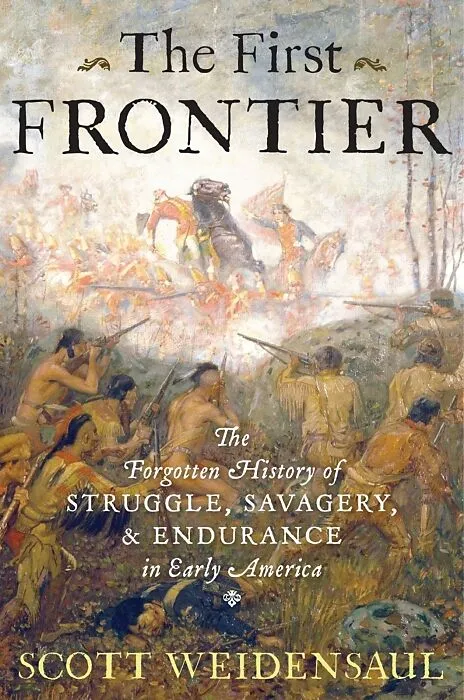
The First Frontier
Beschreibung
Zusatztext With a novelist's flair, he conveys the experiences of ordinary people pitted against powerful and unpredictable nature. . . Mr. Weidensaul invites readers to imagine the bloody ground beneath modern America's apparently tame landscape. The Wall Str...Format auswählen
- Fester EinbandCHF 33.20

Wird oft zusammen gekauft
Andere Kunden kauften auch
Beschreibung
Zusatztext With a novelist's flair, he conveys the experiences of ordinary people pitted against powerful and unpredictable nature. . . Mr. Weidensaul invites readers to imagine the bloody ground beneath modern America's apparently tame landscape. The Wall Street Journal Exhaustively researched and entertainingly written. . . Credit Weidensaul with proving once again that history does not have to be dull in order to be comprehensive. It would be difficult to find a work of either fact or fiction more filled with excitement and suspense than The First Frontier. The Seattle Times With a novelist's flair, he conveys the experiences of ordinary people pitted against powerful and unpredictable nature. . . Mr. Weidensaul invites readers to imagine the bloody ground beneath modern America's apparently tame landscape. The Wall Street Journal Informationen zum Autor Author and naturalist Scott Weidensaul, who grew up in the heart of the old Eastern frontier, has written more than two dozen books, including the Pulitzer Prize finalist Living on the Wind: Across the Hemisphere with Migratory Birds. Klappentext Frontier : the word carries the inevitable scent of the West. But before Custer or Lewis and Clark, before the first Conestoga wagons rumbled across the Plains, it was the East that marked the frontierthe boundary between complex Native cultures and the first colonizing Europeans.Here is the older, wilder, darker history of a time when the land between the Atlantic and the Appalachians was contested groundwhen radically different societies adopted and adapted the ways of the other, while struggling for control of what all considered to be their land. The First Frontier traces two and a half centuries of history through poignant, mostly unheralded personal storieslike that of a Harvard-educated Indian caught up in seventeenth-century civil warfare, a mixed-blood interpreter trying to straddle his white and Native heritage, and a Puritan woman wielding a scalping knife whose bloody deeds still resonate uneasily today. It is the first book in years to paint a sweeping picture of the Eastern frontier, combining vivid storytelling with the latest research to bring to life modern America's tumultuous, uncertain beginnings. Leseprobe Introduction On the Hochstetler farm, which in September 1757 sat like an oasis of orchards and fields below the dark forests of the Kittochtinny Hills in eastern Pennsylvania, there was a rhythm to the seasons, and for the young people of the surrounding German community, apfelschnitz time was one of the highlights of autumn. The apple trees, planted more than fifteen years earlier, hung ripe with fruita testimony to God's mercy, which, having brought these followers of the Mennonite elder Jakob Ammann out of persecution in Germany and Switzerland, led them to this new land of Pennsylvania, William Penn's holy experiment of religious tolerance. Never mind that their neighborsEnglish, Welsh, Scots-Irish, even their fellow Germans, the Lutherans and Reformeds, who worshipped together at the union church down the Tulpehocken Valleywere not always the most welcoming, calling them Amish or looking askance at their pacifist ways in these troubled times of war. The Amish community along Northkill Creekthe first of its kind in the New Worldwas strong and growing. Jacob Hochstetler knew they were blessed every time he looked at his wife, his children, and their prosperous farms. It was harvest time in the orchards. The best apples would be picked with gloved handsnever letting skin touch skin, which would cause the fruit to spoilthen be carefully packed in boxes of straw to be stored away in the cool, dry root cellar, alongside the potatoes and carrots. In the middle of winter, the fruit wo...
Autorentext
Author and naturalist Scott Weidensaul, who grew up in the heart of the old Eastern frontier, has written more than two dozen books, including the Pulitzer Prize finalist Living on the Wind: Across the Hemisphere with Migratory Birds.
Klappentext
Frontier: the word carries the inevitable scent of the West. But before Custer or Lewis and Clark, before the first Conestoga wagons rumbled across the Plains, it was the East that marked the frontier—the boundary between complex Native cultures and the first colonizing Europeans.
Here is the older, wilder, darker history of a time when the land between the Atlantic and the Appalachians was contested ground—when radically different societies adopted and adapted the ways of the other, while struggling for control of what all considered to be their land.
The First Frontier traces two and a half centuries of history through poignant, mostly unheralded personal stories—like that of a Harvard-educated Indian caught up in seventeenth-century civil warfare, a mixed-blood interpreter trying to straddle his white and Native heritage, and a Puritan woman wielding a scalping knife whose bloody deeds still resonate uneasily today. It is the first book in years to paint a sweeping picture of the Eastern frontier, combining vivid storytelling with the latest research to bring to life modern America’s tumultuous, uncertain beginnings.
Leseprobe
**Introduction
**On the Hochstetler farm, which in September 1757 sat like an oasis of orchards and fields below the dark forests of the Kittochtinny Hills in eastern Pennsylvania, there was a rhythm to the seasons, and for the young people of the surrounding German community, apfelschnitz time was one of the highlights of autumn.
The apple trees, planted more than fifteen years earlier, hung ripe with fruit—a testimony to God’s mercy, which, having brought these followers of the Mennonite elder Jakob Ammann out of persecution in Germany and Switzerland, led them to this new land of Pennsylvania, William Penn’s “holy experiment” of religious tolerance. Never mind that their neighbors—English, Welsh, Scots-Irish, even their fellow Germans, the Lutherans and Reformeds, who worshipped together at the union church down the Tulpehocken Valley—were not always the most welcoming, calling them “Amish” or looking askance at their pacifist ways in these troubled times of war. The Amish community along Northkill Creek—the first of its kind in the New World—was strong and growing. Jacob Hochstetler knew they were blessed every time he looked at his wife, his children, and their prosperous farms.
It was harvest time in the orchards. The best apples would be picked with gloved hands—never letting skin touch skin, which would cause the fruit to spoil—then be carefully packed in boxes of straw to be stored away in the cool, dry root cellar, alongside the potatoes and carrots. In the middle of winter, the fruit would be portioned out, like treasures, crisp and dripping juice as though straight from the tree. The other, lesser apples would be ground into sauce or boiled in great iron kettles to make creamy apple butter, while the tartest (along with the windfalls) would be home-milled and pressed for cider, stored in casks that went into the root cellar, too.
But enormous piles of apples lay ready this day for schnitz, dried apples that, when soaked in water, would plump up to make fillings for pies and tarts. In the morning, all the children and teens from the surrounding farms—the Yoders, Hertzlers, Nues, Glicks, Zoogs, and other Amish families—gathered at the Hochstetlers’ to help with the chore, as did the Hochstetlers’ grown children, John and Barbara, who lived on neighboring farms. Working steadily but happily—with a lot of joking and, among the older ones, whatever discreet flirting they could manage—the kids sliced and pared the apples with sweet-sticky fingers, cutting them into translucent half-moons that Frau Hochstetler and th…