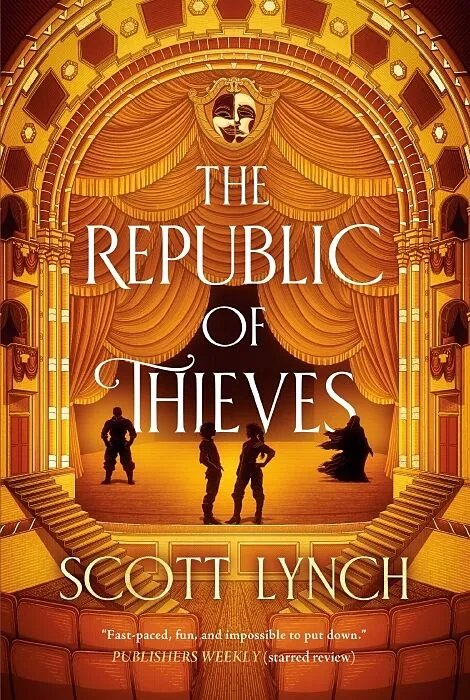
The Republic of Thieves
Beschreibung
Scott Lynch Klappentext NEW YORK TIMES BESTSELLER • In the third book of the “gorgeously realized” (George R. R. Martin) epic fantasy caper Gentleman Bastard Sequence, Locke Lamora must make the hardest decision of his life . . . or death. &l...Format auswählen
- Kartonierter EinbandCHF 19.30

Wird oft zusammen gekauft
Andere Kunden kauften auch
Beschreibung
** Scott Lynch
Klappentext
**NEW YORK TIMES BESTSELLER • In the third book of the “gorgeously realized” (George R. R. Martin) epic fantasy caper Gentleman Bastard Sequence, Locke Lamora must make the hardest decision of his life . . . or death.
“Fast paced, fun, and impossible to put down . . . Locke and company remain among the most engaging protagonists in fantasy.”—Publishers Weekly (starred review)
ONE OF PASTE’S BEST FANTASY BOOKS OF THE DECADE
With the greatest heist of their career gone spectacularly sour, con artist extraordinaire Locke Lamora and his trusted partner, Jean, have barely escaped with their lives. Or at least Jean has. Locke is slowly succumbing to a lethal poison that no alchemist can cure.
With the end nearing, Locke’s only hope is to accept a mysterious Bondsmage’s offer: act as a political pawn in the Magi elections, and in exchange be healed. But the lifesaving sorcery promises to rival even the most excruciating death, and Locke refuses. Until the Bondsmage invokes the name of Sabetha, the love of Locke’s life, his equal in skill and wit . . . and now his greatest rival. From his first glimpse of Sabetha as a fellow orphan and thief-in-training, Locke was smitten. But after a tumultuous courtship, she broke away. Now they will reunite in another clash of wills.
Faced with his only equal in both love and trickery, Locke must choose whether to fight Sabetha—or woo her. It is a decision on which both of their lives may depend.
Don’t miss any of Scott Lynch’s epic fantasy Gentleman Bastard Sequence:
THE LIES OF LOCKE LAMORA • RED SEAS UNDER RED SKIES • THE REPUBLIC OF THIEVES
Leseprobe
Chapter One
Things Get Worse
Weak sunlight against his eyelids drew him out of sleep. The brightness intruded, grew, made him blink groggily. A window was open, letting in mild afternoon air and a freshwater smell. Not Camorr. Sound of waves lapping against a sand beach. Not Camorr at all.
He was tangled in his sheets again, light-headed. The roof of his mouth felt like sun—dried leather. Chapped lips peeled apart as he croaked, “What are you . . .”
“Shhhh. I didn’t mean to wake you. The room needed some air.” A dark blur on the left, more or less Jean’s height. The floor creaked as the shape moved about. Soft rustle of fabric, snap of a coin purse, clink of metal. Locke pushed himself up on his elbows, prepared for the dizziness. It came on punctually.
“I was dreaming about her,” he muttered. “The times that we . . . when we first met.”
“Her?”
“Her. You know.”
“Ah. The canonical her.” Jean knelt beside the bed and held out a cup of water, which Locke took in his shaking left hand and sipped at gratefully. The world was slowly coming into focus.
“So vivid,” said Locke. “Thought I could touch her. Tell her . . . how sorry I am.”
“That’s the best you can manage? Dreaming of a woman like that, and all you can think to do with your time is apologize?”
“Hardly under my control—”
“They’re your dreams. Take the reins.”
“I was just a little boy, for the gods’ sakes.”
“If she pops up again move it forward ten or fifteen years. I want to see some blushing and stammering next time you wake up.”
“Going somewhere?”
“Out for a bit. Making my rounds.”
“Jean, there’s no point. Quit torturing yourself.”
“Finished?” Jean took the empty cup from him.
“Not nearly. I—”
“Won’t be gone long.” Jean set the cup on the table and gave the lapels of his coat a perfunctory brushing as he moved to the door. “Get some more rest.”
“You don’t bloody listen to reason, do you?”
“You know what they say about imitation and flattery.”
The door slid shut and Jean was gone, out into the streets of Lashain.
Lashain was famous as a city where anything could be bought and anything could be left behind. By the grace of the regio, the city’s highest and thinnest order of nobility (where a title that could be traced back more than two generations qualified one for the old guard), just about anyone with cash in hand and enough of a pulse to maintain semiconsciousness could have their blood transmuted to a reasonable facsimile of blue.
From every corner of the Therin world they came—merchants and criminals, mercenary captains and pirates, gamblers and adventurers and exiles. As commoners they entered the chrysalis of a countinghouse, shed vast quantities of precious metal, and as newborn peers of Lashain they emerged into daylight. The regio minted demibarons, barons, viscounts, counts, and even the occasional marquis, with styles largely of their own invention. Honors were taken from a list and cost extra; “Defender of the Twelvefold Faith” was quite popular. There were also half a dozen meaningless orders of knighthood that looked marvelous on a coat lapel.
Because of the novelty of this purchased respectability to those who brokered it for themselves, Lashain was the most violently manners—conscious city Jean Tannen had ever visited. Lacking centuries of aristocratic descent to assure them of their worth, the neophytes of Lashain overcompensated with ceremony. Their rules of precedence were like alchemical formulae, and dinner parties killed more of them each year than fevers and accidents combined. It seemed that little could be more thrilling for those who’d just bought their family names than to risk them (not to mention their mortal flesh) over minor insults.
The record, as far as Jean had heard, was three days from counting—house to dueling green to funeral cart. The regio, of course, offered no refunds to relations of the deceased.
As a result of this nonsense, it was difficult for those without titles, regardless of the color of their coin, to gain ready access to the city’s best physikers. They were made such status symbols by their noble clients that they rarely had to scamper after gold from other sources.
The taste of autumn was in the cool wind blowing off the Amathel, the Lake of Jewels—the freshwater sea that rolled to the horizon north of Lashain. Jean was conservatively dressed by local standards, in a brown velvet frock coat and silks worth no more than, say, three months’ wages for an average tradesman. This marked him instantly as someone’s man and suited his current task. No gentleman of consequence did his own waiting at a physiker’s garden gate.
Scholar Erkemar Zodesti was regarded as the finest physiker in Lashain, a prodigy with the bone saw and the alchemist’s crucible. He’d also shown complete disinterest, for three days straight, in Jean’s requests for a consultation.
Today Jean once again approached the iron—barred gate at the rear of Zodesti’s garden, from behind which an elderly servant peered at him with reptilian insolence. In Jean’s outstretched hand was a parchment envelope and a square of white card, just like the three days previous. Jean was getting testy.
The servant reached between the bars without a word and took everything Jean offered. The envelope, containing the customary gratuity of (far too many) silver coins, vanished into the servant’s coat. The old man read or pretended to read the white card, raised his eyebrows at Jean, and walked away.
The card said exactly what it alw…