
IHR WARENKORB IST AKTUELL LEER.
Haben Sie noch nichts passendes gefunden? Stöbern Sie durch unser komplettes Sortiment.
Oder melden Sie sich an bzw. registrieren Sie sich.
- Kostenlose Lieferung
- Kauf auf Rechnung
- Ex Libris Tiefpreis
- Filiallieferung und 650+ Abholorte
- Rabatt-Bons als Club-Mitglied
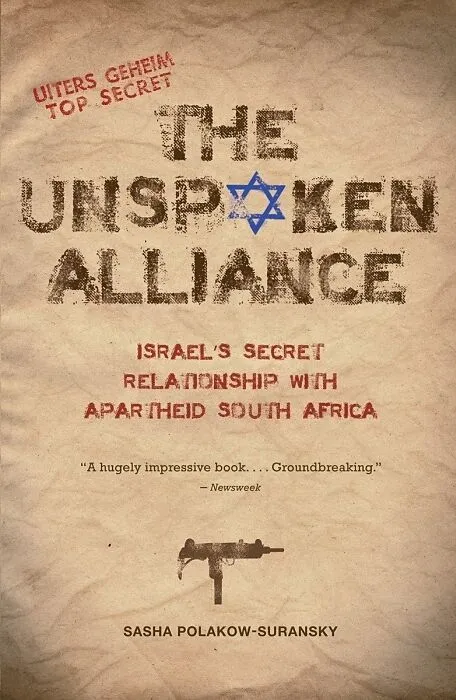
The Unspoken Alliance
Beschreibung
Zusatztext 77469275 Informationen zum Autor Sasha Polakow-Suransky is an editor at The New York Times op-ed page. He was a senior editor at Foreign Affairs from 2007 to 2011 and holds a doctorate in modern history from Oxford University, where he was a Rhodes ...Format auswählen
- Kartonierter EinbandCHF 20.30

Wird oft zusammen gekauft
Andere Kunden kauften auch
Beschreibung
Zusatztext 77469275 Informationen zum Autor Sasha Polakow-Suransky is an editor at The New York Times op-ed page. He was a senior editor at Foreign Affairs from 2007 to 2011 and holds a doctorate in modern history from Oxford University, where he was a Rhodes Scholar from 2003 to 2006. His writing has appeared in The American Prospect, The Boston Globe, The International Herald Tribune, The New Republic, and Newsweek . He lives in Brooklyn. Klappentext Prior to the Six-Day War, Israel was a darling of the international left, vocally opposed to apartheid and devoted to building alliances with black leaders in newly independent African nations. South Africa, for its part, was controlled by a regime of Afrikaner nationalists who had enthusiastically supported Hitler during World War II. But after Israel's occupation of Palestinian territories in 1967, the country found itself estranged from former allies and threatened anew by old enemies. As both states became international pariahs, a covert-and lucrative-military relationship blossomed between these seemingly unlikely allies. Based on extensive archival research and exclusive interviews with former generals and high-level government officials in both countries, The Unspoken Alliance tells a troubling story of Cold War paranoia, moral compromises, and startling secrets. from the Prologue ON APRIL 9, 1976 , South African prime minister Balthazar Johannes Vorster arrived at the Yad Vashem Holocaust memorial in Jerusalem with full diplomatic entourage in tow. After passing solemnly through the corridors commemorating those gassed in Auschwitz and Dachau, he entered the dimly lit Hall of Remembrance, where a memorial flame burned alongside a crypt filled with the ashes of Holocaust victims. Vorster bowed his head as a South African minister read a psalm in Afrikaans, the haunting melody of the Jewish prayer for the dead filling the room. He then kneeled and laid a wreath, containing the colors of the South African flag, in memory of Hitler's victims. Cameras snapped, dignitaries applauded, and Israeli officials quickly ferried the prime minister away to his next destination.1 Back in Johannesburg, the opposition journalist Benjamin Pogrund was sickened as he watched the spectacle on television. Thousands of South African Jews shared Pogrund's disgust; they knew all too well that Vorster had another, darker past. In addition to being the architect of South Africa's brutal crackdown on the black democratic opposition and the hand behind many a tortured activist and imprisoned leader, Vorster and his intelligence chief, Hendrik van den Bergh, had served as generals in the Ossewa Brandwag, a militant Afrikaner nationalist organization that had openly supported the Nazis during World War II. The group's leader, Hans van Rensburg, was an enthusiastic admirer of Adolf Hitler. In conversations with Nazi leaders in 1940, van Rensburg formally offered to provide the Third Reich with hundreds of thousands of men in order to stage a coup and bring an Axis- friendly government to power at the strategically vital southern tip of Africa. Lacking adequate arms supplies, van Rensburg's men eventually abandoned their plans for regime change and settled for industrial sabotage, bombings, and bank robberies. South Africa's British-aligned government con sidered the organization so dangerous that it imprisoned many of its members. But Vorster was unapologetic and proudly compared his nation to Nazi Germany: We stand for Christian Nationalism which is an ally of National Socialism . . . you can call such an anti- democratic system a dictatorship if you like, he declared in 1942. In Italy it is called Fascism, in Germany National Socialism and in South Africa Christian Nationalism. As a result of their pro-Nazi activities, Vorster and van den Ber...
“A hugely impressive book. . . . Groundbreaking.”
—Newsweek
“Important. . . . The best-documented, most thorough, and most credible account ever offered of the secret marriage between the apartheid state and Israel.”
—Foreign Policy
“Tantalizing. . . . Stands out because of the new material its author has dug up, which may be deemed to provide a measure of insight into ongoing and tricky proliferation issues.”
—The New York Review of Books
“Rich with intrigue and shocking details but written without a trace of stridency, [this] is the most authoritative account to date. . . . A meticulously researched book that reads like a spy thriller.”
—The Nation
“Fascinating. . . . Deft and fair. . . . A well-crafted work of history, not to be mistaken for another jeremiad. . . . A tale of clandestine missions, surreptitious shipments, and elaborate political theater between two states perched precariously on the margins of both their continents and the Cold War.”
—The National Review
“A harrowing account of a Mephistophelian bargain between two rogue states, told with indisputable fact—many of them new—and on-the-record interviews. No moralizing needed. Israel’s twenty-year collaboration with South Africa betrayed its founding principles and, more tragically, anticipated the cynicism with which it conducts its Palestinian policy today.”
—Seymour Hersh
“A compelling history. . . . All states engage in secret diplomacy, but Israel offers some of the most shocking examples. . . . Although he deplores Israel’s ties to the apartheid regime, Polakow-Suransky has treated the handful of officials in the two countries implementing that alliance fairly, even empathetically.”
—Foreign Affairs
“A deft, pacy and revealing account. . . . Admirably dispassionate.”
—The Economist
“The extent to which these two countries began to rely on each other economically and militarily in the mid-1970s through the late 1980s has never been so fully fleshed out. . . . There are some striking revelations.”
—Forward
“A careful, painful, hugely important book.”
—Peter Beinart, author of The Icarus Syndrome
“Provocative. . . . Richly detailed. . . . Especially relevant today, as nuclear rivalries escalate in the Middle East, because it explains—calmly, methodically, and with full documentation—how Israel and South Africa helped each other build atomic bombs in secret.”
—Stephen Kinzer, The Daily Beast
“Path-breaking. . . . Remarkably revealing. . . . A wise, elegantly written, and strikingly fair-minded book which deserves the widest possible readership.”
—Avi Shlaim, author of The Iron Wall: Israel and the Arab World
“Well-researched, readable and . . . balanced.”
—The London Review of Books
“Comprehensive. . . . A very important contribution in the study of modern and contemporary history for its wealth of material and the objectivity of its author. It is highly recommended for both academics and the general reader.”
—The Middle East Journal
“Fascinating. . . . A major, long overdue study of the rise and demise of one of the most intriguing alliances of our time. Polakow-Suransky has written a masterfully researched history that reads like a thriller unraveling the secrets of an alliance between two embattled societies under siege.”
—Shlomo Ben-Ami, foreign minister of Israel, 2000-2001
Autorentext
Sasha Polakow-Suransky is an editor at The New York Times op-ed page. He was a senior editor at Foreign Affairs from 2007 to 2011 and holds a doctorate in modern history from Oxford University, where he was a Rhodes Scholar from 2003 to 2006. His writing has appeared in *The American Prospec…