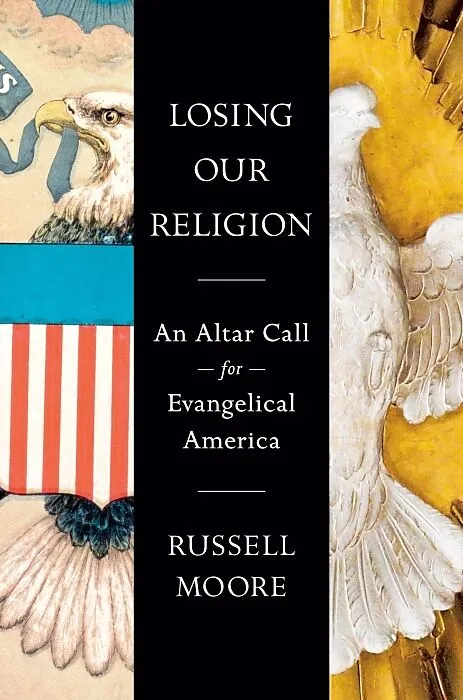
Losing Our Religion
Beschreibung
Informationen zum Autor Russell Moore Klappentext "Former Southern Baptist pastor and Christianity Today editor-in-chief Russell Moore calls for repentance and renewal in American evangelicalism American evangelical Christianity has lost its way. While the wit...Format auswählen
- Fester EinbandCHF 38.05

Wird oft zusammen gekauft
Andere Kunden kauften auch
Beschreibung
Informationen zum Autor Russell Moore Klappentext "Former Southern Baptist pastor and Christianity Today editor-in-chief Russell Moore calls for repentance and renewal in American evangelicalism American evangelical Christianity has lost its way. While the witness of the church before a watching world is diminished beyond recognition, congregations are torn apart over Donald Trump, Christian nationalism, racial injustice, sexual predation, disgraced leaders, and covered-up scandals. Left behind are millions of believers who counted on the church to be a place of belonging and hope. As greater and greater numbers of younger Americans bleed out from the church, even the most rooted evangelicals are wondering, "Can American Christianity survive?" In Losing Our Religion, Russell Moore calls his fellow evangelical Christians to conversion over culture wars, to truth over tribalism, to the gospel over politics, to integrity over influence, and to renewal over nostalgia. With both prophetic honesty and pastoral love, Moore offers a word of counsel for how a new generation of disillusioned and exhausted believers can find a path forward after the crisis and confusion of the last several years. Believing the gospel is too important to leave it to hucksters and grifters, he shows how a Christian can avoid both cynicism and complicity in order to imagine a different, hopeful vision for the church. The altar call of the old evangelical revivals was both a call to repentance and the offer of a new start. In the same way, this book invites unmoored and discouraged Christians to step out into an uncertain future, first by letting go of the kind of cultural, politicized, status quo Christianity that led us to this moment of reckoning. Only when we see how lost we are, we can find our way again. Only when we bury what's dead can we experience life again. Only when we lose our religion can we be amazed by grace again"-- Leseprobe If we wanted to find Jesus, we would have to lose our religion. That's what the preacher said. In fact, he said it every week, every Sunday morning and every Sunday night, and then in the fall and the spring, he would bring in a guest evangelist to tell us the same thing. Religion, he said, gave the wrong answers because it asked the wrong questions. Religion asked, "Am I a church member?" or "Am I an American?" Religion asked, "Am I a moral person?" or "Do my good deeds outweigh my bad?" Religion asked, "Can I assent to the fact that the Bible is true?" or "Can I recite a creed or a catechism?" Those were the wrong questions, and religion gave the wrong answers. The ultimate questions were deeper, more personal: "Do you know you're a sinner?" and "Do you trust the crucified and risen Jesus to atone for that sin?" and "Will you commit your life to taking up your cross and following him?" For those questions, they would assert, religion would not do, only a relationship, a personal, living faith-not your church's faith, not your country's faith, not your family's faith, but yours. If we were to see the kingdom of God, religion couldn't get us there, they said. We must be born again. Some people call it an altar call. Some call it a "Come to Jesus" meeting. We called it an "invitation." Though we were low-church Mississippi Baptists, who thought we didn't have any ritual or formality, this was part of our liturgy. Every week, at the end of the service, the gospel would be repeated-about how God so loved the world that he gave his only Son, that whoever believed in him would not perish but have everlasting life. Every week the question "How do I become a Christian?" was answered with step-by-step guidance, sometimes even with a prayer a person could repeat. Every head would be bowed, every eye would be closed, but sometimes we would be looking around, with everybody praying that this would be the week that Miss Velma's husband would go down the aisle, to accept Jesus a...
Autorentext
Russell Moore
Klappentext
Former Southern Baptist pastor and Christianity Today editor-in-chief Russell Moore calls for repentance and renewal in American evangelicalism
American evangelical Christianity has lost its way. While the witness of the church before a watching world is diminished beyond recognition, congregations are torn apart over Donald Trump, Christian nationalism, racial injustice, sexual predation, disgraced leaders, and covered-up scandals. Left behind are millions of believers who counted on the church to be a place of belonging and hope. As greater and greater numbers of younger Americans bleed out from the church, even the most rooted evangelicals are wondering, “Can American Christianity survive?”
In Losing Our Religion, Russell Moore calls his fellow evangelical Christians to conversion over culture wars, to truth over tribalism, to the gospel over politics, to integrity over influence, and to renewal over nostalgia. With both prophetic honesty and pastoral love, Moore offers a word of counsel for how a new generation of disillusioned and exhausted believers can find a path forward after the crisis and confusion of the last several years. Believing the gospel is too important to leave it to hucksters and grifters, he shows how a Christian can avoid both cynicism and complicity in order to imagine a different, hopeful vision for the church.
The altar call of the old evangelical revivals was both a call to repentance and the offer of a new start. In the same way, this book invites unmoored and discouraged Christians to step out into an uncertain future, first by letting go of the kind of cultural, politicized, status quo Christianity that led us to this moment of reckoning. Only when we see how lost we are, we can find our way again. Only when we bury what’s dead can we experience life again. Only when we lose our religion can we be amazed by grace again.
Leseprobe
If we wanted to find Jesus, we would have to lose our religion. That's what the preacher said. In fact, he said it every week, every Sunday morning and every Sunday night, and then in the fall and the spring, he would bring in a guest evangelist to tell us the same thing. Religion, he said, gave the wrong answers because it asked the wrong questions. Religion asked, "Am I a church member?" or "Am I an American?" Religion asked, "Am I a moral person?" or "Do my good deeds outweigh my bad?" Religion asked, "Can I assent to the fact that the Bible is true?" or "Can I recite a creed or a catechism?"
Those were the wrong questions, and religion gave the wrong answers. The ultimate questions were deeper, more personal: "Do you know you're a sinner?" and "Do you trust the crucified and risen Jesus to atone for that sin?" and "Will you commit your life to taking up your cross and following him?" For those questions, they would assert, religion would not do, only a relationship, a personal, living faith-not your church's faith, not your country's faith, not your family's faith, but yours. If we were to see the kingdom of God, religion couldn't get us there, they said. We must be born again.
Some people call it an altar call. Some call it a "Come to Jesus" meeting. We called it an "invitation." Though we were low-church Mississippi Baptists, who thought we didn't have any ritual or formality, this was part of our liturgy. Every week, at the end of the service, the gospel would be repeated-about how God so loved the world that he gave his only Son, that whoever believed in him would not perish but have everlasting life. Every week the question "How do I become a Christian?" was answered with step-by-step guidance, sometimes even with a prayer a person could repeat. Every head would be bowed, every eye would be closed, but sometimes we would be looking around, with everybody praying that this would be the week that Miss Velma's husband would go down the aisle, to accept Jesus as his personal Lord and Savio…