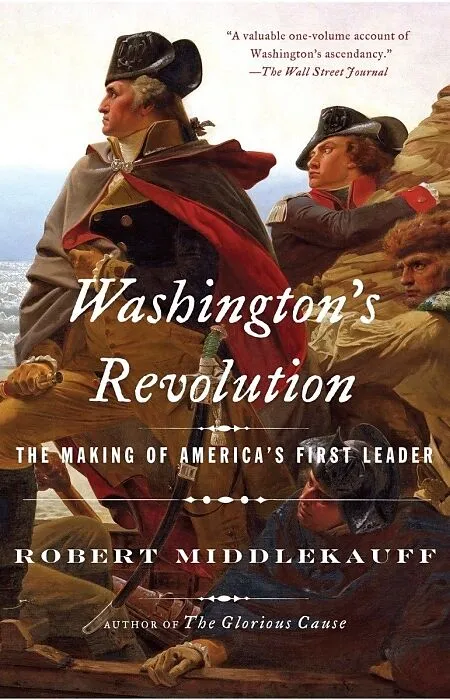
Washington's Revolution
Beschreibung
Zusatztext 77527837 Informationen zum Autor ROBERT MIDDLEKAUFF is Preston Hotchkis Professor of American History, Emeritus, at the University of California, Berkeley. He has been the director of the Huntington Library, Art Collections, and Botanical Gardens (1...Format auswählen
- Kartonierter EinbandCHF 25.60
- E-Book (epub)CHF 9.90

Wird oft zusammen gekauft
Andere Kunden kauften auch
Beschreibung
Zusatztext 77527837 Informationen zum Autor ROBERT MIDDLEKAUFF is Preston Hotchkis Professor of American History, Emeritus, at the University of California, Berkeley. He has been the director of the Huntington Library, Art Collections, and Botanical Gardens (19831988); and Harold Vyvyan Harmsworth Visiting Professor of American History at the University of Oxford. His books include The Mathers: Three Generations of Puritan Intellectuals, 15961728 , which won the Bancroft Prize; The Glorious Cause: The American Revolution, 17631789 , which was a finalist for the Pulitzer Prize; and Benjamin Franklin and His Enemies . Klappentext Focusing on Washington's early years, Bancroft Prize winner and Pulitzer Prize finalist Robert Middlekauff penetrates his mystique, revealing his all-too-human fears, values, and passions. Rich in psychological detail regarding Washington's temperament, idiosyncrasies, and experiences, this book shows a self-conscious Washington who grew in confidence and experience as a young soldier, businessman, and Virginia gentleman, and who was transformed into a patriot by the revolutionary ferment of the 1760s and '70s. Middlekauff makes clear that Washington was at the heart of not just the revolution's course and outcome but also the success of the nation it produced. This vivid, insightful new account of the formative years that shaped a callow George Washington into an extraordinary leader is an indispensable book for truly understanding one of America's great figures. Washington had demonstrated throughout the war his commitment to civilian supremacy in the American republic. His convictions about the relationship of the army to Congress remained firm and clear, never wavering in the face of appeals that he take matters into his own hands and, in effect, exercise the powers of a king or dictator. Such action on his part, or the army's, would be giving up the meaning of the Revolution, a surrender he would not accede to, as he explained to his officers at Newburgh. He made his belief in civilian control even clearer virtually every day, in the way he dealt with Congress. There was no question of yielding power to themhe had never claimed such power; he was the servant of the American people and of Congress, nothing less and nothing more. All the time that he served as commander of the Continental Army, he was in fact also the leader of the Revolution. His unspoken and undefined responsibilities in this role transcended those of his assignment as commander in chief, and he became, as the war developed, a symbol of the freedom the young republic embodied. He was the political leader of the Revolution, though he drafted no legislation and signed no laws. But if he failed, it was widely understood, the Revolution failed. For Washington, more than any American leader in or out of Congress, by his actions and example, held together the political structure that constituted the United States. Several of his officers came to proclaim this fact through their insistence that the army was the Revolution and Washington its leader. It was the institutiondespite its failures and, at times, its weaknessthat held together, demonstrating to the enemy that American independence possessed a reality that could not be crushed. Had Washington not persevered in the service of the cause he called glorious, the Revolution would have given way to slow collapse. None of the Americans around him in the army, the Congress, or the states commanded the moral force he embodied. Success in maintaining the American effort would not have been achieved without him. He succeeded in large part because he understood that the Revolution represented a rare opportunitysomething quite new, in factto lead a people in defense of principles long honored in conceptions of liberty, stifled or suppressed elsewhere in the world. He did not f...
Praise for Robert Middlekauff’s Washington’s Revolution:
“Middlekauff has written about Washington’s war rather as Washington himself might have, had he been a historian: carefully, thoroughly, with an eye for detail and a grasp, at all times, of the important points.” —Richard Brookhiser, The New York Times Book Review
“Middlekauff writes a cogent character study of an icon, without either polishing or puncturing Washington's image. He clearly admires his subject, but recognizes Washington's limits, especially in the matter of slavery.” —Michael D. Schaffer, Philadelphia Inquirer
**“**It is in the nuances, the telling details and the subtle shadings where Mr. Middlekauff excels. . . . Middlekauff paints anew the familiar scenes of Washington’s war . . . a valuable one-volume account of Washington’s ascendancy.” —Jack Schwartz, The Wall Street Journal
“A useful and readable new portrait of Washington at war . . . Anyone who enters this territory is required to supply an original insight, and Middlekauff, known for his magisterial volume on the Revolution and the early national period for the Oxford History of the United States, does so, offering an important one. Middlekauff advances the idea that Washington was not only the winner of the American Revolution, but also the essence of the Revolution . . . The battles Washington fought defined not only his life but also our own . . . [Middlekauff’s] triumph is to portray Washington as a man of parts, as more than a cardboard cutout hero or a sterile vessel of virtues.” —David M. Shribman, The Boston Globe
“[An] excellent new study of Washington’s leadership . . . Expertly traces the arc of Washington’s career . . . A deeply researched and enlightening look at three transformative decades in the life of an indispensable American . . . At the heart of the book is an engaging narrative of the Revolutionary War as seen from Washington’s saddle and writing desk . . . Middlekauff’s book is a thorough, persuasive explanation of why Americans, from the era of the Revolution to the early republic, gloried in having Washington as their leader.” —Michael F. Bishop, *National Review''
*
“Robert Middlekauff writes not just as a biographer, but also as both a political and an intellectual historian . . . a fine narrative.” —The Daily Beast
“Historian Robert Middlekauff rejects the traditional narrative in his important new work on Washington’s military leadership during the Revolutionary War . . . This fine work suggest that independence was not a certitude but an astonishing achievement that owed much to a man who, like his country, came to maturity in war.” —Edward G. Lengel, Military History Quarterly
“Robert Middlekauff introduces the real Washington: an ordinary man guided toward greatness by the extraordinary demands of his time. Equal parts biography and history, Washington’s Revolution is a rare look at the Washington we never knew, from his challenging childhood to the final days of the Revolutionary War.” —Matt Staggs, Biographile
“In his newest book, Robert Middlekauff, Bancroft Prize winner and Pulitzer Prize finalist, traces George Washington’s rise from an ordinary “Virginia provincial” with a dangerous temper to a controlled military and political leader, possessed with great strategic insight . . . Middlekauff makes a point to reveal the self-conscious, fiery, and passionate man behind the composed façade.” —New Criterion Critic’s Notebook
“This is not just another account of George Washington's leadership in the Revolutionary War; it is special. It is perceptive, balanced, judicious, and, most important, clearly and succinctly written. A marvelous achievement.” —Gordon. S. Wood, author of *The Radi…