
IHR WARENKORB IST AKTUELL LEER.
Haben Sie noch nichts passendes gefunden? Stöbern Sie durch unser komplettes Sortiment.
Oder melden Sie sich an bzw. registrieren Sie sich.
- Kostenlose Lieferung
- Kauf auf Rechnung
- Ex Libris Tiefpreis
- Filiallieferung und 650+ Abholorte
- Rabatt-Bons als Club-Mitglied
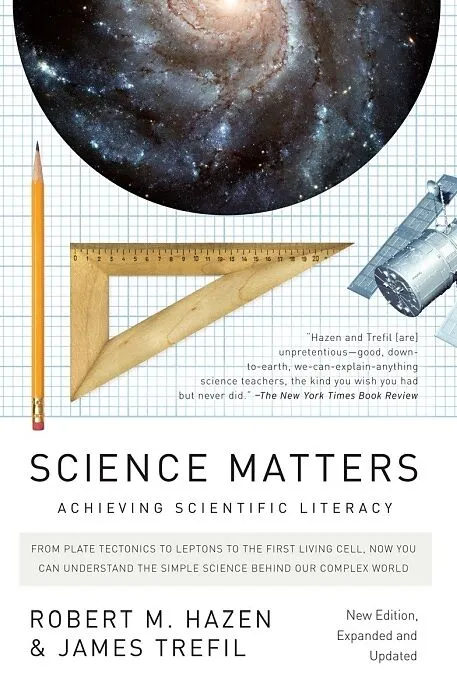
Science Matters
Beschreibung
Zusatztext Lucid and lively. Hazen and Trefil have a particular genius for picturing even formidably abstract ideas in concrete images. . . . Science Matters is as good as they get The Washington Post Book World Hazen and Trefil [are] unpretentiousgood! down-t...Format auswählen
- Poche format BCHF 21.90

Wird oft zusammen gekauft
Andere Kunden kauften auch
Beschreibung
Zusatztext Lucid and lively. Hazen and Trefil have a particular genius for picturing even formidably abstract ideas in concrete images. . . . Science Matters is as good as they get The Washington Post Book World Hazen and Trefil [are] unpretentiousgood! down-to-earth! we-can-explain-anything science teachers! the kind you wish you had but never did. The New York Times Book Review A book that even scientifically literate readers can consult . . . if they find their recollection of relativity or quantum mechanics getting shaky. New Scientist Ordered and accessible! never daunting! never jumping ahead of itself. . . . If you've always thought you could never understand science! Hazen and Trefil will show you you're wrong. Washington Monthly A thoughtful and concise overview of what the citizen needs to know about science. E. D. Hirsch! Jr. Science does matter! as this book shows. Isaac Asimov A model of clarity and coherence. Leon M. Lederman! winner of the Nobel Prize for Physics Lucid. . . . Will cause readers to wonder what was so confusing about the Periodic Table of Elements they confronted in their school days. Publishers Weekly A first rate exposition-thorough! accessible! and entertaining-of the rudiments of scientific knowledge. Kirkus Reviews A confident overview of the fundamentals of science. . . . Comprehensible and carefully paced. Booklist Informationen zum Autor Robert M. Hazen and James Trefil Klappentext Knowledge of the basic ideas and principles of science is fundamental to cultural literacy. But most books on science are often too obscure or too specialized to do the general reader much good. Science Matters is a rare exception-a science book for the general reader that is informative enough to be a popular textbook for introductory courses in high school and college, and yet well-written enough to appeal to general readers uncomfortable with scientific jargon and complicated mathematics. And now, revised and expanded for the first time in nearly two decades, it is up-to-date, so that readers can enjoy Hazen and Trefil's refreshingly accessible explanations of the most recent developments in science, from particle physics to biotechnology.CHAPTER ONE Knowing YOUR LIFE IS FILLED with routineyou set your alarm clock at night, take a shower in the morning, brush your teeth after breakfast, pay your bills on time, and fasten your seat belt. With each of these actions and a hundred others every day you acknowledge the power of predictability. If you don't set the alarm you'll probably be late for work or school. If you don't take a shower you'll probably smell. If you don't fasten your seat belt and then get into a freeway accident you may die. We all seek order to deal with life's uncertainties. We look for patterns to help us cope. Scientists do the same thing. They constantly examine nature, guided by one overarching principle: The universe is regular and predictable . The universe is not random. The sun comes up every morning, the stars sweep across the sky at night. The universe moves in regular, predictable ways. Human beings can grasp the regularities of the universe and can even uncover the basic, simple laws that produce them. We call this activity science. WAYS OF KNOWING Science is one way of knowing about the world. The unspoken assumption behind the scientific endeavor is that general laws, discoverable by the human mind, exist and govern everything in the physical world. In its most advanced form, science is written in the language of mathematics, and therefore is not always easily accessible to the general public. But, like any other language, the language ...
Autorentext
Robert M. Hazen and James Trefil
Klappentext
Knowledge of the basic ideas and principles of science is fundamental to cultural literacy. But most books on science are often too obscure or too specialized to do the general reader much good.
Science Matters is a rare exception-a science book for the general reader that is informative enough to be a popular textbook for introductory courses in high school and college, and yet well-written enough to appeal to general readers uncomfortable with scientific jargon and complicated mathematics. And now, revised and expanded for the first time in nearly two decades, it is up-to-date, so that readers can enjoy Hazen and Trefil's refreshingly accessible explanations of the most recent developments in science, from particle physics to biotechnology.
Zusammenfassung
A science book for the general reader that is informative enough to be a popular textbook and yet well-written enough to appeal to general readers. “Hazen and Trefil [are] unpretentious—good, down-to-earth, we-can-explain-anything science teachers, the kind you wish you had but never did.”—The New York Times Book Review
Knowledge of the basic ideas and principles of science is fundamental to cultural literacy. But most books on science are often too obscure or too specialized to do the general reader much good.
Science Matters is a rare exception—a science book that is informative enough for introductory courses in high school and college, and yet lucid enough for readers uncomfortable with scientific jargon and complicated mathematics. And now, revised and expanded, it is up-to-date, so that readers can enjoy Hazen and Trefil's refreshingly accessible explanations of the most recent developments in science, from particle physics to biotechnology.
Leseprobe
CHAPTER ONE
Knowing
YOUR LIFE IS FILLED with routine—you set your alarm clock at night, take a shower in the morning, brush your teeth after breakfast, pay your bills on time, and fasten your seat belt. With each of these actions and a hundred others every day you acknowledge the power of predictability. If you don’t set the alarm you’ll probably be late for work or school. If you don’t take a shower you’ll probably smell. If you don’t fasten your seat belt and then get into a freeway accident you may die.
We all seek order to deal with life’s uncertainties. We look for patterns to help us cope. Scientists do the same thing. They constantly examine nature, guided by one overarching principle:
The universe is regular and predictable.
The universe is not random. The sun comes up every morning, the stars sweep across the sky at night. The universe moves in regular, predictable ways. Human beings can grasp the regularities of the universe and can even uncover the basic, simple laws that produce them. We call this activity “science.”
WAYS OF KNOWING
Science is one way of knowing about the world. The unspoken assumption behind the scientific endeavor is that general laws, discoverable by the human mind, exist and govern everything in the physical world. In its most advanced form, science is written in the language of mathematics, and therefore is not always easily accessible to the general public. But, like any other language, the language of science can be translated into simple English. When this is done, the beauty and simplicity of the great scientific laws can be shared by everyone.
Science is not the only way, nor always the best way, to gain an understanding of the world in which we find ourselves. Religion and philosophy help us come to grips with the meaning of life without the need for experimentation or mathematics, while art, music, and literature provide us with a kind of aesthetic, nonquantitative knowledge. You don’t need calculus to tell you whether a symphony or a poem has meaning for you. Science complements these other ways of knowing, providing us with insights about a different aspect of the universe.
The Regularity of Nature
Our ancestors perceived the universe in ways that sometimes seem very strange to us. For all but the past few hundred y…