
IHR WARENKORB IST AKTUELL LEER.
Haben Sie noch nichts passendes gefunden? Stöbern Sie durch unser komplettes Sortiment.
Oder melden Sie sich an bzw. registrieren Sie sich.
- Kostenlose Lieferung
- Kauf auf Rechnung
- Ex Libris Tiefpreis
- Filiallieferung und 650+ Abholorte
- Rabatt-Bons als Club-Mitglied
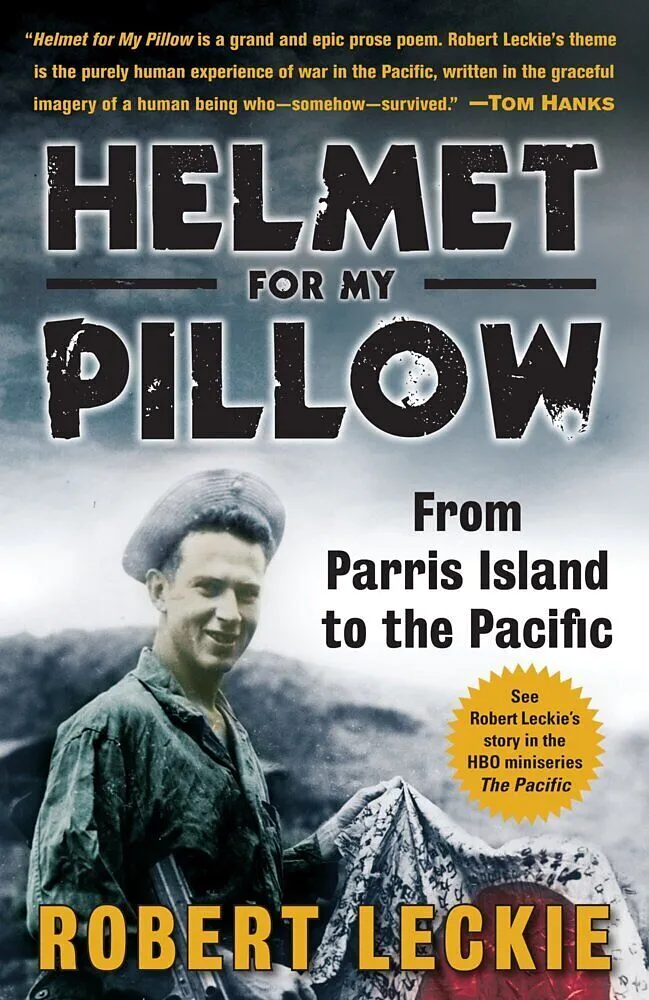
Helmet for My Pillow
Beschreibung
Zusatztext Helmet for My Pillow is a grand and epic prose poem. Robert Leckie's theme is the purely human experience of war in the Pacific! written in the graceful imagery of a human being whosomehowsurvived.Tom Hanks One hell of a book! The real stuff that pr...Format auswählen
- Kartonierter EinbandCHF 28.40

Wird oft zusammen gekauft
Andere Kunden kauften auch
Beschreibung
Zusatztext Helmet for My Pillow is a grand and epic prose poem. Robert Leckie's theme is the purely human experience of war in the Pacific! written in the graceful imagery of a human being whosomehowsurvived.Tom Hanks One hell of a book! The real stuff that proves the U.S. Marines are the greatest fighting men on earth!Leon Uris! author of Battle Cry Informationen zum Autor Robert Leckie was the author of more than thirty works of military history as well as Marines , a collection of short stories, and Lord, What a Family! , a memoir. Raised in Rutherford, New Jersey, he started writing professionally at age sixteen, covering sports for The Bergen Evening Record of Hackensack. He enlisted in the United States Marine Corps on the day following the attack on Pearl Harbor, going on to serve as a machine gunner and as an intelligence scout and participating in all 1st Marine Division campaigns except Okinawa. Leckie was awarded five battle stars, the Naval Commendation Medal with Combat V, and the Purple Heart. Helmet for My Pillow (Random House, 1957) was his first book; it received the Marine Corps Combat Correspondents Association award upon publication. Klappentext A grand and epic prose poem . . . The purely human experience of war in the Pacific, written in the graceful imagery of a human being whosomehowsurvived.Tom Hanks See Robert Leckie's story in the HBO miniseries The Pacific Here is one of the most riveting first-person accounts ever to come out of World War II. Robert Leckie enlisted in the United States Marine Corps in January 1942, shortly after the Japanese attack on Pearl Harbor. In Helmet for My Pillow we follow his odyssey, from basic training on Parris Island, South Carolina, all the way to the raging battles in the Pacific, where some of the war's fiercest fighting took place. Recounting his service with the 1st Marine Division and the brutal action on Guadalcanal, New Britain, and Peleliu, Leckie spares no detail of the horrors and sacrifices of war, painting an unvarnished portrait of how real warriors are made, fight, and often die in the defense of their country. From the live-for-today rowdiness of marines on leave to the terrors of jungle warfare against an enemy determined to fight to the last man, Leckie describes what war is really like when victory can only be measured inch by bloody inch. Woven throughout are Leckie's hard-won, eloquent, and thoroughly unsentimental meditations on the meaning of war and why we fight. Unparalleled in its immediacy and accuracy, Helmet for My Pillow will leave no reader untouched. This is a book that brings you as close to the mud, the blood, and the experience of war as it is safe to come. Chapter One Boot A cutting wind slanted up Church Street in the cheerless dawn of January 5, 1942. That day I departed for the United States Marines. The war with Japan was not yet four weeks old, Wake Island had fallen. Pearl Harbor was a real tragedy, a burning bitter humiliation. Hastily composed war songs were on the lips of everyone, their heavy patriotism failing to compensate for what they lacked in tune and spirit. Hysteria seemed to crouch behind all eyes. But none of this meant much to me. I was aware of my father beside me, bending into the wind with me. I could feel the wound in my lower regions, still fresh, still sore. The sutures had been removed a few days earlier. I had sought to enlist the day after Pearl Harbor, but the Marines had insisted that I be circumcised. It cost me a hundred dollars, although I am not sure to this day whether I paid the doctor or not. But I am certain that few young men went off to war in that fateful time so marked. We had come across the Jersey meadows, ridin...
ldquo;Helmet for My Pillow is a grand and epic prose poem. Robert Leckie’s theme is the purely human experience of war in the Pacific, written in the graceful imagery of a human being who—somehow—survived.”—Tom Hanks
“One hell of a book! The real stuff that proves the U.S. Marines are the greatest fighting men on earth!”—Leon Uris, author of Battle Cry
Autorentext
Robert Leckie was the author of more than thirty works of military history as well as Marines, a collection of short stories, and Lord, What a Family!, a memoir. **Raised in **Rutherford, New Jersey, he started writing professionally at age sixteen, **covering sports for The Bergen Evening Record ****of Hackensack. He enlisted in the United States Marine Corps on the day following the attack on Pearl Harbor, going on to serve as a machine gunner **and as an intelligence scout and participating in all 1st Marine Division campaigns except * *Okinawa. Leckie was awarded five battle stars, the Naval Commendation **Medal with Combat V, and the Purple Heart. Helmet for My Pillow (Random House, 1957) was his first book; it received the Marine Corps **Combat Correspondents Association award upon publication.
Klappentext
“A grand and epic prose poem . . . The purely human experience of war in the Pacific, written in the graceful imagery of a human being who—somehow—survived.”—Tom Hanks
**
See Robert Leckie's story in the HBO miniseries The Pacific**
Here is one of the most riveting first-person accounts ever to come out of World War II. Robert Leckie enlisted in the United States Marine Corps in January 1942, shortly after the Japanese attack on Pearl Harbor. In Helmet for My Pillow we follow his odyssey, from basic training on Parris Island, South Carolina, all the way to the raging battles in the Pacific, where some of the war’s fiercest fighting took place. Recounting his service with the 1st Marine Division and the brutal action on Guadalcanal, New Britain, and Peleliu, Leckie spares no detail of the horrors and sacrifices of war, painting an unvarnished portrait of how real warriors are made, fight, and often die in the defense of their country.
From the live-for-today rowdiness of marines on leave to the terrors of jungle warfare against an enemy determined to fight to the last man, Leckie describes what war is really like when victory can only be measured inch by bloody inch. Woven throughout are Leckie’s hard-won, eloquent, and thoroughly unsentimental meditations on the meaning of war and why we fight. Unparalleled in its immediacy and accuracy, Helmet for My Pillow will leave no reader untouched. This is a book that brings you as close to the mud, the blood, and the experience of war as it is safe to come.
Leseprobe
*Chapter One
Boot*
A cutting wind slanted up Church Street in the cheerless dawn of January 5, 1942. That day I departed for the United States Marines.
The war with Japan was not yet four weeks old, Wake Island had fallen. Pearl Harbor was a real tragedy, a burning bitter humiliation. Hastily composed war songs were on the lips of everyone, their heavy patriotism failing to compensate for what they lacked in tune and spirit. Hysteria seemed to crouch behind all eyes.
But none of this meant much to me. I was aware of my father beside me, bending into the wind with me. I could feel the wound in my lower regions, still fresh, still sore. The sutures had been removed a few days earlier.
I had sought to enlist the day after Pearl Harbor, but the Marines had insisted that I be circumcised. It cost me a hundred dollars, although I am not sure to this day whether I paid the doctor or not. But I am certain that few young men went off to war in that fateful time so marked.
We had come across the Jersey meadows, riding the Erie commuter line, and then on the ferry over the Hudson River to downtown New York. Breakfast at home had been subdued. My mother was up and about; she did not cry. It was not a heart-rending leave-taking, nor was it brave, resolute—any of those words that fail to descri…