
IHR WARENKORB IST AKTUELL LEER.
Haben Sie noch nichts passendes gefunden? Stöbern Sie durch unser komplettes Sortiment.
Oder melden Sie sich an bzw. registrieren Sie sich.
- Kostenlose Lieferung
- Kauf auf Rechnung
- Ex Libris Tiefpreis
- Filiallieferung und 650+ Abholorte
- Rabatt-Bons als Club-Mitglied
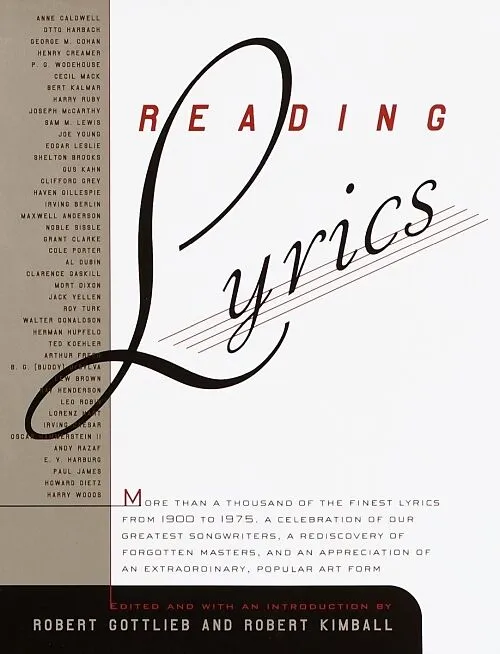
Reading Lyrics
Beschreibung
A comprehensive anthology bringing together more than one thousand of the best American and English song lyrics of the twentieth century; an extraordinary celebration of a unique art form and an indispensable reference work and history that celebrates one of t...Format auswählen
- Fester EinbandCHF 53.50
Wird oft zusammen gekauft
Andere Kunden kauften auch
Beschreibung
A comprehensive anthology bringing together more than one thousand of the best American and English song lyrics of the twentieth century; an extraordinary celebration of a unique art form and an indispensable reference work and history that celebrates one of the twentieth century’s most enduring and cherished legacies. The lyricists are presented chronologically, each introduced by a succinct biography and the incisive commentary of Robert Gottlieb and Robert Kimball....
“With around 170 lyricists on offer, the book makes its share of worthwhile rediscoveries . . . That’s the fun of Reading Lyrics. Readers can hum along with songs they know, while songs they don’t will have them hurrying off to the nearest music megastore.”
—The New York Times Book Review
“*Reading Lyrics *defies literary categorization. It’s reference work. It’s a singalong book. It’s a shadow history of taste and mores over much of the past century. It’s a valentine to a now-vanished artistic craft. And it’s an act of fond provocation.”
*—The Boston Globe
*
“This wondrous and magical concoction is highly recommended.”
—The Wall Street Journal
“Both a groundbreaking social document and its own pleasure dome. Its 706 pages confirm the accomplishments of the greats, but they also provide surprises.”
**—The New Yorker
“Sparklingly entertaining, Reading Lyrics exalts the lyrical sublimity of such cunning wordsmiths as Porter, Gershwin, and Coward.”
—Vanity Fair**
“This music is an amazing art form; it’s a substantial cultural phenomenon.”
—Newsweek
“What joy! No sooner do the lyrics appear before one’s eyes than reading gives way to song.”
—Billboard Magazine
“One of the finest collections of words there is. To quote P.G. Wodehouse, ‘And I wish someday I could find my way/To the land where the good songs go.’ That land is Reading Lyrics. ‘S wonderful.”
—Newsday
Autorentext
edited and with an introduction by Robert Gottlieb and Robert Kimball
Leseprobe
Irving Berlin
(1888–1989)
He is American music,” said Jerome Kern of this extraordinary man who, unlike most of his major colleagues, came from a poor immigrant family and had little formal education, yet he went on to the most all-encompassing and triumphant career in American popular music. Irving Berlin (born Israel Baline) began as a singing waiter on New York’s Lower East Side, graduated to song-plugger, and in 1907, when he was nineteen, had his first song published—“Marie from Sunny Italy.” “Alexander’s Ragtime Band” made him a worldwide figure in 1911, and his career never faltered. As composer and lyricist (although he famously could not read music) he produced three of America’s anthems—“God Bless America,” “White Christmas,” and “Easter Parade”—as well as “Oh, How I Hate to Get Up in the Morning” for World War I and “This Is the Army, Mr. Jones” for World War II. His Broadway shows included Face the Music, As Thousands Cheer, Louisiana Purchase, Annie Get Your Gun, and Call Me Madam. Among the many films he provided songs for were three for Astaire and Rogers—Top Hat, Follow the Fleet, and Carefree—as well as On the Avenue, Alexander’s Ragtime Band, Holiday Inn, White Christmas, Easter Parade, Blue Skies, and There’s No Business Like Show Business. And, of course, he had countless pop hits unconnected to shows or movies. A hallmark of his style is how easy he makes it all look, yet no one ever worked harder; perhaps that helps to explain a success that lasted for half a century. His unique career spans the eras of ragtime and rock and roll, and includes everything in between.
Cole Porter
(1891–1964)
Along with George M. Cohan, Irving Berlin, Frank Loesser, Harold Rome, and Stephen Sondheim, Cole Porter is one of the few top lyricists who composed his own music. A rich young man from Peru, Indiana, Porter began his professional writing career while still at Yale, and quickly had shows on Broadway. His first successes came in the late twenties (“Let’s Do It,” “What Is This Thing Called Love?”), but his quintessential work came in the thirties with a series of shows that included Gay Divorce, Anything Goes, Jubilee, Red Hot and Blue, and DuBarry Was a Lady. His most frequent collaborator was Ethel Merman, and their partnership extended into the forties with Panama Hattie and Something for the Boys. His most famous score— and biggest hit—was Kiss Me, Kate in 1948, which reestablished him as a major force in the American musical theater and prepared the way for his successes of the fifties, Can- Can and Silk Stockings. The Gay Divorcée, the Astaire/Rogers film version of Gay Divorce, used only one song from the show, but that song was “Night and Day.” Other films included Rosalie, Born to Dance, Broadway Melody of 1940, You’ll Never Get Rich, The Pirate, High Society, and Les Girls. And then there was the movie Night and Day, a ludicrous travesty of Porter’s sophisticated life and elegant lifestyle, starring an embarrassed (one hopes) Cary Grant and of course featuring the cream of Porter’s lifework, a unique blend of the passionate and the witty.
E. Y. Harburg
(1896–1981)
Raised on New York’s tough Lower East Side and educated at City College (where he sat next to Ira Gershwin in classes), E. Y. (Yip) Harburg had a three-year stint as a journalist in South America, wrote light verse for newspapers, and ran an electrical appliance business before starting out as a lyricist in the late twenties. (When he was a kid, he had made a few bucks lighting street lamps for Consolidated Edison.) His long and happy career had two great high spots. The first was The Wizard of Oz, in 1939, which amply demonstrated the stretch of his talent: from the classic ballad “Over the Rainbow” to the patter songs of the Munchkins. He had a Broadway success, Bloomer Girl, with Harold Arlen, the composer of Oz, but his real theatrical smash, written in 1947 with composer Burton Lane, was Finian’s Rainbow, a show with half a dozen classic songs, also highly various. And consider the range of three of his most famous songs: the Depression anthem “Brother, Can You Spare a Dime?,” Vernon Duke’s nostalgic ballad “April in Paris,” and the jaunty “It’s Only a Paper Moon.” As he grew older, Harburg’s social conscience—and satirical streak—grew stronger. His great early influence was W. S. Gilbert, both for Gilbert’s wit and his jaundiced view of society. By the time of the unsuccessful Flahooley, Harburg was making his anticapitalist views resoundingly clear. “For me,” he told Max Wilk, “satire has become a weapon. . . . I am stirred when I can tackle a problem that has profundity, depth, and real danger . . . by destroying it with laughter.” Fortunately, his strong political convictions didn’t keep him from receiving and fully enjoying much honor and attention in his later years.
(Original lyrics to mentioned songs included.)
Inhalt
Introduction xxiii
**Anne Caldwell (1867–1936) **
I Know That You Know 3
Left All Alone Again Blues 3
Raggedy Ann 4
*…