
IHR WARENKORB IST AKTUELL LEER.
Haben Sie noch nichts passendes gefunden? Stöbern Sie durch unser komplettes Sortiment.
Oder melden Sie sich an bzw. registrieren Sie sich.
- Kostenlose Lieferung
- Kauf auf Rechnung
- Ex Libris Tiefpreis
- Filiallieferung und 650+ Abholorte
- Rabatt-Bons als Club-Mitglied
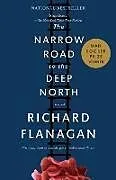
The Narrow Road to the Deep North
Beschreibung
Zusatztext 42760577 Informationen zum Autor Richard Flanagan's five previous novels Death of a River Guide, The Sound of One Hand Clapping, Gould's Book of Fish, The Unknown Terrorist, and Wanting have received numerous honors and are published in forty-two co...Format auswählen
- Poche format BCHF 21.10
Wird oft zusammen gekauft
Andere Kunden kauften auch
Beschreibung
Zusatztext 42760577 Informationen zum Autor Richard Flanagan's five previous novels Death of a River Guide, The Sound of One Hand Clapping, Gould's Book of Fish, The Unknown Terrorist, and Wanting have received numerous honors and are published in forty-two countries. He won the Man Booker Prize for The Narrow Road to the Deep North. He lives in Tasmania. www.richardflanagan.com Klappentext Winner of the Man Booker Prize "Nothing since Cormac McCarthy's The Road has shaken me like this." -The Washington Post In The Narrow Road to the Deep North, Richard Flanagan displays the gifts that have made him one of the most acclaimed writers of contemporary fiction. Moving deftly from a Japanese POW camp to present-day Australia, from the experiences of Dorrigo Evans and his fellow prisoners to that of the Japanese guards, this savagely beautiful novel tells a story of the many forms of love and death, of war and truth, as one man comes of age, prospers, only to discover all that he has lost.chapter 1 Why at the beginning of things is there always light? Dorrigo Evans' earliest memories were of sun flooding a church hall in which he sat with his mother and grandmother. A wooden church hall. Blinding light and him toddling back and forth, in and out of its transcendent welcome, into the arms of women. Women who loved him. Like entering the sea and returning to the beach. Over and over. Bless you, his mother says as she holds him and lets him go. Bless you, boy. That must have been 1915 or 1916. He would have been one or two. Shadows came later in the form of a forearm rising up, its black outline leaping in the greasy light of a kerosene lantern. Jackie Maguire was sitting in the Evanses' small dark kitchen, crying. No one cried then, except babies. Jackie Maguire was an old man, maybe forty, perhaps older, and he was trying to brush the tears away from his pockmarked face with the back of his hand. Or was it with his fingers? Only his crying was fixed in Dorrigo Evans' memory. It was a sound like something breaking. Its slowing rhythm reminded him of a rabbit's hind legs thumping the ground as it is strangled by a snare, the only sound he had ever heard that was similar. He was nine, had come inside to have his mother look at a blood blister on his thumb, and had little else to compare it to. He had seen a grown man cry only once before, a scene of astonishment when his brother Tom returned from the Great War in France and got off the train. He had swung his kitbag onto the hot dust of the siding and abruptly burst into tears. Watching his brother, Dorrigo Evans had wondered what it was that would make a grown man cry. Later, crying became simply affirmation of feeling, and feeling the only compass in life. Feeling became fashionable and emotion became a theatre in which people were players who no longer knew who they were off the stage. Dorrigo Evans would live long enough to see all these changes. And he would remember a time when people were ashamed of crying. When they feared the weakness it bespoke. The trouble to which it led. He would live to see people praised for things that were not worthy of praise, simply because truth was seen to be bad for their feelings. That night Tom came home they burnt the Kaiser on a bonfire. Tom said nothing of the war, of the Germans, of the gas and the tanks and the trenches they had heard about. He said nothing at all. One man's feeling is not always equal to all life is. Sometimes it's not equal to anything much at all. He just stared into the flames. 2 A happy man has no past, while an unhappy man has nothing else. In his old age Dorrigo Evans never knew if he had read this or had himself made it up. Made up, mixed up, and broken down. Relentlessly broken down. Rock to gravel to dust to mud to rock and so the world goes, as his mother used t...
One of the Best Books of the Year at • The New York Times • NPR **• The Washington Post*** • The Minneapolis Star-Tribune • The Economist • The Seattle Times • Financial Times*****************
“Some years, very good books win the Man Booker Prize, but this year a masterpiece has won it.” —A.C. Grayling, Chair of Judges, Man Booker Prize 2014
“Richard Flanagan has written a sort of Australian War and Peace.” **—Alan Cheuse, NPR
**
“A symphony of tenderness and love, a moving and powerful story that captures the weight and breadth of a life . . . A masterpiece.” —The Guardian
**
“I suspect that on rereading, this magnificent novel will seem even more intricate, more carefully and beautifully constructed.” —New York Times Book Review
“Captivating . . . This is a classic work of war fiction from a world-class writer . . . Nothing since Cormac McCarthy’s The Road has shaken me like this.” —Ron Charles, Washington Post
**
“Elegantly wrought, measured, and without an ounce of melodrama, Flanagan’s novel is nothing short of a masterpiece.” **—Financial Times
**“A moving and necessary work of devastating humanity and lasting significance.” **—Seattle Times
**
“A novel of extraordinary power, deftly told and hugely affecting. A classic in the making.” **—The Observer
**“Nothing could have prepared us for this immense achievement . . . The Narrow Road to the Deep North is beyond comparison.” **—The Australian
**“A devastatingly beautiful novel.” **—The Sunday Times (London)
**
“The book Richard Flanagan was born to write.” **—The Economist
**
“It is the story of Dorrigo, as one man among many POWs in the Asian jungle, that is the beating heart of this book: an excruciating, terrifying, life-altering story that is an indelible fictional testament to the prisoners there.” **—Michiko Kakutani, New York Times
**
“Exhilarating . . . Life affirming.” **—Sydney Morning Herald
**
“A supple meditation on memory, trauma, and empathy that is also a sublime war novel . . . Pellucid, epic, and sincerely touching.” **—Publishers Weekly
**
“Homeric . . . Flanagan’s feel for language, history’s persistent undercurrent, and subtle detail sets his fiction apart. There isn’t a false note in this book.” **—Irish Times
**
“The Narrow Road to the Deep North is a big, magnificent novel of passion and horror and tragic irony. Its scope, its themes and its people all seem to grow richer and deeper in significance with the progress of the story, as it moves to its extraordinary resolution. It’s by far the best new novel I’ve read in ages.” **—Patrick McGrath, author of *Constance
“I loved this book. Not just a great novel but an important book in its ability to look at terrible things and create something beautiful. Everyone should read it.” **—Evie Wyld, author of *All the Birds, Singing
***“The luminous imagination of Richard Flanagan is among the most precious of Australian literary treasures.” ***—Newcastle Herald
***“In an already sparkling career, this might be his biggest, best, most moving work yet.” —Sunday Age (Melbourne)
“An unforgettable story of men at war . . . Flanagan’s prose is richly innovative and captures perfectly the Australian demotic of tough blokes, with their love of nicknames and excellent swearing. He evokes Evans’s affair with Amy, and his subsequent soulless wanderings, with an intensity and be…