Haben Sie noch nichts passendes gefunden? Stöbern Sie durch unser komplettes Sortiment.
Oder melden Sie sich an bzw. registrieren Sie sich.


Beschreibung
Memetic algorithms are evolutionary algorithms that apply a local search process to refine solutions to hard problems. Memetic algorithms are the subject of intense scientific research and have been successfully applied to a multitude of real-world problems r...
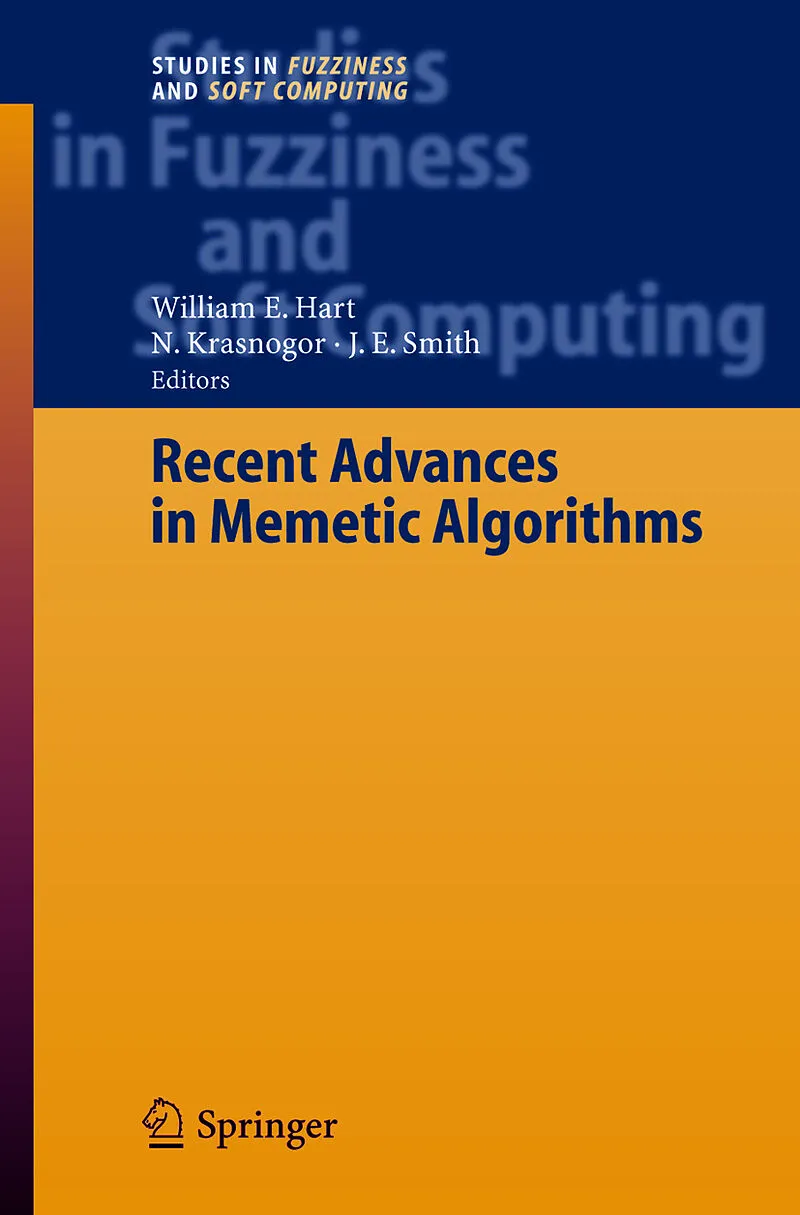
Memetic algorithms are evolutionary algorithms that apply a local search process to refine solutions to hard problems. Memetic algorithms are the subject of intense scientific research and have been successfully applied to a multitude of real-world problems ranging from the construction of optimal university exam timetables, to the prediction of protein structures and the optimal design of space-craft trajectories. This monograph presents a rich state-of-the-art gallery of works on memetic algorithms. Recent Advances in Memetic Algorithms is the first book that focuses on this technology as the central topical matter. This book gives a coherent, integrated view on both good practice examples and new trends including a concise and self-contained introduction to memetic algorithms. It is a necessary read for postgraduate students and researchers interested in recent advances in search and optimization technologies based on memetic algorithms, but can also be used as complement to undergraduate textbooks on artificial intelligence.
First book focusing on memetic algorithms as the central topical matter Gives a coherent, integrated view on both good practice examples and new trends including a concise and self-contained introduction to memetic algorithms Presents a rich state-of-the-art gallery of works on memetic algorithms Includes supplementary material: sn.pub/extras
Autorentext
William E. Hart, Carl D. Laird, Bethany L. Nicholson, John D. Siirola, and Michael L. Bynum are researchers affiliated with the Sandia National Laboratories in Albuquerque, New Mexico. Jean-Paul Watson is a researcher with the Lawrence Livermore Laboratory. David L. Woodruff is professor at the graduate school of management at the University of California, Davis. Gabriel Hackebeil is affiliated with Deepfield Nokia, Ann Arbor, MI. The 2019 INFORMS Computing Society prize was awarded to William E. Hart, Carl D. Laird, Jean-Paul Watson, David L. Woodruff, Gabriel A. Hackebeil, Bethany L. Nicholson and John Siirola for spearheading the creation and advancement of Pyomo, an open-source software package for modeling and solving mathematical programs in Python. A.E. Eiben (M.Sc in Maths 1985, Ph.D. in computer science 1991) is one of the European early birds of EC, his first EC paper is dating back to 1989. This was a technical report on Markov chain convergence properties of GAs, that was published in the proceedings of the first European EC conference, the PPSN 1990. Ever since he has been active in the field with special interest in multi-parent recombination, constraint satisfaction, and self-calibrating evolutionary algorithms. During the last decade he was chair or member of the organizing committee of almost all major events of the field: CEC, EP, FOGA, GECCO, PPSN and is a member of the PPSN Steering Committee. Currently he is an editorial board member of premium EC and EC-related jorunals: Evolutionary Computing, Genetic Programming and Evolvable Machines, IEEE Transactions on Evolutionary Computation, Applied Soft Computing, and Natural Computing. Furthermore, he is one of the founders and the executive board members of the European Network of Excellence in Evolutionary Computing, EvoNet. He is one of the series editors of the Springer book series Natural Computing. His also has almost ten years of teaching experience, having given academic and industrial EC courses and organising European EC Summer Schools. J.E. Smith (Msc. Communicating Computer Systems 1993, PhD in computer science 1998) has been actively researching and publishing on the field of EC since 1994. His work has combined theoretical modelling with empirical studies in a number of areas, especially concerning so-called "self-adaptive" and "hybrid" systems which exhibit the common characteristic of being able to "learn how to learn". This research has been backed up with industrial collaborations applying EC-based (and other) techniques to a range of diverse problems such as VLSI verification and bio-informatics. For a number of years he has served on the programme committees of all of the major (and many smaller) conferences in thefield, and as a reviewer for all of the principal journals. Since 2000 he has been one of the co-organisers of the annual International Workshop on Memetic Algorithms (WOMA). In addition to teaching courses in Evolutionary Computing in academia and industry, he has been a member of the Training Committee of the European Network of Excellence in Evolutionary Computing, EvoNet, since its formation and as such has been heavily involved in the production of a variety of different training materials for the EvoNet "flying circus".
Inhalt
to Memetic Algorithms.- Memetic Evolutionary Algorithms.- Applications of Memetic Algorithms.- An Evolutionary Approach for the Maximum Diversity Problem.- Multimeme Algorithms Using Fuzzy Logic Based Memes For Protein Structure Prediction.- A Memetic Algorithm Solving the VRP, the CARP and General Routing Problems with Nodes, Edges and Arcs.- Using Memetic Algorithms for Optimal Calibration of Automotive Internal Combustion Engines.- The Co-Evolution of Memetic Algorithms for Protein Structure Prediction.- Hybrid Evolutionary Approaches to Terminal Assignment in Communications Networks.- Effective Exploration & Exploitation of the Solution Space via Memetic Algorithms for the Circuit Partition Problem.- Methodological Aspects of Memetic Algorithms.- Towards Robust Memetic Algorithms.- NK-Fitness Landscapes and Memetic Algorithms with Greedy Operators and k-opt Local Search.- Self-Assembling of Local Searchers in Memetic Algorithms.- Designing Efficient Genetic and Evolutionary Algorithm Hybrids.- The Design of Memetic Algorithms for Scheduling and Timetabling Problems.- Memetic Algorithms for Multiobjective Optimization: Issues, Methods and Prospects.- Related Search Technologies.- A Memetic Learning Classifier System for Describing Continuous-Valued Problem Spaces.- Angels & Mortals: A New Combinatorial Optimization Algorithm.
Tief- preis