
IHR WARENKORB IST AKTUELL LEER.
Haben Sie noch nichts passendes gefunden? Stöbern Sie durch unser komplettes Sortiment.
Oder melden Sie sich an bzw. registrieren Sie sich.
- Kostenlose Lieferung
- Kauf auf Rechnung
- Ex Libris Tiefpreis
- Filiallieferung und 650+ Abholorte
- Rabatt-Bons als Club-Mitglied
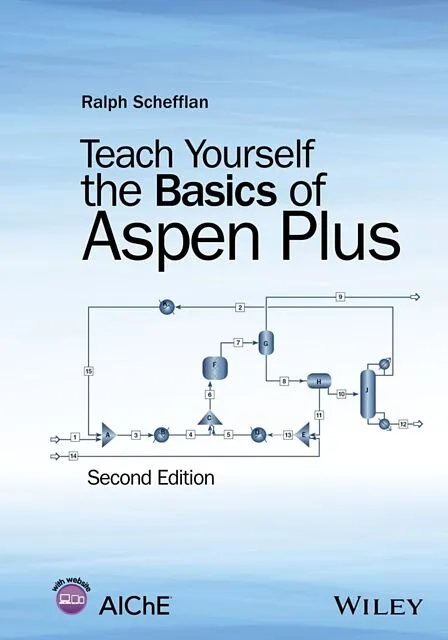
Teach Yourself the Basics of Aspen Plus
Beschreibung
Autorentext Ralph Schefflan has been an adjunct professor at Stevens Institute of Technology for the past thirty-five years. He has taught four graduate courses, thermodynamics, process simulation, numerical methods, and equilibrium stage operations during his...Format auswählen
- Kartonierter EinbandCHF 114.80

Wird oft zusammen gekauft
Andere Kunden kauften auch
Beschreibung
Autorentext
Ralph Schefflan has been an adjunct professor at Stevens Institute of Technology for the past thirty-five years. He has taught four graduate courses, thermodynamics, process simulation, numerical methods, and equilibrium stage operations during his time there as well as being SIT's representative to Aspen Technology. Dr. Schefflan introduced process simulation at SIT evolving from Flowtran to Aspen Plus and taught it for thirty years.
Klappentext
The complete step-by-step guide to mastering the basics of Aspen Plus software
Used for a wide variety of important scientific tasks, Aspen Plus software is a modeling tool used for conceptual design, optimization, and performance monitoring of chemical processes. After more than twenty years, it remains one of the most popular and powerful chemical engineering programs used both industrially and academically.
Teach Yourself the Basics of Aspen Plus, Second Edition continues to deliver important fundamentals on using Aspen Plus software. The new edition focuses on the newest version of Aspen Plus and covers the newest functionalities. Lecture-style chapters set the tone for maximizing the learning experience by presenting material in a manner that emulates an actual workshop classroom environment. Important points are emphasized through encouragement of hands-on learning techniques that direct learners toward achievement in creating effective designs fluidly and with confidence. Teach Yourself the Basics of Aspen Plus, Second Edition includes:
- Examples embedded within the text to focus the reader on specific aspects of the material being covered
- Workshops at the end of each chapter that provide opportunities to test the reader's knowledge in that chapter's subject matter
- Functionalities covered in the newest version of Aspen including the solution of a flowsheet by an equation oriented, EO approach, and the solution of problems which involve electrolyte equilibria
- Aspen Plus executable format as well as .txt format files containing details of the examples and the workshops as well as their solutions are provided as a download
Designed with both students and professionals in mind, Teach Yourself the Basics of Aspen Plus, Second Edition is like having a personal professor 24/7. Its revolutionary format is an exciting way to learn how to operate this highly sophisticated software-and a surefire way for readers to get the results they expect.
Zusammenfassung
The complete step-by-step guide to mastering the basics of Aspen Plus software Used for a wide variety of important scientific tasks, Aspen Plus software is a modeling tool used for conceptual design, optimization, and performance monitoring of chemical processes. After more than twenty years, it remains one of the most popular and powerful chemical engineering programs used both industrially and academically. Teach Yourself the Basics of Aspen Plus, Second Edition continues to deliver important fundamentals on using Aspen Plus software. The new edition focuses on the newest version of Aspen Plus and covers the newest functionalities. Lecture-style chapters set the tone for maximizing the learning experience by presenting material in a manner that emulates an actual workshop classroom environment. Important points are emphasized through encouragement of hands-on learning techniques that direct learners toward achievement in creating effective designs fluidly and with confidence. Teach Yourself the Basics of Aspen Plus, Second Edition includes: * Examples embedded within the text to focus the reader on specific aspects of the material being covered * Workshops at the end of each chapter that provide opportunities to test the reader's knowledge in that chapter's subject matter * Functionalities covered in the newest version of Aspen including the solution of a flowsheet by an equation oriented, EO approach, and the solution of problems which involve electrolyte equilibria * Aspen Plus executable format as well as .txt format files containing details of the examples and the workshops as well as their solutions are provided as a download Designed with both students and professionals in mind, Teach Yourself the Basics of Aspen Plus, Second Edition is like having a personal professor 24/7. Its revolutionary format is an exciting way to learn how to operate this highly sophisticated software--and a surefire way for readers to get the results they expect. Ralph Schefflan has been an adjunct professor at Stevens Institute of Technology for the past thirty-five years. He has taught four graduate courses, thermodynamics, process simulation, numerical methods, and equilibrium stage operations during his time there as well as being SIT's representative to Aspen Technology. Dr. Schefflan introduced process simulation at SIT evolving from Flowtran to Aspen Plus and taught it for thirty years.
Inhalt
PREFACE TO THE SECOND EDITION xiii
PREFACE TO THE FIRST EDITION xv
ACKNOWLEDGMENTS xix
ABOUT THE COMPANION WEBSITE xxi
1 INTRODUCTION TO ASPEN PLUS 1
1.1 Basic Ideas / 1
1.2 Starting Aspen Plus / 4
1.3 The Next Function / 6
1.4 The Navigation Pane / 6
1.5 The Property Environment / 8
1.6 Properties for Simulation / 11
1.7 The Simulation Environment / 13
1.8 Simulation Options / 13
1.9 Units / 14
1.10 Streams / 15
1.11 Blocks / 16
1.12 The Object Manager / 17
1.13 Model Execution / 17
1.14 Viewing Results / 18
1.15 Plotting Results / 20
References / 20
2 PROPERTIES 21
2.1 Introduction / 21
2.2 The Pure Component Databanks / 22
2.3 Property Analysis / 25
2.4 Property Estimation / 29
2.5 Workshops / 32
2.6 Workshop Notes / 33
References / 34
3 THE SIMPLE BLOCKS 35
3.1 Introduction / 35
3.2 Mixer/Splitter Blocks / 35
3.3 The Simple Separator Blocks / 37
3.4 Some Manipulator Blocks / 40
3.5 Workshops / 43
3.6 Workshop Notes / 44
4 PROCESSES WITH RECYCLE 47
4.1 Introduction / 47
4.2 Blocks with Recycle / 48
4.3 Heuristics / 51
4.4 Workshops / 51
4.5 Workshop Notes / 55
References / 56
5 FLOWSHEETING AND MODEL ANALYSIS TOOLS 57
5.1 Introduction / 57
5.2 Introduction to Fortran in Aspen Plus / 58
5.3 Basic Interpreted Fortran Capabilities / 58
5.4 The Sensitivity Function / 61
5.5 The Design Specification / 63
5.6 The Calculator Function / 65
5.7 The Transfer Function / 68
5.8 Workshops / 69
5.9 Workshop Notes / 71
References / 71
6 THE DATA REGRESSION SYSTEM (DRS) 73
6.1 Introduction / 73
6.2 Parameters of Equations of State / 74
6.3 Parameters of Activity Coefficient Equations / 76
6.4 Basic Ideas of Regression / 78
6.5 The Mathematics of Regression / 80
6.6 Practical Aspects of Regression of VLE or LLE Data / 82
6.7 VLE and LLE Data Sources / 90
6.8 Workshops / 93
6.9 Workshop Notes / 95
References / 96
7 FLASHES AND DECANTER 99
7.1 Introduction / 99
7.2 The Flash2 Block / 99
7.3 The Flash3 Block / 104
7.4 The Decanter Block / 105
7.5 Workshops / 107
7.6 Workshop Notes / 108
References / 109
8 PRESSURE CHANGERS 111
8.1 Introduction / 111
8.2 The Pump Block / 111
8.3 The Compr Block / 112
8.4 The MCompr Block / 113
8.5 Pipelines and Fittings / 114
8.6 Workshops / 115
8.7 Workshop Notes / 116
References / 116
9 HEAT EXCHANGERS 117
9.1 Introduction / 117
9.2 The Heater Block / 118
9.3 The Heatx Block / 122
9.4 The Mheatx Block / 126
9.5 Workshops / 127
9.6 Workshop Notes / 128
References / 129
10 REACTORS 131
10.1 Introduction / 131
10.2 The RStoic Block / 132
10.3 The RYield Block / 133
10.4 The REquil Block / 135
10.5 The RGibbs Block / 136
10.6 Reactions for the Rigorous Models / 138
10.7 The RCSTR Block / 143
10.8 The RPlug Block / 143
10.9 The RBatch Block / 145
10.10 Workshops / 148
10.11 Workshop Notes / 150
References / 151
**11 MULTIS…