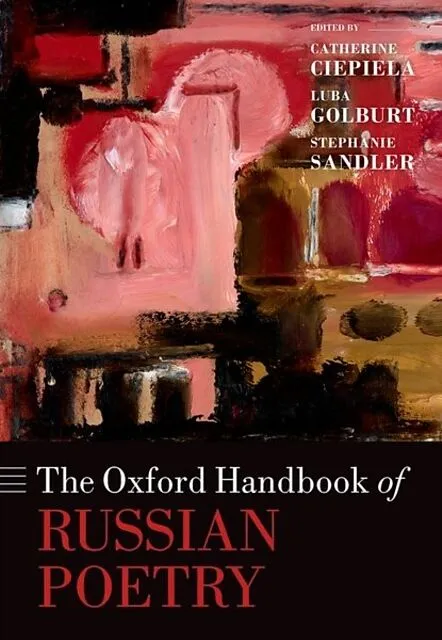
The Oxford Handbook of Russian Poetry
Beschreibung
Autorentext Catherine Ciepiela publishes on and translates modernist and contemporary Russian poetry. She is the author of The Same Solitude (2006), a study of Marina Tsvetaeva's epistolary romance with Boris Pasternak, and editor of two anthologies of Russian...Format auswählen
- Fester EinbandCHF 178.00
Wird oft zusammen gekauft
Andere Kunden kauften auch
Beschreibung
Autorentext
Catherine Ciepiela publishes on and translates modernist and contemporary Russian poetry. She is the author of The Same Solitude (2006), a study of Marina Tsvetaeva's epistolary romance with Boris Pasternak, and editor of two anthologies of Russian poetry in translation, The Stray Dog Cabaret (2007) and Relocations: 3 contemporary Russian women poets (2013). Her translation of Polina Barskova's Living Pictures appeared in 2021. She is Howard M. and Martha P. Mitchell Professor of Russian at Amherst College and director of the Amherst Center for Russian Culture.
Luba Golburt is Associate Professor of Slavic Languages and Literatures at the University of California-Berkeley. She is the author of The First Epoch: The Eighteenth Century and the Russian Cultural Imagination (2014) and many articles on Enlightenment and Romanticism, as well as on modern Russian poetry from the eighteenth century to the present. Her jointly written essay on "First Novels, First Publics"
appeared in the Oxford Handbook of the Russian Novel (2025), and she has edited collections of articles on Nikolai Nekrasov and Yan Satunovsky. She is currently at work on a case-study based critical history of the nature lyric in Russia.
Stephanie Sandler has written on Pushkin, myths of Pushkin, and a number of modern Russian poets, several of whom she has also translated. She was a co-author of A History of Russian Literature (2018). She collaborated in editing and translating Olga Sedakova, In Praise of Poetry (2014) as well as a volume of essays about Sedakova's poetry and poetics (2019). In 2024 she published The Freest Speech in Russia: Poetry Unbound 1989-2022. She is Ernest E. Monrad Professor in the Slavic Department at Harvard University.
Klappentext
The Oxford Handbook of Russian Poetry brings together forty original chapters by scholars, critics, and poets from across North America, Russia, and Europe, offering a wide-ranging account of the Russian poetic tradition from the early modern period to the present. Responding to evolving critical priorities and the expanded sense of Russian poetic practice in recent decades, the Handbook aims not to settle the canon but rather to model a range of approaches to poetic history. Chapters are attentive to rupture, reinvention, and literature's changing social and institutional conditions. In particular, the volume engages with an increasingly complex understanding of Russian twentieth-century literature-one that treats, separately and together, censored, uncensored, and émigré writing, and that engages with multilingualism and rapidly shifting cultural boundaries.
Collectively, the contributions consider texts both well-known and newly recovered, metropolitan and diasporic, official and underground. They reflect diverse methodologies, from close reading and historical poetics to network theory and performance studies. The volume is organized around seven conceptual rubrics-Timelines, Maps, Networks, Forms, Intersections, Performances, and Rereadings-which take up thematic and historiographical questions at varied scales. While designed to serve both as a reference and a pedagogical resource, the Handbook also considers urgent contemporary questions raised by war, censorship, and relocation, recognizing that the historical frameworks through which Russian poetry has been studied are themselves in flux. It is intended for a broad anglophone readership-from students and general readers to scholars of Russian literature and comparative poetics, and all quotations from Russian poetry are in the original and in English translation.
Inhalt
Part I. Timelines
1: Mikhail Odessky: Early Modern Russian Poetry
2: Tatiana Smoliarova and Andrey Kostin: Enlightenment and Classicism
3: Boris Gasparov: Romanticism
4: Luba Golburt: Russian Poetry in the Age of Prose
5: Irina Shevelenko: Modernism
6: Eugene Ostashevsky: Linguistic Materiality in the Avant-garde
7: Ilya Kukulin: Official, Unofficial, and Émigré Poetry
8: Kevin M. F. Platt: Post-Soviet, Postmodern, Contemporary, Beyond
Part II. Maps
9: Heinrich Kirschbaum: Poetry and Empire
10: Catherine Ciepiela: Poetry in Diaspora
11: Polina Barskova: The Petersburg Text
12: Ainsley Morse: Moscow Poetry
13: Jennifer Flaherty: The Countryside
Part III. Networks
14: Daria Khitrova: Poetry of Literary Circles in the Golden Age
15: Susanne Fusso: Editors and Poets
16: Jonathan Stone: Russian Poetry in Journals and Periodicals
17: Ilja Kukuj: Soviet Underground Poetry
18: Mikhail Gronas and Artjoms %Se a: Poetry in the Age of Networks
Part IV. Forms
19: Boris Maslov: Theories of Poetic Form
20: Nila Friedberg: Versification
21: Irina Reyfman: Fixed Forms in Russian Poetic Tradition
22: Michael Wachtel: The Poema
Part V. Intersections
23: Martha M. F. Kelly: Poetry and Orthodoxy
24: Philip Ross Bullock: Poetry and Music in Nineteenth-Century Russia
25: Stephanie Sandler: Poetry and the Visual
26: Maria Khotimsky: Poetry and Translation
27: Andrew Kahn: Poetry and Memory
28: Sofya Khagi: Poetry and Philosophy
Part VI. Performances
29: Ilya Vinitsky: The Court Poet
30: Kirill Ospovat: The Poet Orator
31: Mikhail Makeev: The Poor Poet
32: Sibelan Forrester: The Woman Poet
33: Mark Lipovetsky: The Soviet Poet
34: Isobel Palmer: Performed Poetry
Part VII. Rereadings
35: Vladimir Gandelsman: Rereading Mandelstam's Voronezh Notebooks
36: Sergey Zavyalov: The Poetry of Socialist Realism
37: Olga Sedakova: Anna Barkova, an Epoch's Witness
38: Stanislav Lvovsky: Viktor Krivulin, Historian of Time
39: Lev Oborin: Mikhail Eremin and the Tradition of Russian Scientific Poetry
40: Anna Glazova: Minimalism as a Last Resort