Beschreibung
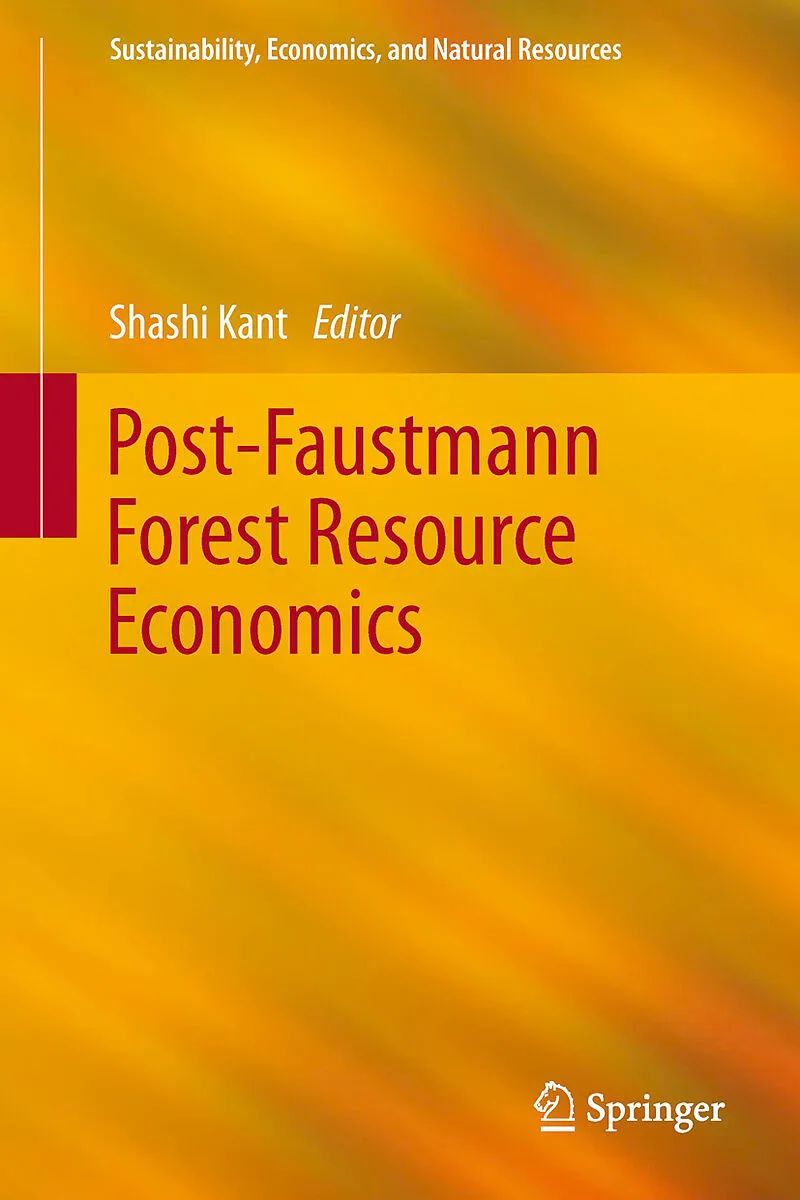
This book offers a unique critique of the dominant paradigm of forest economics, Faustmann Forest Economics. It presents new economic approaches, applications of experimental methods and systems approaches, and new perspectives about temporal aspects. The curr...This book offers a unique critique of the dominant paradigm of forest economics, Faustmann Forest Economics. It presents new economic approaches, applications of experimental methods and systems approaches, and new perspectives about temporal aspects.
The current paradigm of forest economics is based on Faustmann Formulation (FF) of land expectation value proposed by Martin Faustmann. It was a great achievement by a forester to propose a formulation that captures some fundamental economic features of capital theory which. However, the followers of the FF approach have trapped themselves into the past, and have not shown any indication of economic acumen of the great Faustmann. This has resulted in a common problem in the current paradigm of forest economics, known as Faustmann Forest Resource Economics (FFRE), to prescribe the application of a single (FF) approach to all situations irrespective of the specific features of the situation. The current state of forest economics is similar to that of neoclassical economics, and is full of inefficiencies. In neoclassical economics, inefficiencies are due to its locked-in position in rational economic man, while in forest economics inefficiencies are due to its locked-in position in the FF. The focus of this volume is on the new paradigm of forest economics termed as Post-Faustmann Forest Resource Economics (PFFRE). The first chapter lays the foundation of the PFFRE, and presents the key distinctions between the FFRE and the PFFRE. The volume includes twelve other chapters that address issues related to forest economics from perspectives different than the FFRE. Chapter 2 to 6 are focused on issues related to human behavior that is different than the rational economic man, Chapter 7 and 8 on public choice theory, Chapter 9 and 10 on systems approaches, and Chapter 11 to 13 on incremental approaches to incorporate new features in the FFRE.
Offers a thorough critique of the dominant paradigm of forest economics Faustmann Forest Economics Proposes more advanced economic perspectives on forest resource economics, including sustainability, complexity, and human behavior Applies cutting-edge experimental methods and systems approaches to forest resource economics Includes supplementary material: sn.pub/extras
Autorentext
The first book on the topic offers 21st century alternatives to the 163 year-old Faustmann paradigm at the heart of forest resource economics. Since that time, many new streams of economics including agent-based economics, behavioral economics, complexity theory, ecological economics, evolutionary game theory, social choice theory and public choice theory have extended the horizons of economic thinking far beyond the limits of neoclassical economics. Today, the role of multiple forest ecosystem services in climate change, human health, environmental sustainability and human development is increasingly recognized, and attention turns to enhancing the contribution of forests to a green economy rather than the traditional contribution of forests to an industrial economy. The fourth volume in the Sustainability, Economics and Natural Resources series, Post-Faustmann Forest Resource Economics focuses on the new paradigm of forest economics. The first chapter lays the foundation of the PFFRE, presenting the key distinctions between the FFRE and the PFFRE. Twelve following chapters address issues related to forest economics from perspectives different than the FFRE. Chapters 2 to 6 discuss issues related to human behavior that is different than the traditional rational economic man, Chapters 7 and 8 examine public choice theory, Chapters 9 and 10 survey systems approaches, and Chapters 11 to 13 describe incremental approaches for incorporating new features in the FFRE.
Klappentext
One of the first on the topic, this book offers 21 st century alternatives to the 163 year-old paradigm at the heart of forest resource economics, the Faustmann Formulation of land expectation value. Since that time, many new streams of economics including agent-based economics, behavioral economics, complexity theory, ecological economics, evolutionary game theory, social choice theory and public choice theory have extended the horizons of economic thinking far beyond the limits of neoclassical economics. Today, the role of multiple forest ecosystem services in climate change, human health, environmental sustainability and human development is increasingly recognized, and attention turns to enhancing the contribution of forests to a green economy rather than the traditional contribution of forests to a blue (industrial) economy.
The fourth volume in the Sustainability, Economics and Natural Resources series, Post-Faustmann Forest Resource Economics (PFFRE) focuses on the new paradigm of forest economics. The first chapter lays the foundation of the PFFRE, presenting the key distinctions between the FFRE and the PFFRE. Twelve following chapters address issues related to forest economics from perspectives different than the FFRE. Chapters 2 to 6 discuss issues related to human behavior that is different than the traditional rational economic man, Chapters 7 and 8 examine public choice theory, Chapters 9 and 10 present systems approaches, and Chapters 11 to 13 describe incremental approaches for incorporating new features in the FFRE.
Inhalt