
IHR WARENKORB IST AKTUELL LEER.
Haben Sie noch nichts passendes gefunden? Stöbern Sie durch unser komplettes Sortiment.
Oder melden Sie sich an bzw. registrieren Sie sich.
- Kostenlose Lieferung
- Kauf auf Rechnung
- Ex Libris Tiefpreis
- Filiallieferung und 650+ Abholorte
- Rabatt-Bons als Club-Mitglied
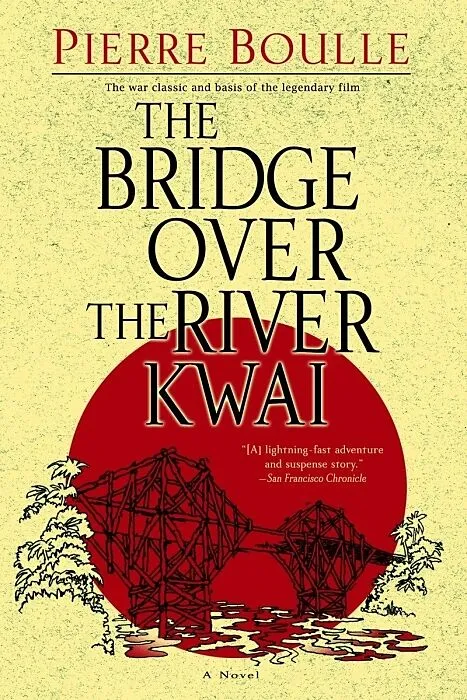
The Bridge over the River Kwai
Beschreibung
Zusatztext [A] lightning-fast adventure and suspense story. San Francisco Chronicle An amazing story . . . jumpy with suspense. The New Yorker A fine story of adventure in which a highly original conception makes a psychologically rich situation out of what co...Format auswählen
- BroschiertCHF 18.00

Wird oft zusammen gekauft
Andere Kunden kauften auch
Beschreibung
Zusatztext [A] lightning-fast adventure and suspense story. San Francisco Chronicle An amazing story . . . jumpy with suspense. The New Yorker A fine story of adventure in which a highly original conception makes a psychologically rich situation out of what could have easily been a simple tale of daring. Chicago Tribune An exciting story of action. The Atlantic Monthly Intelligent and thrilling. New York Post A memorable novel brilliantly conceived and brilliantly written. Harper's Magazine Superb . . . suspenseful. Time Informationen zum Autor Pierre Boulle was born in Avignon, France, in 1912. He originally trained as an engineer, but in 1936 he went to Malaysia and worked as a rubber planter. In 1939 he was called up in the French forces in Indochina, and when France fell during World War II, he fled to Singapore, where he joined the Free French Mission. After the Japanese invasion, he was sent via Rangoon and the Burma Road to Yunnan to establish contact with Kuomintang forces. He infiltrated Indochina as a guerilla where he was captured in 1943. He escaped in 1944, was picked up by a British plane, and served in the Special Forces in Calcutta for the rest of the war.His first novel to be published in the United States was The Bridge on the River Kwai . The book was awarded the Prix Sainte-Beuve prize in France, which led to the film version that received an amazing seven Academy Awards. He considered his subsequent books, of which Planet of the Apes is the most well known, to be social fantasies. Klappentext 1942: Boldly advancing through Asia! the Japanese need a train route from Burma going north. In a prison camp! British POWs are forced into labor. The bridge they build will become a symbol of service and survival to one prisoner! Colonel Nicholson! a proud perfectionist. Pitted against the warden! Colonel Saito! Nicholson will nevertheless! out of a distorted sense of duty! aid his enemy. While on the outside! as the Allies race to destroy the bridge! Nicholson must decide which will be the first casualty: his patriotism or his pride. 1 the insuperable gap between east and west that exists in some eyes is perhaps nothing more than an optical illusion. Perhaps it is only the conventional way of expressing a popular opinion based on insufficient evidence and masquerading as a universally recognized statement of fact, for which there is no justification at all, not even the plea that it contains an element of truth. During the last war, saving face was perhaps as vitally important to the British as it was to the Japanese. Perhaps it dictated the behavior of the former, without their being aware of it, as forcibly and as fatally as it did that of the latter, and no doubt that of every other race in the world. Perhaps the conduct of each of the two enemies, superficially so dissimilar, was in fact simply a different, though equally meaningless, manifestation of the same spiritual reality. Perhaps the mentality of the Japanese colonel, Saito, was essentially the same as that of his prisoner, Colonel Nicholson. These were the questions which occupied Major Clipton's thoughts. He, too, was a prisoner, like the five hundred other wretches herded by the Japanese into the camp on the River Kwai, like the sixty thousand English, Australians, Dutch, and Americans assembled in several groups in one of the most uncivilized corners of the earth, the jungle of Burma and Siam, in order to build a railway linking the Bay of Bengal to Bangkok and Singapore. Clipton occasionally answered these questions in the affirmative, realizing, however, that this point of view was in the nature of a paradox; to acquire it one had to disregard all superficial appearances. Above all, one had to assume that the beatings-up, the butt-end blows, and even worse forms of brutality th...
#8220;[A] lightning-fast adventure and suspense story.”
–San Francisco Chronicle
“An amazing story . . . jumpy with suspense.”
–The New Yorker
“A fine story of adventure in which a highly original conception makes a psychologically rich situation out of what could have easily been a simple tale of daring.”
–Chicago Tribune
“An exciting story of action.”
–The Atlantic Monthly
“Intelligent and thrilling.”
–New York Post
“A memorable novel brilliantly conceived and brilliantly written.”
–Harper’s Magazine
“Superb . . . suspenseful.”
–Time
Autorentext
Pierre Boulle was born in Avignon, France, in 1912. He originally trained as an engineer, but in 1936 he went to Malaysia and worked as a rubber planter. In 1939 he was called up in the French forces in Indochina, and when France fell during World War II, he fled to Singapore, where he joined the Free French Mission. After the Japanese invasion, he was sent via Rangoon and the Burma Road to Yunnan to establish contact with Kuomintang forces. He infiltrated Indochina as a guerilla where he was captured in 1943. He escaped in 1944, was picked up by a British plane, and served in the Special Forces in Calcutta for the rest of the war.His first novel to be published in the United States was The Bridge on the River Kwai. The book was awarded the Prix Sainte-Beuve prize in France, which led to the film version that received an amazing seven Academy Awards. He considered his subsequent books, of which Planet of the Apes is the most well known, to be social fantasies.
Klappentext
1942: Boldly advancing through Asia, the Japanese need a train route from Burma going north. In a prison camp, British POWs are forced into labor. The bridge they build will become a symbol of service and survival to one prisoner, Colonel Nicholson, a proud perfectionist. Pitted against the warden, Colonel Saito, Nicholson will nevertheless, out of a distorted sense of duty, aid his enemy. While on the outside, as the Allies race to destroy the bridge, Nicholson must decide which will be the first casualty: his patriotism or his pride.
Leseprobe
1
the insuperable gap between east and west that exists in some eyes is perhaps nothing more than an optical illusion. Perhaps it is only the conventional way of expressing a popular opinion based on insufficient evidence and masquerading as a universally recognized statement of fact, for which there is no justification at all, not even the plea that it contains an element of truth. During the last war, “saving face” was perhaps as vitally important to the British as it was to the Japanese. Perhaps it dictated the behavior of the former, without their being aware of it, as forcibly and as fatally as it did that of the latter, and no doubt that of every other race in the world. Perhaps the conduct of each of the two enemies, superficially so dissimilar, was in fact simply a different, though equally meaningless, manifestation of the same spiritual reality. Perhaps the mentality of the Japanese colonel, Saito, was essentially the same as that of his prisoner, Colonel Nicholson.
These were the questions which occupied Major Clipton’s thoughts. He, too, was a prisoner, like the five hundred other wretches herded by the Japanese into the camp on the River Kwai, like the sixty thousand English, Australians, Dutch, and Americans assembled in several groups in one of the most uncivilized corners of the earth, the jungle of Burma and Siam, in order to build a railway linking the Bay of Bengal to Bangkok and Singapore. Clipton occasionally answered these questions in the affirmative, realizing, however, that this point of view was in the nature of a paradox; to acquire it one had to disregard all superficial appearances. Above all, one had to assume that the beatings-up, the butt-end blows, and even worse forms of brutality through which the Japanese mentality made itself felt were all a…