
IHR WARENKORB IST AKTUELL LEER.
Haben Sie noch nichts passendes gefunden? Stöbern Sie durch unser komplettes Sortiment.
Oder melden Sie sich an bzw. registrieren Sie sich.
- Kostenlose Lieferung
- Kauf auf Rechnung
- Ex Libris Tiefpreis
- Filiallieferung und 650+ Abholorte
- Rabatt-Bons als Club-Mitglied
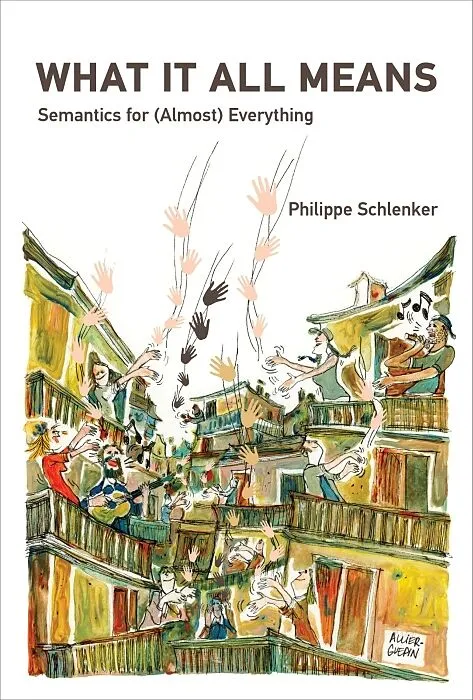
What It All Means
Beschreibung
Informationen zum Autor Philippe Schlenker is Senior Research Fellow at Centre national de la recherche scientifique (Institut Jean-Nicod, Paris) and Global Distinguished Professor at New York University. His work spans all aspects of meaning, from philosophic...Format auswählen
- Fester EinbandCHF 42.30
Wird oft zusammen gekauft
Andere Kunden kauften auch
Beschreibung
Informationen zum Autor Philippe Schlenker is Senior Research Fellow at Centre national de la recherche scientifique (Institut Jean-Nicod, Paris) and Global Distinguished Professor at New York University. His work spans all aspects of meaning, from philosophical logic to formal semantics, in both spoken and signed languages. Klappentext How meaning works-from monkey calls to human language, from spoken language to sign language, from gestures to music-and how meaning is connected to truth. We communicate through language, connecting what we mean to the words we say. But humans convey meaning in other ways as well, with facial expressions, hand gestures, and other methods. Animals, too, can get their meanings across without words. In What It All Means, linguist Philippe Schlenker explains how meaning works, from monkey calls to human language, from spoken language to sign language, from gestures to music. He shows that these extraordinarily diverse types of meaning can be studied and compared within a unified approach-one in which the notion of truth plays a central role. "It's just semantics" is often said dismissively. But Schlenker shows that semantics-the study of meaning-is an unsung success of modern linguistics, a way to investigate some of the deepest questions about human nature using tools from the empirical and formal sciences. Drawing on fifty years of research in formal semantics, Schlenker traces how meaning comes to life. After investigating meaning in primate communication, he explores how human meanings are built, using in some cases sign languages as a guide to the workings of our inner "logic machine." Schlenker explores how these meanings can be enriched by iconicity in sign language and by gestures in spoken language, and then turns to more abstract forms of iconicity to understand the meaning of music. He concludes by examining paradoxes, which-being neither true nor false-test the very limits of meaning. Zusammenfassung How meaning worksfrom monkey calls to human language, from spoken language to sign language, from gestures to musicand how meaning is connected to truth. We communicate through language, connecting what we mean to the words we say. But humans convey meaning in other ways as well, with facial expressions, hand gestures, and other methods. Animals, too, can get their meanings across without words. In What It All Means , linguist Philippe Schlenker explains how meaning works, from monkey calls to human language, from spoken language to sign language, from gestures to music. He shows that these extraordinarily diverse types of meaning can be studied and compared within a unified approachone in which the notion of truth plays a central role . It's just semantics is often said dismissively. But Schlenker shows that semanticsthe study of meaningis an unsung success of modern linguistics, a way to investigate some of the deepest questions about human nature using tools from the empirical and formal sciences. Drawing on fifty years of research in formal semantics, Schlenker traces how meaning comes to life. After investigating meaning in primate communication, he explores how human meanings are built, using in some cases sign languages as a guide to the workings of our inner logic machine. Schlenker explores how these meanings can be enriched by iconicity in sign language and by gestures in spoken language, and then turns to more abstract forms of iconicity to understand the meaning of music. He concludes by examining paradoxes, whichbeing neither true nor falsetest the very limits of meaning. Inhaltsverzeichnis Acknowledgments ix Introduction xi Prologue: Primate Meanings xxiii 1 Meaning in the Wild 1 Part I: The Building Blocks of Meaning 37 2 Visible Logic: Sign Language and Pronouns 39 3 Me, Me, Me! Perspectives in Language 69 4 Nouns and Verbs: Objects and Events 91 5 Bey...
Autorentext
Philippe Schlenker is Senior Research Fellow at Centre national de la recherche scientifique (Institut Jean-Nicod, Paris) and Global Distinguished Professor at New York University. His work spans all aspects of meaning, from philosophical logic to formal semantics, in both spoken and signed languages.
Klappentext
"An introduction to semantics for the general reader. How things mean, from animal communication to music"--
Zusammenfassung
How meaning works—from monkey calls to human language, from spoken language to sign language, from gestures to music—and how meaning is connected to truth.
We communicate through language, connecting what we mean to the words we say. But humans convey meaning in other ways as well, with facial expressions, hand gestures, and other methods. Animals, too, can get their meanings across without words. In What It All Means, linguist Philippe Schlenker explains how meaning works, from monkey calls to human language, from spoken language to sign language, from gestures to music. He shows that these extraordinarily diverse types of meaning can be studied and compared within a unified approach—one in which the notion of truth plays a central role**.**
“It’s just semantics” is often said dismissively. But Schlenker shows that semantics—the study of meaning—is an unsung success of modern linguistics, a way to investigate some of the deepest questions about human nature using tools from the empirical and formal sciences. Drawing on fifty years of research in formal semantics, Schlenker traces how meaning comes to life. After investigating meaning in primate communication, he explores how human meanings are built, using in some cases sign languages as a guide to the workings of our inner “logic machine.” Schlenker explores how these meanings can be enriched by iconicity in sign language and by gestures in spoken language, and then turns to more abstract forms of iconicity to understand the meaning of music. He concludes by examining paradoxes, which—being neither true nor false—test the very limits of meaning.