Beschreibung
Die seit 1925 erscheinenden Arbeiten zur Kirchengeschichte bilden eine der traditionsreichsten historischen Buchreihen im deutschsprachigen Raum. Sie enthalten Forschungen zur Kirchen- und Dogmengeschichte des Christentums aller Epochen, veröffentlichen aber ...
Die seit 1925 erscheinenden Arbeiten zur Kirchengeschichte bilden eine der traditionsreichsten historischen Buchreihen im deutschsprachigen Raum. Sie enthalten Forschungen zur Kirchen- und Dogmengeschichte des Christentums aller Epochen, veröffentlichen aber auch Arbeiten aus verwandten Disziplinen wie beispielsweise der Archäologie, Kunstgeschichte oder Literaturwissenschaft. Kennzeichnend für die Reihe ist der durchgängige Anspruch, historisch-methodische Präzision mit systematischen Kontextualisierungen des jeweiligen Gegenstandes zu verbinden. In jüngerer Zeit erscheinen verstärkt Arbeiten zu Themen einer Kultur- und Ideengeschichte des Christentums in einem methodisch offenen christentumsgeschichtlichen Horizont.
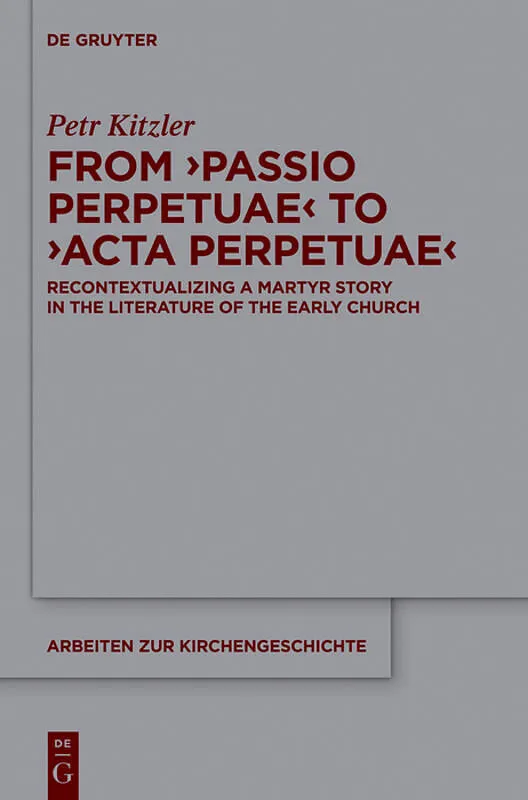
While concentrated on the famous Passio Perpetuae et Felicitatis , this book focuses on an area that has so far been somewhat marginalized or even overlooked by modern interpreters: the recontextualizing of the Passio Perpetuae in the subsequent reception of this text in the literature of the early Church. Since its composition in the early decades of the 3rd century, the Passio Perpetuae was enjoying an extraordinary authority and popularity. However, it contained a number of revolutionary and innovative features that were in conflict with existing social and theological conventions. This book analyses all relevant texts from the 3rd to 5th centuries in which Perpetua and her comrades are mentioned, and demonstrates the ways in which these texts strive to normalize the innovative aspects of the Passio Perpetuae . These efforts, visible as they are already on careful examination of the passages of the editor of the passio, continue from Tertullian to Augustine and his followers. The normalization of the narrative reaches its peak in the so-called Acta Perpetuae which represent a radical rewriting of the original and an attempt to replace it by a purified text, more compliant with the changed socio-theological hierarchies.
Autorentext
Petr Kitzler, Centre for Classical Studies at the Institute of Philosophy of the Czech Academy of Sciences, Prague, Czech Republic.
Klappentext
While concentrated on the famous Passio Perpetuae et Felicitatis, this book focuses on an area that has so far been somewhat marginalized or even overlooked by modern interpreters: the recontextualizing of the Passio Perpetuae in the subsequent reception of this text in the literature of the early Church. Since its composition in the early decades of the 3rd century, the Passio Perpetuae was enjoying an extraordinary authority and popularity. However, it contained a number of revolutionary and innovative features that were in conflict with existing social and theological conventions. This book analyses all relevant texts from the 3rd to 5th centuries in which Perpetua and her comrades are mentioned, and demonstrates the ways in which these texts strive to normalize the innovative aspects of the Passio Perpetuae. These efforts, visible as they are already on careful examination of the passages of the editor of the passio, continue from Tertullian to Augustine and his followers. The normalization of the narrative reaches its peak in the so-called Acta Perpetuae which represent a radical rewriting of the original and an attempt to replace it by a purified text, more compliant with the changed socio-theological hierarchies.
Tief- preis