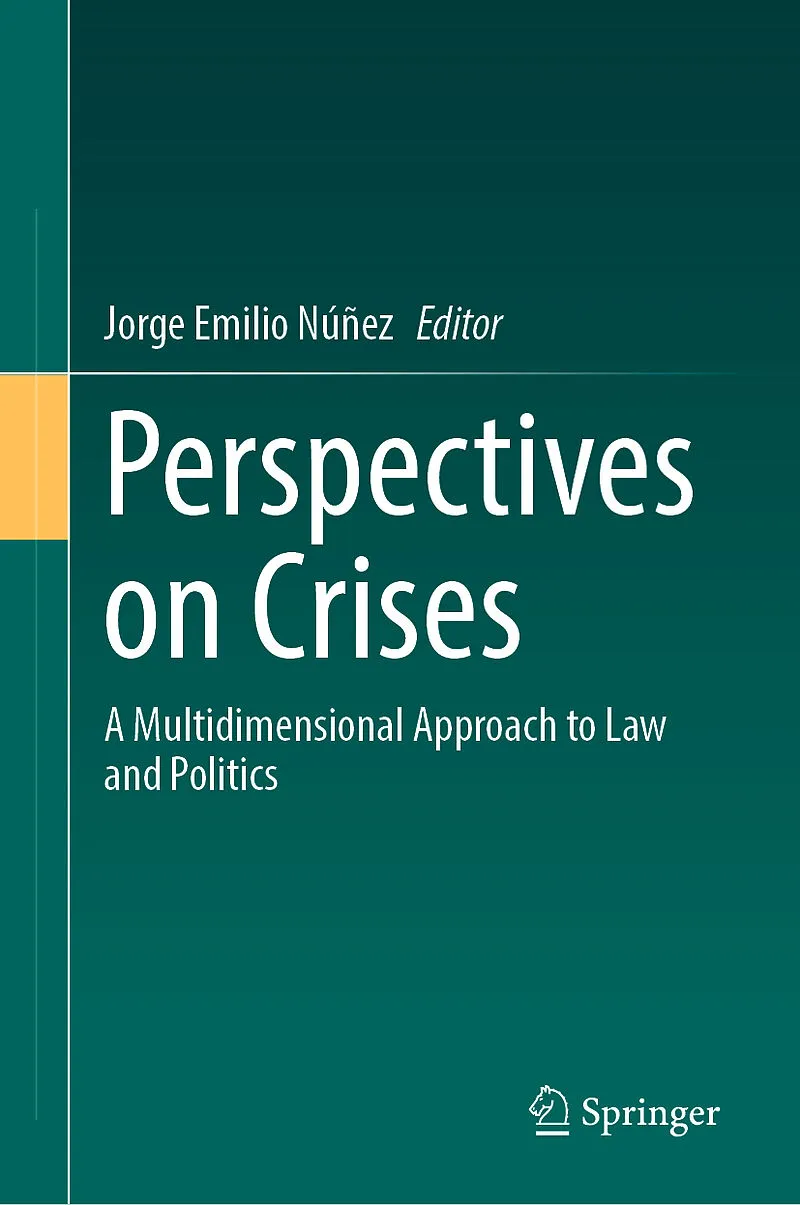
Perspectives on Crises
Beschreibung
What if the next global crisis is already hereand we're still tackling it with yesterday's tools? This book confronts this question head-on, offering a bold, multidimensional rethinking of how humanity can navigate overlapping emergenciespandemics, climate co...Format auswählen
- Fester EinbandCHF 148.40
Wird oft zusammen gekauft
Andere Kunden kauften auch
Beschreibung
What if the next global crisis is already hereand we're still tackling it with yesterday's tools?
This book confronts this question head-on, offering a bold, multidimensional rethinking of how humanity can navigate overlapping emergenciespandemics, climate collapse, deepening inequalitywithout sacrificing sovereignty or dignity.
Drawing on original contributions from leading scholars and activists across five continents, this book delivers an in-depth, comparative analysis of real-world legal, political, and community responses to the COVID-19 pandemic and the worsening global crisis. The chapters trace how crises magnify structural vulnerabilities, expose failures in governance, and simultaneously reveal unexpected spaces for resistance and innovationfrom Indigenous legal activism in Brazil and civic water-protection initiatives in India and Costa Rica, to evolving greenhouse-gas regulation in the United States and Brazil, and the still-unrealised potential of cooperation within the BRICS countries.
The approach used is deliberately multidimensional: no single discipline's or nation-state's perspective dominates. Instead, the authors weave together legal theory, political philosophy, environmental justice, and on-the-ground empirical insights to challenge unidimensional thinking and propose practical pathways toward coordinated pluralism.
Particular attention is given to the tension between sovereignty and shared responsibility, the relational nature of dignity in times of triage and scarcity, and the urgent need for multiscalar governance that learns across borders rather than replicating national silos.
This book will be of considerable interest to researchers and scholars of international law, climate justice, human rights, global governance, and political theoryand to activists, policymakers, and practitioners seeking intellectually rigorous yet actionable responses to the polycrisis we already find ourselves in.
Perspectives on Crises does not offer easy answers. Rather, it equips readers with more precise questionsand more honest toolsto help them face what comes next.
Provides timely views, perspectives and analysis about global crisis that sets ground for future research and collaborations Offers a dialogue between scholars from different disciplines Written by junior and seasoned scholars from different backgrounds that enable egalitarian academic exchange
Autorentext
Jorge E. Núñez is Reader (Associate Professor) at Manchester Law School, UK, where he leads research and teaching in legal and political theory, international law and politics. He is the founder and chair of Juris North, an international legal and political discussion network launched in 2015 that now connects over 2,000 scholars and practitioners worldwide. His work focuses on territorial disputes, global legal/political pluralism and sovereignty. He has published widely and is the editor-in-chief of this collection. Jorge E. Núñez holds a PhD and has held visiting positions and collaborations across Europe, Latin America and Asia.
Inhalt
Chapter 1. Perspectives on Crises: Introduction.- Part I. Human Dignity.- Chapter 2. A Legal Ethics of the Vulnerability of Human Beings: Human Dignity and Responsibility to Rethinking the Present Time.- Chapter 3. Human Dignity, Right to Health, and Balancing: With Special Focus on Vulnerability in a Public Health Emergency.- Chapter 4. Indigenous Dignity Under Threat in the Brazilian COVID-19 Pandemic.- Chapter 5. Response to Part I: Human Dignity in Times of Crisis: A Contested Concept.- Part II. Climate Change.-
Chapter 6. Regulating Greenhouse Gases as Criteria Pollutants in the United States and Brazil.- Chapter 7. BRICS Response to Climate Governance Crisis in Pandemic Times.- Chapter 8. Repairing Water in the Face of Climate Change: A Tale of Two Communities.- Chapter 9. Response to Part II: Global Perspectives from Law and Policy on the Climate Crisis.- Part III Conclusion.- Chapter 10. Conclusion.