Beschreibung
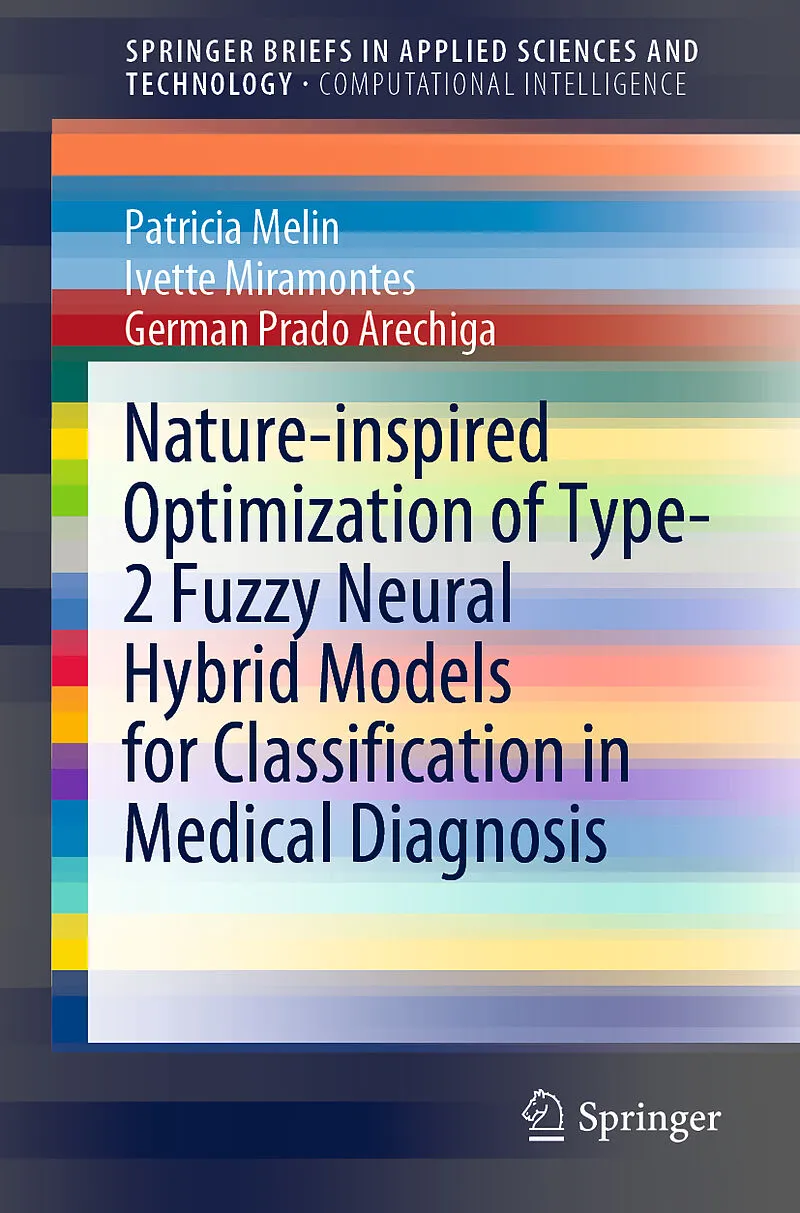
This book describes the utilization of different soft computing techniques and their optimization for providing an accurate and efficient medical diagnosis. The proposed method provides a precise and timely diagnosis of the risk that a person has to develop a ...This book describes the utilization of different soft computing techniques and their optimization for providing an accurate and efficient medical diagnosis. The proposed method provides a precise and timely diagnosis of the risk that a person has to develop a particular disease, but it can be adaptable to provide the diagnosis of different diseases. This book reflects the experimentation that was carried out, based on the different optimizations using bio-inspired algorithms (such as bird swarm algorithm, flower pollination algorithms, and others). In particular, the optimizations were carried out to design the fuzzy classifiers of the nocturnal blood pressure profile and heart rate level. In addition, to obtain the architecture that provides the best result, the neurons and the number of neurons per layers of the artificial neural networks used in the model are optimized. Furthermore, different tests were carried out with the complete optimized model. Another work that is presented in this book is the dynamic parameter adaptation of the bird swarm algorithm using fuzzy inference systems, with the aim of improving its performance. For this, different experiments are carried out, where mathematical functions and a monolithic neural network are optimized to compare the results obtained with the original algorithm. The book will be of interest for graduate students of engineering and medicine, as well as researchers and professors aiming at proposing and developing new intelligent models for medical diagnosis. In addition, it also will be of interest for people working on metaheuristic algorithms and their applications on medicine.
Autorentext
Patricia Melin holds the Doctor in Science degree (Doctor Habilitatus D.Sc.) in Computer Science from the Polish Academy of Sciences. She is a Professor of Computer Science in the Graduate Division, Tijuana Institute of Technology, Tijuana, Mexico, since 1998. In addition, she is serving as Director of Graduate Studies in Computer Science and head of the research group on Hybrid Neural Intelligent Systems (2000-present). She is past President of NAFIPS (North American Fuzzy Information Processing Society) 2019-2020. Prof. Melin is the founding Chair of the Mexican Chapter of the IEEE Computational Intelligence Society. She is member of the IEEE Neural Network Technical Committee (2007 to present), the IEEE Fuzzy System Technical Committee (2014 to present) and is Chair of the Task Force on Hybrid Intelligent Systems (2007 to present) and she is currently Associate Editor of the Journal of Information Sciences and IEEE Transactions on Fuzzy Systems. She is member of NAFIPS, IFSA, and IEEE. She belongs to the Mexican Research System with level III. Her research interests are in Modular Neural Networks, Type-2 Fuzzy Logic, Pattern Recognition, Fuzzy Control, Neuro-Fuzzy and Genetic-Fuzzy hybrid approaches. She has published over 300 journal papers, 20 authored books, 50 edited books, and more than 300 papers in conference proceedings, for a total of more than 800 publications with h-index of 86 in Google Scholar. She is Editor-in-Chief of the Advances in Fuzzy Systems journal (Wiley). She has served as Guest Editor of several Special Issues in the past, in journals like: Applied Soft Computing, Intelligent Systems, Information Sciences, Non-Linear Studies, JAMRIS, Fuzzy Sets and Systems. She has been recognized as Highly Cited Researcher in 2017 and 2018 by Clarivate Analytics because of having multiple highly cited papers in Web of Science. Martha Ram rez holds the B.S. in Computer Science, M.S. in Computer Science, and the Ph.D. in Computer Science from Tijuana Institute of Technology. Currently she works at Tecnologico Nacional de Mexico in Mexico City. Her current research interests include hybrid intelligent systems, neural networks and fuzzy systems. She has published more 10 papers in time series prediction, classification and clustering using supervised and unsupervised neural network models, in addition to type-1 and type-2 fuzzy logic for aggregation of responses in ensembles and modular neural networks. Oscar Castillo holds the Doctor in Science degree (Doctor Habilitatus) in Computer Science from the Polish Academy of Sciences (with the Dissertation "Soft Computing and Fractal Theory for Intelligent and Manufacturing"). He is a Professor of Computer Science in the Graduate Division, Tijuana Institute of Technology, Tijuana, Mexico. In addition, he is serving as Research Director of Computer Science and head of the research group on Hybrid Fuzzy Intelligent Systems. Currently, he is President of HAFSA (Hispanic American Fuzzy Systems Association) and Past President of IFSA (International Fuzzy Systems Association). Prof. Castillo is also Chair of the Mexican Chapter of the Computational Intelligence Society (IEEE). He is also a member of NAFIPS, IFSA and IEEE. He belongs to the Mexican Research System (SNI Level 3). His research interests are in Type-2 Fuzzy Logic, Fuzzy Control, Neuro-Fuzzy and Genetic-Fuzzy hybrid approaches. He has published over 300 journal papers, 20 authored books, 100 edited books, 300 papers in conference proceedings, and more than 300 chapters in edited books, in total more than 1180 publications (according to Scopus) with h index of 97 and more than 31000 citations according to Google Scholar. He has been Guest Editor of several successful Special Issues in the past, like in the following journals: Applied Soft Computing, Intelligent Systems, Information Sciences, Soft Computing, Non-Linear Studies, Fuzzy Sets and Systems, JAMRIS and Engineering Letters. He is currently Associate Editor