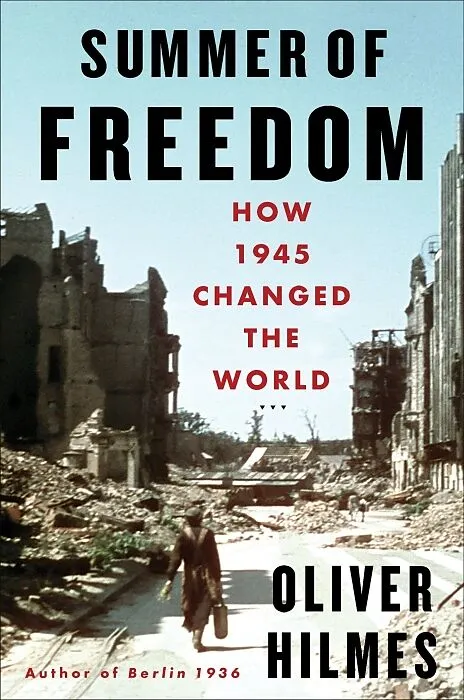

Summer of Freedom
Beschreibung
This colorful post–World War II history brings to life a crucial yet understudied period, through the eyes of both major figures and ordinary people. It was a summer like no one had ever experienced: in the four months from May to September 1945, the old...Format auswählen
- Fester EinbandCHF 30.30

Wird oft zusammen gekauft
Andere Kunden kauften auch
Beschreibung
This colorful post–World War II history brings to life a crucial yet understudied period, through the eyes of both major figures and ordinary people. It was a summer like no one had ever experienced: in the four months from May to September 1945, the old world collapsed, and a new one opened up. The heinous Third Reich was over, ushering in an era of freedom, but also fresh conflicts. With a gripping historical panorama, Oliver Hilmes offers insight into this unprecedented summer, from the perspectives of the victors and the vanquished, victims and perpetrators, celebrities and unknowns. The “Big Three”--Harry S. Truman, Winston Churchill, and Joseph Stalin--determine the course of history at the Potsdam Conference. German housewife Else Tietze fears for her son’s safety. US soldier Klaus Mann tracks down Nazi criminals. And in Berlin Billy Wilder plans a comedy about life in the ruins. Cafés and restaurants reopen their doors, and Red Army soldier Vasily Petrowitsch is begged for bread by German children. Through a series of scenes that lead from Berlin to Tokyo, from Munich to Paris, from Bayreuth to Moscow, Hilmes captures the unique atmosphere of this time of extremes: the great happiness and hope of the liberated; the misery, grief, and fear of the defeated; and the uncertainty that comes with freedom.
Autorentext
Oliver Hilmes
Leseprobe
AT THE ABYSS
When Harry walks down the hallways of his new home, he gets the feeling of being at sea. The floor creaks under his steps and seems to move like the deck of a rolling ship. Chandeliers weighing half a ton begin to swing, and the crystal glasses on the table clink together. Again and again, the heavy curtain sways as though directed by an invisible hand while mysterious groans emanate from the venerable walls. You might think that Harry is imagining this. Perhaps his nerves are gone or his fantasy has run wild. But Harry’s senses aren’t deceiving him. His new domicile is in fact in disrepair, and unless something is done in the foreseeable future, it could collapse like a house of cards. The building in question is the White House.
In November 1944, Harry S. Truman ran for Vice President of the United States of America alongside Franklin D. Roosevelt. It was the fourth time Roosevelt had put himself up for America’s highest office and, again, his ticket won. A few months later, on April 12, 1945, FDR suddenly died, making Truman president. Former First Lady Eleanor Roosevelt gave him, his wife Bess, and his daughter Margaret a tour of the presidential residence.
“The White House looked splendid from the outside,” Margaret would remember. “But the private quarters were anything but comfortable in those days. It was not unlike moving into a furnished apartment, where no new furniture or equipment had been purchased for twenty or thirty years. The furniture looked like it had come from a third-rate boarding house. Some of it was literally falling apart.” Mrs. Roosevelt assured the new inhabitants that the place would look much better with a fresh coat of paint on the walls. Margaret chose Wedgwood Blue for her living room and pink for her bedroom. Bess Truman preferred blue for her bedroom and gray for her living room, while her husband’s bedroom was painted beige. The couple obviously slept apart. The Oval Office was made over in off-white. On May 7, the renovations were completed. That very day the Trumans moved into their quarters in the White House.
As the movers carry hundreds of boxes into the building, and a crane hoists Margaret’s grand piano into the second floor, President Truman learns from General Dwight D. Eisenhower, Supreme Commander of the Allied Forces in Northwestern Europe, that Colonel General Alfred Jodl of the German Wehrmacht has capitulated at Eisenhower’s headquarters in the French city of Reims. Because Jodl has argued that the Wehrmacht leadership needs time to communicate the order to surrender down through the ranks, it has been agreed that Germany will officially cease hostilities the following day. Truman thus spends his first night in the White House secure in the knowledge that the Second World War will be coming to an end, five years, eight months, and seven days after it began.
When Truman awakes at the crack of dawn on May 8 in the presidential bedroom, he no doubt has little desire to think about the physical state of the building. A press conference, to be broadcast on the radio, is planned for 9:00 a.m. Word has gone round that the new president has something very important to communicate to the American people, and the press jockeys for position when White House spokesman Jonathan W. Daniels admits reporters into the Oval Office at 8:35. Also present are Bess and Margaret, Truman’s cabinet, and ranking American and British military commanders and congressional leaders. They’re seated on chairs ringing the president’s desk. The journalists have to stand. It’s so crowded that someone could pass out without hitting the floor.
Truman tells those in attendance that what he’s going to announce is top secret until 9:00 a.m. But it’s so brief, he adds, they’ll all have plenty of time to write their reports. The reporters laugh. Truman jokes that it’s also a special day for him personally. He’s just turned sixty-one. “Happy Birthday, Mr. President,” someone calls out. Then the clock strikes nine, and Truman begins to speak.
“This is a solemn but glorious hour,” he says. “General Eisenhower informs me that the forces of Germany have surrendered to the United Nations.” He points out that the Second World War isn’t yet over and done with and that Japan and the United States are still locked in a terrible battle in the Pacific. He warns the Japanese that, from now on, the full might of the American military machine will be directed against them. The press conference is over in minutes.
While Truman accepts further birthday congratulations, shakes countless hands, cuts a huge cake, passes pieces to his closest staff members, and at some point goes back to work, New York prepares for what is by far the biggest American celebration of V-E Day. Masses of people gather in Times Square, getting ready for the tens of thousands of celebrants who will march down Fifth Avenue to showers of confetti. All in all, half a million people take part. But by evening, the city returns to its normal hustle and bustle. “Yesterday’s news had hardly any effect on the theatrical box offices last night,” the New York Times reports the following day. “Ticket booth attendants said that there were some seats canceled, but they were immediately snapped up by other buyers.”
V
How long has the German novelist Alfred Döblin waited for this day? How often has he imagined a gigantic sinkhole opening in the ground and sucking Adolf Hitler down to the depths of hell? Twenty times? Thirty? More? Döblin can’t say. “It’s good that this beast has finally been laid low, but what damage has it done!” he writes to friends in May. Some sixty million people have died, civilians as well as soldiers, and nine million men, women, and children have been murdered in the concentration camps and death camps, including six million Jews. Broad stretches of the European continent have been devastated.
In Los Angeles, the city in which Döblin sought refuge five years ago, he notes: “Perhaps my exile will be over in a few months — but what comes next? Life is a series of adventures.”
V
A good week after Adolf Hitler’s suicide in the bunker of the Reich Chancellery, wild rumors are swirling around Berlin. “Hitler is in Japan, in Spain, near Hamburg, he’s shot hims…