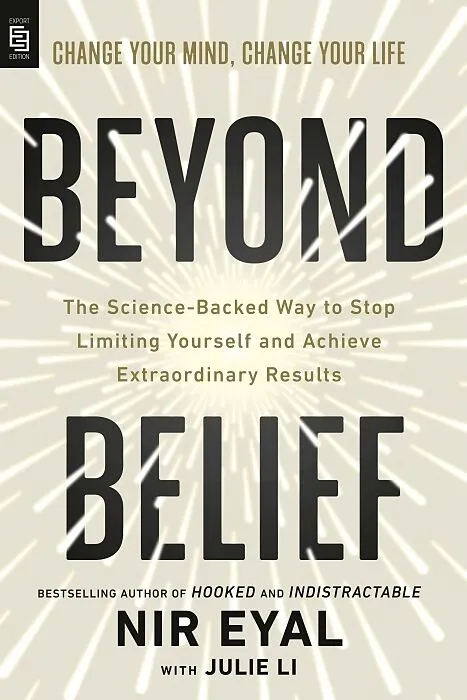
Beyond Belief
Beschreibung
From the bestselling author of In our quest for improved performance, we don''t need more information. We are awash in advice on the "how to." But where many of us fall short is on taking action. We constantly find ourselves caught between the desire to do the...Format auswählen
- Kartonierter EinbandCHF 23.50
- Fester EinbandCHF 33.20

Wird oft zusammen gekauft
Andere Kunden kauften auch
Beschreibung
From the bestselling author of In our quest for improved performance, we don''t need more information. We are awash in advice on the "how to." But where many of us fall short is on taking action. We constantly find ourselves caught between the desire to do the things we know are good for us and actually doing them. So, In <Beyond Belief< gives you the toolkit to fill the gap between your expectations and your actions, because, ultimately, the goal isn''t just to "believe in yourself." It''s to build beliefs that give you the life you deserve.
Autorentext
Nir Eyal with Julie Li
Klappentext
From the bestselling author of Hooked and Indistractable, the surprising reason for our mental and physical limits and a bold, new framework for how to surpass— and even erase them permanently.
In our quest for improved performance, we don't need more information. We are awash in advice on the "how to." But where many of us fall short is on taking action. We constantly find ourselves caught between the desire to do the things we know are good for us and actually doing them. So, what is stopping us from doing what we decide to do?
In Beyond Belief bestselling author Nir Eyal shows that the key to oustanding mental and physical performance is not habits, grit, or effort, but the degree to which you believe your actions will be effective. What's more, the limiting beliefs you don't know you have can be changed--and the results are unbelievable.
Beyond Belief distills the latest in psychological research into an engaging and accessible guide to reprogramming your mind and body to go beyond what you think is possible. Through jaw-dropping case studies and simple, practical exercises, you will learn how to:
- avoid the secret dark side of positive thinking
- to see the opportunities that others miss
- critically and constructively examine your judgments
Beyond Belief gives you the toolkit to fill the gap between your expectations and your actions, because, ultimately, the goal isn't just to "believe in yourself." It's to build beliefs that give you the life you deserve.
Leseprobe
Chapter 1
Beliefs Are Tools, Not Truths
How the beliefs you choose shape the life you live.
For much of my life, I was the kid who never took off his shirt at the community pool. While other teenagers splashed and played in the Central Florida summer heat, I'd sit on the edge, feet dangling in the water, wearing an oversized T-shirt to hide my belly rolls. On the rare occasions I mustered up the courage to get in, I still kept it on. Taking it off wasn't an option. Better to let the soaked garment cling to my boy breasts.
My friends wore jeans fresh from the mall, perfectly fitted and brand new but torn in all the right places. I wore hand-me-downs that needed to be shortened by half. I have painful memories of struggling into my overweight dad's old jeans, sucking in my gut until my ribs ached. No matter how I twisted or tugged, I couldn't hide the flesh spilling over the waistband.
Over the next thirty years, my bookshelf became a graveyard of diet books. In 1994, I meticulously logged fat grams in a worn spiral notebook, celebrating as the numbers on the scale dropped. Three years later, that notebook gathered dust while I filled my fridge with tofu and potatoes, convinced by passionate vegetarians that meat was the enemy. Then the pendulum swung. Foods I previously ate became contraband as I embraced low-carb, and then keto, preaching the gospel of metabolic flexibility. Eventually, I discovered intermittent fasting, which I believed was a new, higher state of being. Each new plan felt like the answer.
And in a way, each one was. I'd lose weight, feel better, and think I'd finally found the answer. I was the guy at parties who couldn't stop preaching about my latest diet revelation to anyone who would listen. Whether it was the evils of fat, the miracles of plant-based eating, or the magic of ketosis, I believed I'd found the "truth" of weight loss.
But every time, without fail, something awful would happen. I'd read an article or hear an expert explaining why my current diet was wrong. "Low-fat diets increase hunger." "Plant-based diets lack essential nutrients." "Ketosis damages your kidneys."
As my confidence faltered, so did my results. A new set of failure-justifying beliefs crept in along with the pounds. "It's hard for a bigger person to exercise," I'd tell friends. "The food-industrial complex is conspiring to keep us overweight. It doesn't matter what I eat." Without the guardrails of conviction, food choices became a free-for-all. I ate whatever I wanted, whenever I wanted. The pounds crept back on. Month after month, year after year, my weight graph traced the peaks and plunges of a roller coaster: rising, falling, and rising again.
Every diet worked . . . until it didn't. Every approach succeeded . . . until I abandoned it. There was a pattern here, something deeper than calories and carbs. Each success unraveled the same way, pointing to a cause I couldn't name. I kept looking in diet books for answers, unaware that the real explanation lay elsewhere entirely.
Hope Floats
In the 1950s, biologist Curt Richter conducted a groundbreaking, though ethically dubious, study. In the initial version of the experiment, Richter placed rats into tall glass cylinders that were half-filled with water. The animals paddled in frantic circles, searching for an escape that wasn't there. Richter watched in silence, stopwatch in hand, recording the moment each struggle came to an end.
The average rat gave up and slipped under the water's surface in about fifteen minutes. Richter observed that the rats didn't appear to drown from physical exhaustion; instead, they seemed to surrender, as if they had concluded their struggle was pointless.
To gather additional evidence, Richter compared wild rats with domesticated ones. Intuition would suggest that wild rats, being stronger swimmers with greater natural survival instincts, would last longer in the cylinders. But strikingly, he observed the opposite. The wild rats often gave up within minutes, simply sinking despite their physical ability, while the domesticated rats swam for much longer.
This finding challenges our conventional wisdom about resilience. We often assume that "tougher" individuals-the ones with more strength or grit-naturally persist longer. But Richter's experiment suggested something different.
He theorized that domesticated rats, having been handled by humans throughout their lives, might interpret their predicament differently than wild rats that had never experienced human intervention. When trapped in the cylinder, the wild rats appeared to surrender to despair immediately. In his notes, Richter described them as exhibiting "hopelessness," literally appearing to "give up" without a fight.
Although he could not know their thoughts, Richter suspected that the rats' survival, at least in part, depended on their mental state. To test his hunch, Richter's curiosity led him to a variation of the experiment that would yield his most remarkable discovery.
Richter placed a new group of domesticated rats into the cylinders and observed them until their exhaustion set in. Just as each animal's strength was about to give out, he plunged his hand into the water and scooped up the exhausted creature. Richter cradled them briefly as water dripped from their matted fur. He dried them off and allowed them to catch their breath. Then, after this momentary reprieve . . . plunk! Back into the jar they went.
Now, I'd like to ask you to guess how much longer these rescued rats kept swimming.
I've often posed that question to audiences when discussing Richter's study. Most people expect the answer to be surprising. Many guess that the rescued r…