Beschreibung
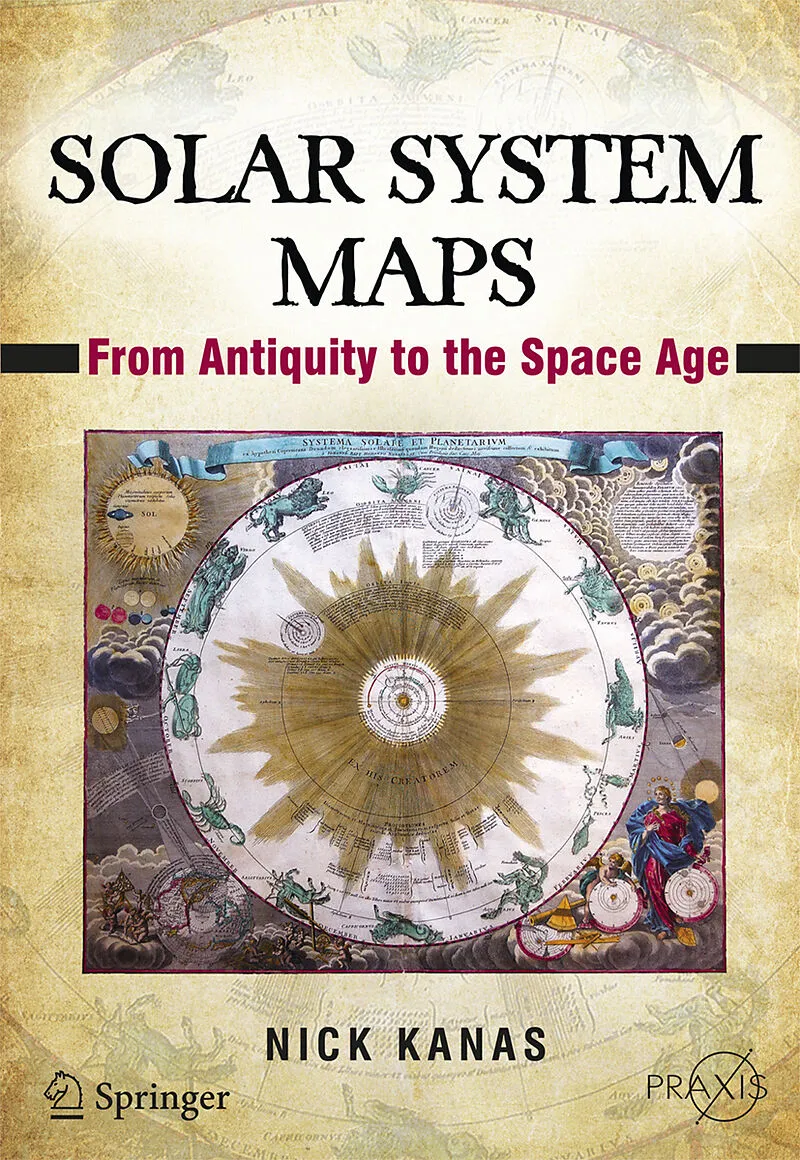
This volume tells the fascinating story of Man's conceptualization of the solar system from the earliest times, when star maps represented what could be seen to the naked eye, to the modern age, when powerful telescopes and probes afford fresh insights. I...This volume tells the fascinating story of Man's conceptualization of the solar system from the earliest times, when star maps represented what could be seen to the naked eye, to the modern age, when powerful telescopes and probes afford fresh insights.
In recent years, there has been increased interest in our Solar System. This has been prompted by the launching of giant orbiting telescopes and space probes, the discovery of new planetary moons and heavenly bodies that orbit the Sun, and the demotion of Pluto as a planet. In one generation, our place in the heavens has been challenged, but this is not unusual. Throughout history, there have been a number of such world views. Initially, Earth was seen as the center of the universe and surrounded by orbiting planets and stars. Then the Sun became the center of the cosmos. Finally, there was no center, just a vast array of galaxies with individual stars, some with their own retinue of planets. This allowed our Solar System to be differentiated from deep-sky objects, but it didn't lose its mystery as more and more remarkable bodies were discovered within its boundaries.
This book tells the exciting story of how we have conceptualized and mapped our Solar System from antiquity to modern times. In addition to the complete text, this story is made more vivid by:
• 162 Solar System and planetary maps, diagrams, and images (over a third in color);
• direct quotes and figures from antiquarian, contemporary, and Space Age documents and photographs that allow the reader to track how humans have viewed the Solar System from original sources;
• nine tables that compare the various world views, relative planetary positions, and components of the Solar System with each other.
Broad in scope and rich in imagery, this book will draw the reader into the story of our Solar System and how it has been mapped since the beginning of recorded time.
Recounts the evolving conceptualization of the solar system from ancient to modern times Provides examples of the artistry of antiquarian celestial maps from books and atlases Includes a large section on solar system mapping in the Space Age, highlighting large telescope and space probe images Presents each illustration with a legend explaining the relevant astronomical and cartographical features Includes supplementary material: sn.pub/extras
Autorentext
Dr. Nick Kanas is an Emeritus Professor of Psychiatry at the University of California, San Francisco, where he directed the group therapy training program and wrote a book entitled Group Therapy for Schizophrenic Patients. For over 20 years, he conducted research in group therapy, and for over 15 years after that he was the Principal Investigator of NASA-funded psychological research on astronauts and cosmonauts. In 1999, Dr. Kanas received the Aerospace Medical Association Raymond F. Longacre Award for Outstanding Accomplishment in the Psychological and Psychiatric Aspects of Aerospace Medicine. In 2008, he received the International Academy of Astronautics Life Science Award. He has over 230 scientific publications.Dr. Kanas is the coauthor of Space Psychology and Psychiatry (now in its 2nd edition), which won the 2004 International Academy of Astronautics Life Science Book Award. In 2015, he authored Humans in Space: The Psychological Hurdles, which won the 2016 International Academy of Astronautics Life Science Book Award. Dr. Kanas has been an amateur astronomer for over 50 years. He has collected antiquarian celestial maps for over 30 years and has given talks on the history of celestial cartography to amateur and professional groups. He is the author of Star Maps: History, Artistry, and Cartography (now in its 2nd edition), and Solar System Maps: From Antiquity to the Space Age. An avid science fiction reader, Dr. Kanas has given talks and participated on panels at numerous World Science Fiction Conventions. He has published articles for Analog Science Fiction and Fact magazine and won the Analog AnLab 2015 readers' poll award for Best Fact Article of the year. He has published three science fiction novels for the Springer Science and Fiction series: The New Martians, The Protos Mandate, and The Caloris Network. Except for his group therapy book, all of his books are published by Springer.
Zusammenfassung
This volume tells the fascinating story of Man's conceptualization of the solar system from the earliest times, when star maps represented what could be seen to the naked eye, to the modern age, when powerful telescopes and probes afford fresh insights.
Inhalt
Introduction.- Ancient Models of the Universe/Solar System from several non-European cultures.- Earth-centered universe/Solar System model of the Classical Greeks through the Roman and Middle Ages.- Sun-centered universe/Solar System models in the pre-telescope era.- Sun-centered universe/Solar System in the early telescope era.- More powerful telescopes and associated advances leading to a separation of our solar system from the wider universe, as nebulae and galaxies were discovered.- How the Solar System has been more accurately perceived in the Space Age.