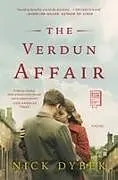
The Verdun Affair
Beschreibung
ldquo;The Verdun Affair is ravishingly beautiful, and as much about love as about war. Nick Dybek is a storyteller of great power. I found myself drawn in immediately, believing the place, the characters, everything in his magnificently woven story. If th...Format auswählen
- Kartonierter EinbandCHF 18.35

Wird oft zusammen gekauft
Andere Kunden kauften auch
Beschreibung
ldquo;The Verdun Affair is ravishingly beautiful, and as much about love as about war. Nick Dybek is a storyteller of great power. I found myself drawn in immediately, believing the place, the characters, everything in his magnificently woven story. If there’s any justice, this novel will be widely read and recognized. I absolutely adored it.”
—Paula McLain, author of The Paris Wife and Circling the Sun
“Sometimes the true battle begins only after the fighting is over. In this case, it’s the struggle to regain feeling, memory, and love in a landscape where verdancy can flourish again over graves and trenches and bones, but not over the craters of a wounded spirit. In the end, only a story can do that, but it must be as rich and poignant and compelling as Nick Dybek’s immersive and atmospheric The Verdun Affair. The meaning in life often goes AWOL, and we look to our great writers—writers like Nick Dybek—to bring it back.”
—Adam Johnson, author of The Orphan Master’s Son and Fortune Smiles
“The Verdun Affair is an intensely gripping story set in the immediate aftermath of war. From a still-smoldering battlefield, Nick Dybek conjures a sweeping saga of secrets, lies, mistaken identity, love and betrayal. This is the kind of book you can’t put down.”
—Claire Vaye Watkins, author of Gold Fame Citrus and Battleborn
“The Verdun Affair is a masterful, sweeping novel of love and war and the way we reconstruct ourselves and our stories after everything has come apart. Nick Dybek is a vivid storyteller, and this is a beautiful and exciting book.”
—Ramona Ausubel, author of Sons and Daughters of Ease and Plenty and No One is Here Except all of Us
“I am still haunted by the images of war so deftly conjured in the midst of an elegiac love story. Dybek writes with a commanding sense of story and language. This novel will not let you go.”
—Helen Simonson, author of Major Pettigrew’s Last Stand and The Summer Before The War
"Love, war, the mysteries of who we are — it's all in The Verdun Affair. A masterful novel that will fizz your brain and enchant your heart."
—David Ebershoff, author of The Danish Girl and The 19th Wife
“A haunting, beautiful, and wholly absorbing book, that is at once a gripping story of war, a poignant coming of age, and a bittersweet romance. Dybek conjures the time period with elegance and visceral detail. I didn’t want it to end!”
—Madeline Miller, author of The Song of Achilles and Circe
Autorentext
Nick Dybek is a recipient of a Granta New Voices selection, a Michener-Copernicus Society of America Award, and a Maytag Fellowship. He received a BA from the University of Michigan and an MFA from The Iowa Writers’ Workshop. He teaches at Oregon State University. He is the author of When Captain Flint Was Still a Good Man and The Verdun Affair.
Klappentext
Across a continent still reeling from World War I, a “ravishingly beautiful” (Paula McClain) story about a love affair between two Americans and the lie that changes everything.
France, 1921—Tom, a young American orphaned in World War I, is helping comfort the grieving families who travel through Verdun, seeking answers about their loved ones. But nothing in his past—not his rough Chicago childhood nor his experiences driving ambulances across French battlefields—can prepare Tom for the arrival of Sarah Hagen.
From the moment he meets her, a disarmingly magnetic woman looking for news of her missing husband, he knows he will help her in any way he can—even if that means crossing an unforgivable line. As their affair takes them across a fractured Europe careening toward World War 2, Tom and Sarah learn how love can be both a cure for—and a distraction from—the realities of a world turned upside down. But they can only hide from the truth for so long.
When news of an amnesiac soldier in Bologna reaches Tom in Paris, he sets off as a journalist to uncover the story, only to find Sarah at the soldier’s bedside, hopeful as ever. Both are surprised to encounter an Austrian journalist named Paul with his own interest in the amnesiac. As they confront the past, Tom’s actions come back to haunt him, and each is forced to make a choice that will change their lives forever.
A deeply transporting novel about love and identity, truth and consequences, The Verdun Affair is a page-turning and vividly imagined “literary romance… [that] unravels a love triangle and its players’ secrets” (Los Angeles Times).
Leseprobe
The Verdun Affair
CHAPTER ONE
Verdun, 1921
On the morning Sarah Hagen was to arrive, I awoke with the feeling of something crawling over me in the dark. A scrape of scale, a scratch of claw. I found Father Perrin in the courtyard, looking as though he hadn’t slept either. He waited for me to wash and finish my bread and coffee, smoking cigarettes as if they offended him. He started the car, and we left for the hills north of the city.
It had taken years, but you could almost call Verdun a city again. In late 1919 the famous candied almond factory reopened, and people began to creep back into the streets. A café opened, then a bakery, then a school. Well, that’s French life for you, Father Perrin said.
By 1921 the roads were clear, the bridges over the river rebuilt, the cathedral stitched with scaffolding. In the evenings the sun reflected red in the new windows. In the hours just after dawn there was a chalky light, as if all the old cordite still hung in the air.
I’d been the aide de l’évêque de Verdun for two years by then. My title sounded sophisticated, but my duties weren’t especially; I helped the priests of the diocese with whatever they needed, and was offered board and a small salary in exchange. Nonetheless, given Verdun’s particular circumstances, it was an important job for which I was hardly qualified. Eventually, I learned to write better in French than I did in English. I often thought in French. I likely would have dreamt in French, but in my dreams no one ever spoke.
On that day we were headed to the Thiaumont Ridge, to the village of Fleury. But there was no Fleury anymore, just as there was no Ornes or Douaumont or Vaux or Cumières—all villages leveled during the battle. The government had declared them officially destroyed. Though it seems that destruction is usually a matter of admission rather than fact, it probably was too dangerous to rebuild. Between February and December of 1916, a thousand explosive shells had fallen on every square meter of ground—ground that had been farmland and forest, then battlefield, then something new, known only as zone rouge.
We crossed the snaking Meuse on a new bridge, the water below sleepy and dark—a few ripples, a few branches nodding just under the surface. The road wove up through the hills. The mud remained in some places, but grass had returned in others, a bright, almost hallucinatory green. The earth has never seen anything like this, Father Perrin had said. We’ve confused it.
I couldn’t disagree. Much would be said about the battle’s brutality, its exhausting length and strategic peculiarity. But at the time it was waged, it often wasn’t referred to as a battle at all. Will the Verdun affair ever end? the newspapers asked, using the preferred euphemism for catastrophe and scandal. Will the French ever recover from the Verdun affair, even if they…