
IHR WARENKORB IST AKTUELL LEER.
Haben Sie noch nichts passendes gefunden? Stöbern Sie durch unser komplettes Sortiment.
Oder melden Sie sich an bzw. registrieren Sie sich.
- Kostenlose Lieferung
- Kauf auf Rechnung
- Ex Libris Tiefpreis
- Filiallieferung und 650+ Abholorte
- Rabatt-Bons als Club-Mitglied
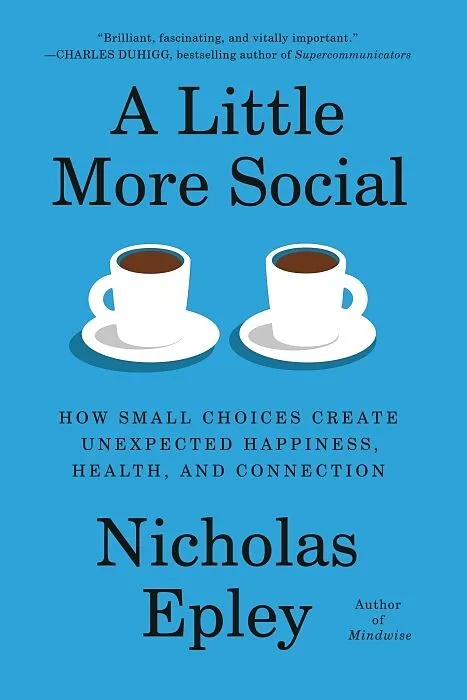
A Little More Social
Beschreibung
A life-changing message for our lonely age about why we often avoid what makes us happiest—connecting with other people—and how we can build wiser social habits through small and simple acts, from leading behavioral scientist and author of ...Format auswählen
- Fester EinbandCHF 24.30

Wird oft zusammen gekauft
Andere Kunden kauften auch
Beschreibung
A life-changing message for our lonely age about why we often avoid what makes us happiest—connecting with other people—and how we can build wiser social habits through small and simple acts, from leading behavioral scientist and author of <Mindwise<.
“<A Little More Social <explores the power and promise of the human connections that most of us never make—but could make so easily if we just opened our eyes. This is the eye-opener. Insightful, engaging, scientifically grounded and beautifully written, <A Little More Social <is one of those rare books that might actually change your life.” —Daniel Gilbert, <New York Times <bestselling author of <Stumbling on Happiness<
There is a fundamental paradox at the core of human life. We are a highly social species uniquely equipped to connect with other people—and doing so makes us happier and healthier. And yet, we so often choose to be <unsocial<. We avoid talking to the stranger who sits next to us. We can’t seem to get beyond small talk with an acquaintance. We feel grateful to those we love but are reluctant to express our gratitude. We are constantly presented with opportunities to make a connection—with our fellow commuters, our baristas, our colleagues, our families—yet we don’t take them. Even in a time when loneliness and isolation have reached epidemic proportions, we forfeit these little moments, not realizing how they can add up to a happier, healthier you.
In <A Little More Social<, renowned University of Chicago psychologist Nicholas Epley breaks down that split-second decision we face countless times a day: do we choose to reach out and connect with someone or hold back and avoid them? The science is resoundingly clear:
<lOur happiness, health, and self-esteem are boosted by social behavior—whether we are introverts or extroverts.</l<lOur pessimism about reaching out creates a self-fulfilling prophecy: the less we try, the more likely we are to think we’ll fail.</l<lOur social interactions are almost always better than we expect them to be.</l<lSocial media and texting do not foster strong connections in the way meeting face-to-face or talking on the phone do.</l<lWhile there are many books promising one big fix, lots of small moments of sociality are more likely to improve your life than anything else.</l
Drawing on decades of research, his own life, and stories of people who have transformed their thinking and their social lives, Epley reveals the psychological mechanisms behind our hesitancy to reach out and empowers readers to put science into practice and build wiser social habits. <A Little More Social< shows us that changing our thinking about how we approach others can change our lives....
Autorentext
NICHOLAS EPLEY is the John Templeton Keller Professor of Behavioral Science and faculty director of the Roman Family Center for Decision Research at the University of Chicago Booth School of Business. He is the author of Mindwise: Why We Misunderstand What Others Think, Believe, Feel, and Want. He lives with his family in Chicago.
Klappentext
**We know that social connection enriches our lives—so why do we hesitate to connect?
“One of those rare books that might actually change your life.” —Daniel Gilbert, New York Times bestselling author of Stumbling on Happiness**
There is a paradox at the core of human life. We are a highly social species uniquely equipped to connect with other people and doing so is better for us. Yet we so often choose to be unsocial. We avoid talking to the stranger who sits next to us. We struggle to move beyond small talk with an acquaintance. We are reluctant to express our gratitude to people we appreciate. Every day, we avoid opportunities to connect with strangers, neighbors, colleagues, friends, and family. By missing those moments, we miss out on all the benefits of a more social life—one that is happier and healthier for everyone.
University of Chicago psychologist and author of Mindwise, Nicholas Epley has spent his career studying the way we connect, and he has found that our social fears often keep us from reaching out. But Epley shows us how to seize the small moments with insights such as:
- Social connection is a choice we make based on expectations about how others will respond to us—expectations that tend to be overly pessimistic.
- Introverts and extroverts alike benefit from choosing to be a little more social.
- Mistaken expectations can cause us to avoid interacting in ways that create strong connections—such as having a conversation—in favor of less satisfying interactions—such as social media or texting.
- While many books promise one big fix, making a habit of small connections is much more likely to improve your life.
- The habits and practices that Epley advocates are approachable. The beauty of this book is that small acts have an outsized impact on the most important parts of our lives.
Bridging the gap between two people is easier than we think, and success more likely, if we choose to be a little more social.
Leseprobe
1
Homo Socialis
No enjoyment equals the satisfaction we receive from the company of those we love and esteem; as the greatest of all punishments is to be oblig’d to pass our lives with those we hate or contemn.
—David Hume, A Treatise of Human Nature
In February 2022, a life-threatening storm sent police in Prestino, Italy, to check on Marinella Beretta’s “small home in the midst of myriad other houses.” Marinella was home, but the police were too late. Her withered skeleton was sitting at the kitchen table. Some other risk had taken her life more than two years earlier.
Marinella died not only completely alone but also completely unnoticed since her neighbors last reported seeing her in September 2019. No family had come or called to check on her. No friends emailed to find out why she didn’t show up for some event or another. Marinella had lived so independently that nobody noticed her absence anywhere, in any capacity, for more than two years. “The mystery of Marinella’s invisible life behind the closed gate of her cottage teaches us a terrible lesson,” reported the Italian newspaper Il messaggero. “The true sadness isn’t that others didn’t notice her death. It’s that they didn’t realize that Marinella Beretta was alive.”
It’s hard to imagine that someone could die so completely alone in today’s world, but it’s nearly impossible to imagine it happening at almost any previous point in human history. Daily life for our ancestors was, by necessity, deeply social. People lived most moments of their entire lives surrounded by family and neighbors, whether they wanted to or not. Simply staying alive required routine interaction, bound together not by impersonal exchanges of money but by the social threads of reciprocity. You scratch my back and I’ll scratch yours; an eye for an eye, a tooth for a tooth. Life wasn’t easy, but you didn’t die unnoticed at your kitchen table.
Times have changed. Thanks to countless technological advances, we are now more independent, and spending more time by ourselves, than ever before. The number of people living alone in the United States, for instance, has more than tripled over the last century, from 7.7 percent in 1940 to 27.7 percent in 2020. In many parts of the world, you could wake up alone in your home on any given day, eat breakfast bought online and delivered touch-free to your doorstep, entertain yourself by surfing the internet or watching television, go wherever you want in your car or on public transportation…