
IHR WARENKORB IST AKTUELL LEER.
Haben Sie noch nichts passendes gefunden? Stöbern Sie durch unser komplettes Sortiment.
Oder melden Sie sich an bzw. registrieren Sie sich.
- Kostenlose Lieferung
- Kauf auf Rechnung
- Ex Libris Tiefpreis
- Filiallieferung und 650+ Abholorte
- Rabatt-Bons als Club-Mitglied
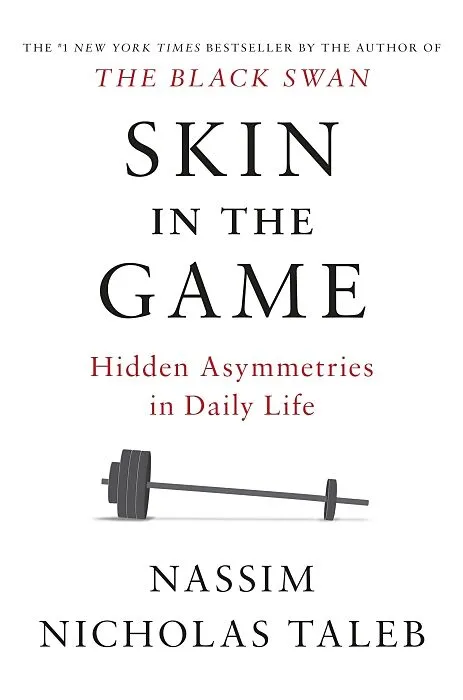
Skin in the Game
Beschreibung
#1 NEW YORK TIMES BESTSELLER • A bold work from the author of The Black Swan that challenges many of our long-held beliefs about risk and reward, politics and religion, finance and personal responsibility In his most provocative and practical book yet, on...Format auswählen
- Fester EinbandCHF 38.80
- Kartonierter EinbandCHF 13.80

Wird oft zusammen gekauft
Andere Kunden kauften auch
Beschreibung
#1 NEW YORK TIMES BESTSELLER • A bold work from the author of The Black Swan that challenges many of our long-held beliefs about risk and reward, politics and religion, finance and personal responsibility In his most provocative and practical book yet, one of the foremost thinkers of our time redefines what it means to understand the world, succeed in a profession, contribute to a fair and just society, detect nonsense, and influence others. Citing examples ranging from Hammurabi to Seneca, Antaeus the Giant to Donald Trump, Nassim Nicholas Taleb shows how the willingness to accept one’s own risks is an essential attribute of heroes, saints, and flourishing people in all walks of life. As always both accessible and iconoclastic, Taleb challenges long-held beliefs about the values of those who spearhead military interventions, make financial investments, and propagate religious faiths. Among his insights: • For social justice, focus on symmetry and risk sharing. You cannot make profits and transfer the risks to others, as bankers and large corporations do. You cannot get rich without owning your own risk and paying for your own losses. Forcing skin in the game corrects this asymmetry better than thousands of laws and regulations. • Ethical rules aren’t universal. You’re part of a group larger than you, but it’s still smaller than humanity in general. • Minorities, not majorities, run the world. The world is not run by consensus but by stubborn minorities imposing their tastes and ethics on others. • You can be an intellectual yet still be an idiot. “Educated philistines” have been wrong on everything from Stalinism to Iraq to low-carb diets. • Beware of complicated solutions (that someone was paid to find). A simple barbell can build muscle better than expensive new machines. • True religion is commitment, not just faith. How much you believe in something is manifested only by what you’re willing to risk for it. The phrase “skin in the game” is one we have often heard but rarely stopped to truly dissect. It is the backbone of risk management, but it’s also an astonishingly rich worldview that, as Taleb shows in this book, applies to all aspects of our lives. As Taleb says, “The symmetry of skin in the game is a simple rule that’s necessary for fairness and justice, and the ultimate BS-buster,” and “Never trust anyone who doesn’t have skin in the game. Without it, fools and crooks will benefit, and their mistakes will never come back to haunt them.”...
Praise for Nassim Nicholas Taleb
“The problem with Taleb is not that he’s an asshole. He is an asshole. The problem with Taleb is that he is right.”—Dan from Prague, Czech Republic (Twitter)
“The most prophetic voice of all . . . [Taleb is] a genuinely significant philosopher . . . someone who is able to change the way we view the structure of the world through the strength, originality and veracity of his ideas alone.”—John Gray, GQ
“Taleb grabs on to core problems that others ignore, or don’t see, and shakes them like an attack dog on a leg.”—Greg from New York (Twitter)**
“For my wife and me, Antifragile is an annual reread.”—Colle from Richmond, Virginia (Twitter)
“I read Antifragile four times. First, to get the wisdom to survive. Second, as a memorial statement for Fat Tony. Third, as Das Kapital with correct mathematics. Fourth, as ethics to learn a good way to die.”—Tamitake from Tokyo, Japan (Twitter)
“November . . . time for my annual reread of Antifragile.”—Johann from Vienna, Austria (Twitter)
“[Taleb writes] in a style that owes as much to Stephen Colbert as it does to Michel de Montaigne.”—The Wall Street Journal
Autorentext
Nassim Nicholas Taleb
Zusammenfassung
*#1 NEW YORK TIMES BESTSELLER • A bold work from the *author of The Black Swan that challenges many of our long-held beliefs about risk and reward, politics and religion, finance and personal responsibility
In his most provocative and practical book yet, ****one of the foremost thinkers of our time redefines what it means to understand the world, succeed in a profession, contribute to a fair and just society, detect nonsense, and influence others. Citing examples ranging from Hammurabi to Seneca, Antaeus the Giant to Donald Trump, Nassim Nicholas Taleb shows how the willingness to accept one’s own risks is an essential attribute of heroes, saints, and flourishing people in all walks of life.
As always both accessible and iconoclastic, Taleb challenges long-held beliefs about the values of those who spearhead military interventions, make financial investments, and propagate religious faiths. Among his insights:
• For social justice, focus on symmetry and risk sharing. You cannot make profits and transfer the risks to others, as bankers and large corporations do. You cannot get rich without owning your own risk and paying for your own losses. Forcing skin in the game corrects this asymmetry better than thousands of laws and regulations.
• Ethical rules aren’t universal. You’re part of a group larger than you, but it’s still smaller than humanity in general.
• Minorities, not majorities, run the world. The world is not run by consensus but by stubborn minorities imposing their tastes and ethics on others.
• You can be an intellectual yet still be an idiot. “Educated philistines” have been wrong on everything from Stalinism to Iraq to low-carb diets.
• Beware of complicated solutions (that someone was paid to find). A simple barbell can build muscle better than expensive new machines.
• True religion is commitment, not just faith. How much you believe in something is manifested only by what you’re willing to risk for it.
The phrase “skin in the game” is one we have often heard but rarely stopped to truly dissect. It is the backbone of risk management, but it’s also an astonishingly rich worldview that, as Taleb shows in this book, applies to all aspects of our lives. As Taleb says, “The symmetry of skin in the game is a simple rule that’s necessary for fairness and justice, and the ultimate BS-buster,” and “Never trust anyone who doesn’t have skin in the game. Without it, fools and crooks will benefit, and their mistakes will never come back to haunt them.”
Leseprobe
Chapter 1
Why Each One Should Eat His Own Turtles: Equality in Uncertainty
Taste of turtle—Where are the new customers?—Sharia and asymmetry—There are the Swiss, and other people—Rav Safra and the Swiss (but different Swiss)
You who caught the turtles better eat them, goes the ancient adage.
The origin of the expression is as follows. It was said that a group of fishermen caught a large number of turtles. After cooking them, they found out at the communal meal that these sea animals were much less edible than they thought: not many members of the group were willing to eat them. But Mercury happened to be passing by—Mercury was the most multitasking, sort of put-together god, as he was the boss of commerce, abundance, messengers, the underworld, as well as the patron of thieves and brigands and, not surprisingly, luck. The group invited him to join them and offered him the turtles to eat. Detecting that he was only invited to relieve them of the unwanted food, he forced them all to eat the turtles, thus establishing the principle that you need to eat what …