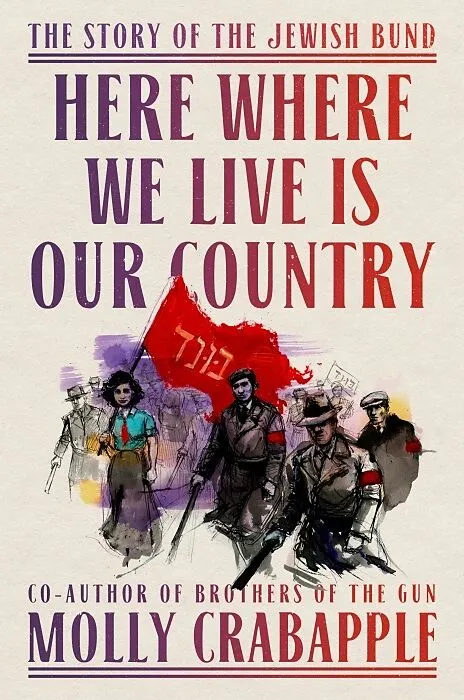
Here Where We Live Is Our Country
Beschreibung
An award-winning writer and illustrator follows the story of her grandfather’s involvement in a freewheeling group of Jewish revolutionaries to question whether the world was ready for their vision of multiracial solidarity--and whether we are today. Mol...Format auswählen
- Fester EinbandCHF 31.60

Wird oft zusammen gekauft
Andere Kunden kauften auch
Beschreibung
An award-winning writer and illustrator follows the story of her grandfather’s involvement in a freewheeling group of Jewish revolutionaries to question whether the world was ready for their vision of multiracial solidarity--and whether we are today. Molly Crabapple first discovered the story of the Jewish Bund when her mother showed her a trove of her grandfather''s old paintings and letters. Sam Rothman was a rough-and-tumble kid who worked at a tannery deep in the Pale of Settlement in 19th century Russia. He discovered that he was an artist--a brilliant interpreter of life in his Jewish village--and soon after that he was a revolutionary, enlisted in the strikes, street fights, and study groups of the Jewish Bund.; Molly saw herself not just in his career but in his revolutionary inclinations--Molly spent much of her life in revolutionary enclaves around the world, marching in the streets and dancing till morning. In the Bund, she discovered a movement of artists, philosophers, working people, and street fighters who had a utopian vision for the world. As Jews--a people always on the margins--they understood themselves as a people who needed special protection. But as Marxist revolutionaries, they also saw themselves as part of an international solidarity that rejected all forms of ethnonationalism. They fought for this vision in the parlors, cafes, battlefields and prison camps. Their ideas sparked the Russian Revolution, which soon swept them aside. They fought with the emerging nationalist movements sweeping Europe. And they battled Zionists over the destiny of the Jewish people, believing that Jews could never find peace by becoming colonizers themselves. Their last stand was against the Nazis--they led the largest Jewish resistance movement, culminating in the Warsaw Ghetto Uprising, a dramatic and tragic climax to their story.; In retelling the history of the Bund and its extraordinary cast of characters during one of the most politically and culturally vibrant moments in European history, Molly is also exploring her own revolutionary life. Her narration is tinged with an almost desperate need to understand whether the Bund failed because their idea was unworkable--or if the world failed the Bund, whose movement could''ve saved us from the violence of Russian Communism, Nazism, and Zionism. This dynamic, tragic story, is driven by that urgent question--and offers a new lens through which to see our contemporary struggles for solidarity in the face of tribalism....
Autorentext
Molly Crabapple is an artist and writer based in New York. She is the author of two books, Drawing Blood and Brothers of the Gun (with Marwan Hisham), which was long-listed for a National Book Award. Her reportage is the winner of the Bernhard Labor Journalism Award, and has been published in The New York Times, New York Review of Books, The Paris Review, Vanity Fair, The Guardian, Rolling Stone, The New Yorker and elsewhere. Her animations have won two Emmys and an Edward R. Murrow Award. Her art is in the permanent collections of the Museum of Modern Art.
Klappentext
The dramatic story of the Jewish Bund—a revolutionary movement from a vanished world—and its radical vision of solidarity in an age of division.
“Molly Crabapple beckons readers through a portal to an irresistible, lost world, one bound together by passion, solidarity, and a burning hunger for justice.”—Naomi Klein, New York Times bestselling author of No Logo and Doppelganger
In the aftermath of the Holocaust, Sam Rothbort created “memory paintings” with the hope of resurrecting the vanished world of his shtetl childhood. Decades later, his great-granddaughter, the award-winning artist Molly Crabapple, discovered these paintings and one stood out: a girl, her dress the color of sky, hurling a rock through a cottage window. Itka the Bundist, Breaking Windows.
Itka is how Crabapple met the Jewish Labor Bund. Once the most influential Jewish political force in eastern Europe, the Bund was secular, socialist, and uncompromisingly anti-Zionist. The Bundists fought for dignity and equality, not in an imagined homeland in Palestine but “here where we live.”
In the first popular history of the Bund, Crabapple re-creates their extraordinary world through dramatic portraits of insurgent poets and antireligious rebels, clandestine revolutionaries and lovers on the barricades. The Bundists live deeply within this violent, volatile, and somehow hopeful period, as their stories interweave with the Russian Revolution and the Holocaust. The Bund’s rise and fall raises the vital question: What can we learn from a movement that, for all its toughness, imagination, and moral clarity, was largely destroyed?
Here Where We Live Is Our Country reanimates a band of idealists who broadened our global political imagination. As we once again contend with nationalism, repression, and the struggle for belonging, the Bund’s remarkable story and message—that liberation, dignity, and solidarity must begin where we stand—reaches across time as a guide to our own urgent moment.