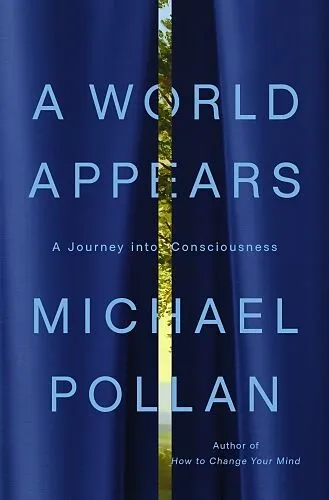
A World Appears
Beschreibung
From the #1 When it comes to the phenomenon that is consciousness, there is one point on which scientists, philosophers, and artists all agree: that it feels When neuroscientists began studying consciousness in the early 1990s, they sought to explain how and w...Format auswählen
- Fester EinbandCHF 26.80
- BroschiertCHF 29.10

Wird oft zusammen gekauft
Andere Kunden kauften auch
Beschreibung
From the #1 When it comes to the phenomenon that is consciousness, there is one point on which scientists, philosophers, and artists all agree: that it feels When neuroscientists began studying consciousness in the early 1990s, they sought to explain how and why three pounds of spongy grey matter could generate a subjective point of view--assuming that the brain is the source of our felt reality. Pollan takes us to the cutting edge of the field, where scientists are entertaining more radical (and less materialist) theories of consciousness. He introduces us to “plant neurobiologists” searching for the first flicker of consciousness in plants; scientists striving to engineer feelings into AI, and psychologists and novelists seeking to capture the felt experience of our slippery stream of consciousness. In Pollan’s dazzling exploration of consciousness, he discovers a world far deeper and stranger than our everyday reality. Eye-opening and mind-expanding, <A World Appears< takes us into the laboratories of our own minds, ultimately showing us how we might make better use of the gift of awareness to more meaningfully connect with our deepest selves....
Autorentext
Michael Pollan is the author of ten books, including This Is Your Mind on Plants, How to Change Your Mind, Cooked, Food Rules, In Defense of Food, The Omnivore’s Dilemma, and The Botany of Desire, all of which were New York Times bestsellers. He is also the author of the audiobook Caffeine. A Guggenheim and Radcliffe Fellow, Pollan has taught writing at the University of California, Berkeley, and at Harvard University. In 2010, Time named him one of the one hundred most influential people in the world.
Klappentext
**The Instant New York Times Bestseller
"Pollan’s real genius—the word is not too strong—remains intact. That is his uncanny ability to scent the direction in which the culture is headed. He did it with food and psychedelics, and now, though A World Appears focuses on AI only intermittently, he has done it again." —Charles Finch, The Atlantic
From the #1 New York Times bestselling author of How to Change Your Mind, a panoptic exploration of consciousness—what it is, who has it, and why—and a meditation on the essence of our humanity**
When it comes to the phenomenon that is consciousness, there is one point on which scientists, philosophers, and artists all agree: it feels like something to be us. Yet the fact that we have subjective experience of the world remains one of nature’s greatest mysteries. How is it that our mental operations are accompanied by feelings, thoughts, and a sense of self? What would a scientific investigation of our inner life look like, when we have as little distance and perspective on it as fish do of the sea? In A World Appears, Michael Pollan traces the unmapped continent that is consciousness, bringing radically different perspectives—scientific, philosophical, literary, spiritual and psychedelic—to see what each can teach us about this central fact of life.
When neuroscientists began studying consciousness in the early 1990s, they sought to explain how and why three pounds of spongy gray matter could generate a subjective point of view—assuming that the brain is the source of our perceived reality. Pollan takes us to the cutting edge of the field, where scientists are entertaining more radical (and less materialist) theories of consciousness. He introduces us to “plant neurobiologists” searching for the first flicker of consciousness in plants, scientists striving to engineer feelings into AI, and psychologists and novelists seeking to capture the felt experience of our slippery stream of consciousness.
In Pollan’s dazzling exploration of consciousness, he discovers a world far deeper and stranger than our everyday reality. Eye-opening and mind-expanding, A World Appears takes us into the laboratories of our own minds, ultimately showing us how we might make better use of the gift of awareness to more meaningfully connect with the world and our deepest selves.
Zusammenfassung
**"Pollan’s real genius—the word is not too strong—remains intact. That is his uncanny ability to scent the direction in which the culture is headed. He did it with food and psychedelics, and now, though A World Appears focuses on AI only intermittently, he has done it again." —Charles Finch, The Atlantic
From the #1 New York Times bestselling author of How to Change Your Mind, a panoptic exploration of consciousness—what it is, who has it, and why—and a meditation on the essence of our humanity**
When it comes to the phenomenon that is consciousness, there is one point on which scientists, philosophers, and artists all agree: it feels like something to be us. Yet the fact that we have subjective experience of the world remains one of nature’s greatest mysteries. How is it that our mental operations are accompanied by feelings, thoughts, and a sense of self? What would a scientific investigation of our inner life look like, when we have as little distance and perspective on it as fish do of the sea? In A World Appears, Michael Pollan traces the unmapped continent that is consciousness, bringing radically different perspectives—scientific, philosophical, literary, spiritual and psychedelic—to see what each can teach us about this central fact of life.
When neuroscientists began studying consciousness in the early 1990s, they sought to explain how and why three pounds of spongy gray matter could generate a subjective point of view—assuming that the brain is the source of our perceived reality. Pollan takes us to the cutting edge of the field, where scientists are entertaining more radical (and less materialist) theories of consciousness. He introduces us to “plant neurobiologists” searching for the first flicker of consciousness in plants, scientists striving to engineer feelings into AI, and psychologists and novelists seeking to capture the felt experience of our slippery stream of consciousness.
In Pollan’s dazzling exploration of consciousness, he discovers a world far deeper and stranger than our everyday reality. Eye-opening and mind-expanding, A World Appears takes us into the laboratories of our own minds, ultimately showing us how we might make better use of the gift of awareness to more meaningfully connect with the world and our deepest selves.
Leseprobe
Introduction
The Wager
In 1998, at a time when the modern science of consciousness was not even a decade old, two of its leading lights made a bet at a bar in Bremen late one night. Christof Koch was an intense young German American neuroscientist who had been in hot pursuit of the “neural correlates” of consciousness since the late 1980s. That’s when he, as a twenty‑eight‑year‑old postdoc at MIT, had teamed up with Francis Crick, one of the most revered scientists in the world. It was Crick who had, along with his colleagues, discovered the double‑ helical structure of DNA, solving one of the deepest puzzles of biology: how traits get passed down from one generation to the next. The discovery earned Crick and his colleagues a Nobel Prize in 1962 and gave him the confidence to believe that consciousness, perhaps the greatest mystery in science, would yield to the power of the same reductive approach that had cracked the code of life. In Koch, Crick had found a brilliant and energetic collaborator. Born in the Midwest to German parents in 1956, Koch had a PhD in what is now called computational neuroscience from Germany’s Max Planck Institute for Biological Cybernetics and would soon join the faculty at Caltech.
With Koch at …