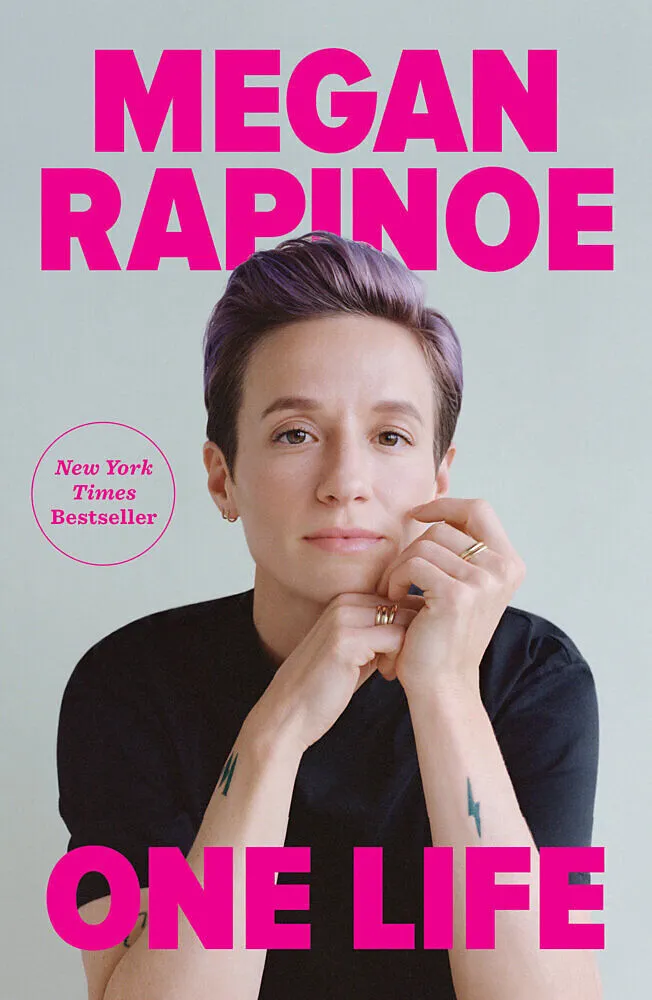
One Life
Beschreibung
An instant New York Times bestseller! Rapinoe's 'signature pose' from the 2019 FIFA Women's World Cup is synonymous to the feeling we got when finishing this book: heart full, arms wide and ready to take up space in this world. USA Today Me...Format auswählen
- Kartonierter Einband (Kt)CHF 17.55
- Kartonierter EinbandCHF 31.90
- Fester EinbandCHF 27.00

Wird oft zusammen gekauft
Andere Kunden kauften auch
Beschreibung
**An instant New York Times bestseller!
Rapinoe's 'signature pose' from the 2019 FIFA Women's World Cup is synonymous to the feeling we got when finishing this book: heart full, arms wide and ready to take up space in this world. USA Today**
Megan Rapinoe, Olympic gold medalist and two-time Women's World Cup champion, reveals for the first time her life both on and off the field. Guided by her personal journey into social justice, brimming with humor, humanity, and joy, she urges all of us to ask ourselves, What will you do with your one life?
Only four years old when she kicked her first soccer ball, Megan Rapinoe developed a love and clear talent for the game at a young age. But it was her parents who taught her that winning was much less important than how she lived her life. From childhood on, Rapinoe always did what she could to stand up for what was right even if it meant going up against people who disagreed.
In One Life, Megan Rapinoe invites readers on a remarkable journey, looking back on both her victories and her failures, and pulls back the curtain on events we know only from the headlines. After the 2011 World Cup, discouraged by how few athletes were open about their sexuality, Rapinoe decided to come out publicly as gay and use her platform to advocate for marriage equality. Recognizing the power she had to bring attention to critical issues, in 2016 she took a knee during the national anthem in solidarity with former NFL player Colin Kaepernick to protest racial injustice and police brutality the first high-profile white athlete to do so. The backlash was immediate, but it couldn t compare to the overwhelming support. Rapinoe became a force of change.
Here for the first time, Rapinoe reflects upon some of the most pivotal moments in her life and career from her realization in college that she was gay, through the disputes with soccer coaches and officials over her decision to kneel, to the first time she met her now-fiancé WNBA champion Sue Bird, and up through suing the US Soccer Federation over gender discrimination and equal pay. Throughout, Rapinoe makes clear the obligation we all have to speak up, and the impact each of us can have on our communities. Deeply personal and inspiring, One Life reveals that real, concrete change lies within all of us, and asks: If we all have the same resource this one precious life, made up of the decisions we make every day what are you going to do?
"One Life makes it clear that Rapinoe s greatest accomplishments may ultimately come away from the soccer pitch. She s a new kind of American hero." San Francisco Chronicle
Autorentext
Megan Rapinoe is an American professional soccer player. As a member of the US Women's national soccer team, she helped win the 2015 and 2019 FIFA Women's World Cup tournaments and a gold medal at the 2012 London Olympics. A co-captain of the team since 2018, she was named the Best FIFA Women's Player in 2019, and was awarded the Golden Boot.
Klappentext
Megan Rapinoe, Olympic gold medalist and two-time Women's World Cup champion, has become a galvanizing force for social change; here, she urges all of us to take up the mantle, with actions big and small, to continue the fight for justice and equality
Raised in a conservative small town in Northern California, the youngest of six, Megan Rapinoe was four years old when she kicked her first soccer ball. Her parents encouraged her love for the game, but taught her that winning was much less important than how she lived her life. From childhood on, Rapinoe always did what she could to stand up for what was right-even if it meant going up against people who disagreed.
In One Life, Rapinoe reflects on the choices she has made, her victories and her failures, and embarks on a thoughtful and candid discussion of her personal journey into social justice. Recognizing the power she had to bring attention to critical issues, in 2016 she took a knee during the national anthem in solidarity with former NFL player Colin Kaepernick to protest racial injustice and police brutality-the first high-profile white athlete to do so. The backlash was immediate, but it couldn't compare to the overwhelming support. Rapinoe becaame a force of change, both on and off the field.
Deeply personal and inspiring, One Life reveals that real, concrete change lies within all of us, and asks: If we all have the same resource-this one precious life, made up of the decisions we make every day-what are you going to do?
Leseprobe
STAND UP
I was on the team bus driving through the suburbs of Chicago when I picked up a call from my agent. It was September 2016, and my team, FC Seattle Reign, had just played the Chicago Red Stars in one of the last games of the season. That wasn t why my agent was calling. Dan Levy had represented me for almost ten years and we d been through a few things together. Five years earlier, he d been a big part of the discussion around my decision to come out as the first, and for a long time practically the only, gay player on the US Women s National Team which is hilarious given the number of gays on the team and he d seen me through injuries and disappointments without losing his cool. Now he sounded concerned. This is blowing up, he said. The actual game that night had been nothing special. Chicago, like New York and Los Angeles, isn t a soccer town, for reasons no one can quite put their finger on. You might get people out for a national team game, but no way are they turning up on a random Sunday night in September for a league match. We d played to a small crowd of three thousand people and the score had been a lackluster 2 2. But at the press conference afterward, the first question out of the gate had little to do with the game itself: Had I intended to kneel during the national anthem, and if so, why?
I had anticipated being asked this question, of course. The decision to kneel wasn t one I d made lightly. At the same time, I hadn t given much thought to how it might be received. In trivial contexts, I can be impulsive the kind of person who dyes their hair pink the night before a huge tournament, for example but it wasn t that. If I didn t rehearse outcomes before kneeling, it s because kneeling, to me, felt more like an imperative than a choice. Any risk assessment I did wasn t premised on how my actions might land, but on calculating the risk huge, societal, unignorable, in my view of doing nothing.
Still, I wasn t expecting much of a backlash. Compared to football or baseball, soccer has a relatively low profile in this country, particularly at the league level. The nine teams in the National Women s Soccer League are very competitive, but they don t exactly dominate the sports pages. In the fall of 2016, even the national team one of the most successful sports teams of all time wasn t riding especially high. A month earlier, we d been eliminated from of the Rio Olympics in the quarterfinals, our worst result in an international tournament for years. I was personally off form, in the final stages of recovering from a knee injury. And the soccer season was about to end. I was also a woman athlete. At thirty-one, I was a veteran of two World Cups and two Olympic Games, with a history of mouthing off at least as long as my playing record. Still, it seemed fair to assume that when it came to talking about politics, my voice would carry less weight than a man s. Earlier that year, when members of three WNBA basketball teams had worn T-shirts emblazoned with black lives matter, it had triggered a flurry of interest before dying down. By contrast, when Colin Kaepernick, quarterback for the 49ers, had knelt before a game in San Diego a week earlier, the response had been swift and engulfing.
I had seen the footage of Colin kneeling. It was im…