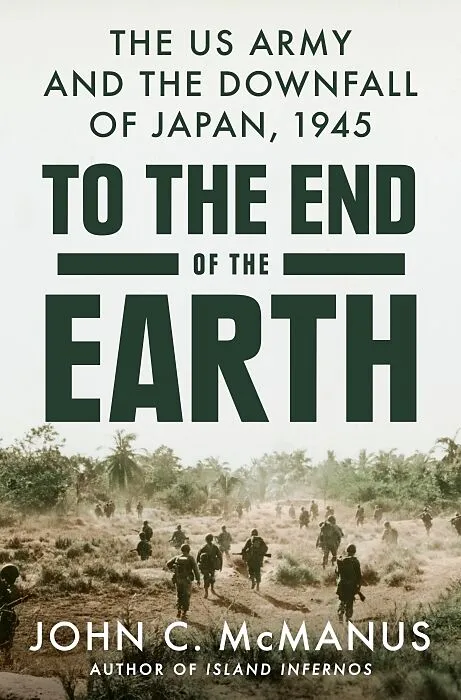
To the End of the Earth
Beschreibung
Informationen zum Autor John C. McManus , PhD, is Curators' Distinguished Professor of US military history at Missouri University of Science and Technology and a leading historian of World War II. His critically acclaimed books include September Hope , The Dea...Format auswählen
- Fester EinbandCHF 50.80

Wird oft zusammen gekauft
Andere Kunden kauften auch
Beschreibung
Informationen zum Autor John C. McManus , PhD, is Curators' Distinguished Professor of US military history at Missouri University of Science and Technology and a leading historian of World War II. His critically acclaimed books include September Hope , The Dead and Those About to Die , Island Infernos , and Fire and Fortitude , recipient of the Gilder Lehrman Prize for Military History. Klappentext "From the liberation of the Philippines to the Japanese surrender, the final volume of John C. McManus's trilogy on the US Army in the Pacific War"-- Leseprobe 1 Crusade Like a faithful steed, USS Boise plunged through the deep blue waters of the South China Sea, the ship's prow knifing gracefully through the relentless waves, bound for Luzon. Below deck, inside a snug, well-appointed private cabin, General Douglas MacArthur sat at a desk, pen in hand, preparing to write a letter to his wife on January 8, 1945, the eve of the largest invasion to date in the war against Japan. At once a magisterial and vexing figure, MacArthur oozed a sense of captivating uniqueness. He was the only US Army field commander who had once served at the very top of the Army as chief of staff. Only he among all the Army ground generals in the Pacific had been decorated with the Medal of Honor, a distinction he shared with his late father, Lieutenant General Arthur MacArthur, who had four decades earlier led American military forces in the Philippines. During World War II, Douglas MacArthur had experienced, by far, more frontline combat than any other American general of four-star rank, only adding to a record of valor that he had already carved out as a younger officer in the First World War. In 1929, he had endured a difficult, stormy divorce from his first wife, Louise Cromwell, putting the lie to Army conventional wisdom that a failed marriage for an officer would inevitably lead to a failed career. Eight years later, he married Jean Faircloth, daughter of a Nashville banker and his true soul mate, who bore him a son named Arthur the next year. Astonishingly, MacArthur subsequently chose-in direct defiance of a War Department order to evacuate military families-to keep them with him in 1941-42, when he led the ill-fated Allied defense of the Philippines. He thus became the only high-level American commander to expose his family to combat in World War II. With unrepentant independence, he continued to live with his family throughout much of the war, seemingly indifferent to the fact that his many thousands of subordinates enjoyed no such option. In yet another characteristic action that revealed much about his broke-the-mold distinctiveness, he had willfully crossed the red line that sensibly separates the civil and the military in the American system by running an unsuccessful clandestine campaign to win the presidency in 1944. Complex to the point of near convolution, an intimate aide once said of the general, "None of us knew MacArthur. We all saw fragments of the man." Over three long years of war, he had carved out a record as a thoughtful military strategist, an innovator with a strong grasp of the potency of airpower and sea power, and an inspirational figure whose keen understanding of image approached the savant level. But far too often, he had also revealed himself to be a petty, paranoid, insecure, vainglorious, egomaniacal schemer who seemingly viewed Washington policy makers as adversaries on par with the Japanese. An ardent opponent of the Allies' Europe First policy, he believed with an almost evangelical fervor that America's geopolitical future lay in Asia and the Pacific. His greatest objective-perhaps as much as or more than defeating Japan-was to liberate the Philippines. His invasion of Leyte a couple months earlier had served only as a warm-up act for what he envisioned as an archipelago-wide liberation, most notably of Luzo...
Autorentext
John C. McManus, PhD, is Curators’ Distinguished Professor of US military history at Missouri University of Science and Technology and a leading historian of World War II. His critically acclaimed books include September Hope, The Dead and Those About to Die, Island Infernos, **and Fire and Fortitude, recipient of the Gilder Lehrman Prize for Military History.
Klappentext
From the liberation of the Philippines to the Japanese surrender, the final volume of John C. McManus's trilogy on the US Army in the Pacific War
“Brilliant [and] riveting… a truly great book.”—Gen. David Petraeus • “Triumphant [and] compelling.”—Richard Frank • “McManus is one of the best—if not the best—World War II historians working today.”—World War II magazine**
The dawn of 1945 finds a US Army at its peak in the Pacific. Allied victory over Japan is all but assured. The only question is how many more months—or years—of fight does the enemy have left. John C. McManus, winner of the Gilder Lehrman Prize for Military History, concludes his magisterial series, described by the Wall Street Journal as being “as vast and splendid as Rick Atkinson’s Pulitzer Prize-winning Liberation Trilogy,” with this brilliant final volume.
On the island of Luzon, a months-long stand-off between US and Japanese troops finally breaks open, as American soldiers push into Manila, while paratroopers and amphibious invaders capture nearby Corregidor. The Philippines are soon liberated, and Allied strategists turn their eyes to China, Iwo Jima, Okinawa, and the Japanese home islands themselves. Readers will walk in the boots of American soldiers and officers, braving intense heat, rampant disease, and a by-now suicidal enemy, determined to kill as many opponents as possible before defeat, and they will encounter Japanese soldiers faced with the terrible choice between capitulation or doom. At the same time, this outstanding narrative lays bare the titanic ego and ambition of the Pacific War’s most prominent general, Douglas MacArthur, and the complex challenges he faced in Japan’s unconditional surrender and America’s lengthy occupation.