
IHR WARENKORB IST AKTUELL LEER.
Haben Sie noch nichts passendes gefunden? Stöbern Sie durch unser komplettes Sortiment.
Oder melden Sie sich an bzw. registrieren Sie sich.
- Kostenlose Lieferung
- Kauf auf Rechnung
- Ex Libris Tiefpreis
- Filiallieferung und 650+ Abholorte
- Rabatt-Bons als Club-Mitglied
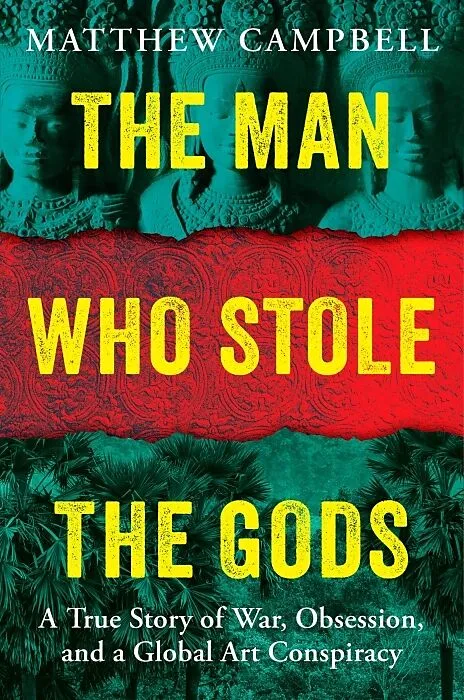
The Man Who Stole the Gods
Beschreibung
From the Killing Fields of Cambodia to the gilded halls of New York’s Metropolitan Museum of Art, a tale of stolen treasures, and the battle to reclaim a nation’s soul. Amidst the chaos of Cambodia''s brutal genocide, a new crime wave emerged--one ...Format auswählen
- Fester EinbandCHF 26.50

Wird oft zusammen gekauft
Andere Kunden kauften auch
Beschreibung
From the Killing Fields of Cambodia to the gilded halls of New York’s Metropolitan Museum of Art, a tale of stolen treasures, and the battle to reclaim a nation’s soul. Amidst the chaos of Cambodia''s brutal genocide, a new crime wave emerged--one that would sweep across borders and entangle the world''s most prestigious art institutions. Priceless treasures of the ancient Khmer Empire, the civilization that produced Angkor Wat, vanished from sacred temples, looted by smugglers and trafficked into the hands of elite collectors. At the center of it all was a man named Douglas Latchford.; Known later as "Dynamite Doug" for the ruthless methods used to extract statues from temple ruins, Latchford orchestrated one of history''s most audacious cultural heists. From dusty Cambodian villages to the glittering auction houses of London and New York and institutions like the Met, he played a double game--posing as an expert on Khmer art while secretly flooding the market with stolen antiquities.; In A masterful blend of true crime, history, and investigative journalism, <The Man Who Stole the Gods< is the definitive account of one man''s greed, an industry''s complicity, and the fight to expose the truth and restore stolen treasures to their rightful home.
Autorentext
Matthew Campbell is an award-winning reporter for Bloomberg Businessweek and the author of The Man Who Stole the Gods: A True Story of War, Obsession, and a Global Art Conspiracy. His previous book, *Dead in the Water—*co-authored with Kit Chellel—was selected as a Book of the Year by The Economist, the Financial Times, and The Times.
Matt has reported from more than twenty-five countries on crime, corruption, terrorism, economics, and the environment. His work has earned some of journalism’s highest honors, including awards from the Gerald Loeb Foundation, the Overseas Press Club, the National Press Club, SOPA, and SABEW for both feature and investigative reporting. A 2025 Jonathan Logan Family Foundation Fellow at New America, Matt lives in Singapore with his family.
Leseprobe
1
On a humid evening in 1957, a young businessman named Douglas Latchford saw the object that would change his life. It was a Khmer female figure, about two feet tall, carved in stone. Around him, men in linen suits and women in flowing dresses of Thai silk-guests at an elegant dinner party in Bangkok-clinked glasses and conversed in myriad languages. But Latchford could only stand among them in silence, staring at the statue: the cool gray of its torso, the fine curves of its waist and shoulders. Like most educated Britons of his generation, he was familiar with Greek and Roman sculpture. This was different, less detailed-no rippling muscles or individually sculpted strands of hair-but no less refined. The piece was like nothing Latchford had ever seen, and it stirred a desire he had never before experienced. He felt that he was looking at the human form reduced to its absolute essentials, somehow made more powerful in its simplicity.
New experiences had been a constant since Latchford had arrived in Bangkok the year prior. He was tall and robustly built, with a firm jaw and wavy auburn hair; in the right light, he had a passing resemblance to the actor Roger Moore. Just twenty-four years old, he had to get to know a city that could feel impossibly exotic to outsiders. The only country in Southeast Asia never to have been colonized by a Western power, Thailand-or Siam, as many still called it-was a world apart. Buddhist monks roamed barefoot from house to house, feeding themselves with alms from strangers. The streets teemed not with cars but with samlors, sturdy trishaws pedaled by laborers who dripped sweat in the tropical heat. Barely anyone outside the elite spoke English, and social norms bewildered the uninitiated. To touch a Thai's head, considered the most sacred part of the body, was a major faux pas, while a smile could indicate anger just as easily as it could signal happiness.
The host of the dinner party, a Belgian aesthete named François Duhau de Berenx, soon noticed that his guest was transfixed by the statue. Its effect was gravitational, magnetic. Latchford knew nothing about its origins, but he knew he needed to possess a figure of his own. "There's another one at the shop where I bought this," Duhau de Berenx told him. It was located in the Woeng Nakhon Kasem, or Thieves' Market, a bazaar in Bangkok's Chinatown where, as the name suggested, neither the merchants nor the customers were especially concerned about the provenance of goods. Latchford went there the next day, weaving between shirtless children and stores stuffed with so many wares-furniture, luggage, pots, and pans-that they spilled over the sidewalk onto the road. The twin to Duhau de Berenx's statue was priced at eighteen thousand Thai baht, or about $900-far more than Latchford could afford. He went to his bank, where he meekly explained why he needed a loan. Happily, the manager agreed. Latchford took the object home, where he could adore its form in private, and began reading whatever he could about the Khmer Empire, the civilization that had produced it.
He had virtually no prior exposure to the subject. Latchford had been born in 1931 in Bombay, during the dying days of the British Raj. His father was a banker, and Latchford had led a relatively privileged life. For an English education, his parents sent him to Brighton College, a well-regarded boarding school in Sussex, where he'd read works like The Jungle Book-reminders of the thrilling, verdant land he'd left behind. Compared with India, the United Kingdom of the late 1940s was a depressing place. For Latchford, its leaden skies and economic privation couldn't compete with the opportunities, and pleasures, on offer in Asia. He skipped university, instead working in Madras and Singapore before moving to Bangkok, where his older brother, Trevor, also chose to pursue a career.
In addition to the challenges of adjusting to the culture, the city had its inconveniences: drinking water had to be boiled, and it was advisable to carry a flashlight when walking at night, to spot the many species of venomous snakes. But for a young man looking for a little adventure, there was nowhere quite like it. Life was lived largely on the water, with hawkers selling melons and coconuts from narrow boats on the khlongs, or canals, that threaded through each neighborhood. On the main waterway, the Chao Phraya, ferries and fishing skiffs puttered past Wat Arun, the Temple of Dawn, its 270-foot spire decorated with snail shells and pieces of Chinese porcelain. Embassies placed their front doors facing the river, since guests of any distinction were likelier to arrive afloat.
Simply being an expatriate conferred some of that status. For perhaps $200 a month, a foreigner could rent a villa in the heart of the city. For not much more, he could populate it with a full household staff, including a driver, cook, maid, and gardener, plus a managerial "number one," ideally with a basic command of English, to keep them all in line. Because Bangkok had nothing like the professional competition in London or New York, the barriers to success were relatively low. Some among the expats joked that it was a first-rate place for second-rate people.
Since Thailand was too distant for many foreign companies to set up their own operations, they relied on "agencies"-local firms that imported goods and handled distribution on behalf of multinationals. Despite not having a university degree or much professional training, Latchford soon got a job as an assistant manager at one such firm: Eastern Agencies, which brought to Southeast Asia some of the consumer bounty of the 1950s. The business was relatively simple, and lucrative. Manufacturers had already done the hard work of developing their products. All that…