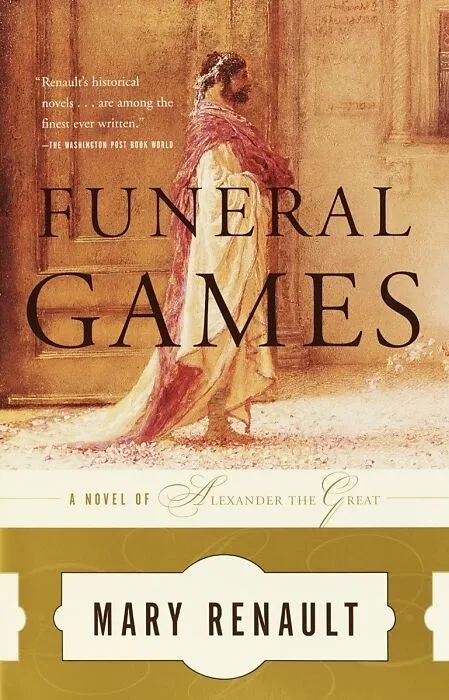
Funeral Games
Beschreibung
Informationen zum Autor Mary Renault was born in London and educated at Oxford. She then trained for three years as a nurse, and wrote her first published novel, Promise of Love . Her next three novels were written while serving in WWII. After the war, she set...Format auswählen
- Kartonierter Einband (Kt)CHF 26.80

Wird oft zusammen gekauft
Andere Kunden kauften auch
Beschreibung
Informationen zum Autor Mary Renault was born in London and educated at Oxford. She then trained for three years as a nurse, and wrote her first published novel, Promise of Love . Her next three novels were written while serving in WWII. After the war, she settled in South Africa and traveled considerably in Africa and Greece. It was at this time that she began writing her brilliant historical reconstructions of ancient Greece, including The King Must Die, The Last of the Wine , and The Persian Boy . She died in Cape Town in 1983. Klappentext "Renault's best historical novel yet.... Every detail has solid historical testimony to support it.-New York Review of Books After Alexander's death in 323 B.C .his only direct heirs were two unborn sons and a simpleton half-brother. Every long-simmering faction exploded into the vacuum of power. Wives, distant relatives, and generals all vied for the loyalty of the increasingly undisciplined Macedonian army. Most failed and were killed in the attempt. For no one possessed the leadership to keep the great empire from crumbling. But Alexander's legend endured to spread into worlds he had seen only in dreams.323 B. C. THE ZIGGURAT OF BEL-MARDUK had been half ruinous for a century and a half, ever since Xerxes had humbled the gods of rebellious Babylon. The edges of its terraces had crumbled in landslides of bitumen and baked brick; storks nested on its ragged top, which had once held the god's golden bedchamber and his sacred concubine in his golden bed. But this was only defacement; the ziggurat's huge bulk had defied destruction. The walls of the inner city by the Marduk Gate were three hundred feet high, but the ziggurat still towered over them. Near by was the god's temple; this Xerxes' men had succeeded in half demolishing. The rest of the roof was patched with thatch, and propped on shafts of rough-hewn timber. At the inner end, where the columns were faced with splendid but chipped enamels, there was still a venerable gloom, a smell of incense and burnt offerings. On an altar of porphyry, under a smoke-duct open to the sky, burned in its bronze basket the sacred fire. It was low; the fuel-box was empty. Its shaven acolyte looked from it to the priest. Abstracted though he was, it caught his eye. "Fetch fuel. What are you about? Must a king die when it serves your laziness? Move! You were got when your mother was asleep and snoring." The acolyte made a sketchy obeisance; the temple discipline was not strict. The priest said, after him, "It will not be yet. Maybe not even today. He is tough as a mountain lion, he will die hard." Two tall shadows fell at the temple's open end. The priests who entered wore the high felt miters of Chaldeans. They approached the altar with ritual gestures, bowing with hand on mouth. The priest of Marduk said, "Nothing yet?" "No," said the first Chaldean. "But it will be soon. He cannot speak; indeed he can scarcely breathe. But when his homeland soldiers made a clamor at the doors, demanding to see him, he had them all admitted. Not the commanders; they were there already. The spear-bearers, the common foot-men. They were half the morning passing through his bedchamber, and he greeted them all by signs. That finished him, and now he is in the death-sleep." A door behind the altar opened to let in two Marduk priests. It gave a glimpse of a rich interior; embroidered hangings, a gleam of gold. There was a smell of spiced meats cooking. The door closed on it. The Chaldeans, reminded of an old scandal, exchanged glances. One of them said, "We did our best to turn him from the city. But he had heard that the temple had not been restored; and he thought we were afraid of him." A Marduk priest said stiffly, "The year has not been auspicious for great works. Nebuchadrezzar built in an inauspicious year. His foreign slaves rioted r...
Klappentext
"Renault's best historical novel yet.... Every detail has solid historical testimony to support it.”-New York Review of Books
After Alexander's death in 323 B.C .his only direct heirs were two unborn sons and a simpleton half-brother. Every long-simmering faction exploded into the vacuum of power. Wives, distant relatives, and generals all vied for the loyalty of the increasingly undisciplined Macedonian army. Most failed and were killed in the attempt. For no one possessed the leadership to keep the great empire from crumbling. But Alexander's legend endured to spread into worlds he had seen only in dreams.
Leseprobe
323 B. C.
THE ZIGGURAT OF BEL-MARDUK had been half ruinous for a century and a half, ever since Xerxes had humbled the gods of rebellious Babylon. The edges of its terraces had crumbled in landslides of bitumen and baked brick; storks nested on its ragged top, which had once held the god's golden bedchamber and his sacred concubine in his golden bed. But this was only defacement; the ziggurat's huge bulk had defied destruction. The walls of the inner city by the Marduk Gate were three hundred feet high, but the ziggurat still towered over them.
Near by was the god's temple; this Xerxes' men had succeeded in half demolishing. The rest of the roof was patched with thatch, and propped on shafts of rough-hewn timber. At the inner end, where the columns were faced with splendid but chipped enamels, there was still a venerable gloom, a smell of incense and burnt offerings. On an altar of porphyry, under a smoke-duct open to the sky, burned in its bronze basket the sacred fire. It was low; the fuel-box was empty. Its shaven acolyte looked from it to the priest. Abstracted though he was, it caught his eye.
"Fetch fuel. What are you about? Must a king die when it serves your laziness? Move! You were got when your mother was asleep and snoring."
The acolyte made a sketchy obeisance; the temple discipline was not strict.
The priest said, after him, "It will not be yet. Maybe not even today. He is tough as a mountain lion, he will die hard."
Two tall shadows fell at the temple's open end. The priests who entered wore the high felt miters of Chaldeans. They approached the altar with ritual gestures, bowing with hand on mouth.
The priest of Marduk said, "Nothing yet?"
"No," said the first Chaldean. "But it will be soon. He cannot speak; indeed he can scarcely breathe. But when his homeland soldiers made a clamor at the doors, demanding to see him, he had them all admitted. Not the commanders; they were there already. The spear-bearers, the common foot-men. They were half the morning passing through his bedchamber, and he greeted them all by signs. That finished him, and now he is in the death-sleep."
A door behind the altar opened to let in two Marduk priests. It gave a glimpse of a rich interior; embroidered hangings, a gleam of gold. There was a smell of spiced meats cooking. The door closed on it.
The Chaldeans, reminded of an old scandal, exchanged glances. One of them said, "We did our best to turn him from the city. But he had heard that the temple had not been restored; and he thought we were afraid of him."
A Marduk priest said stiffly, "The year has not been auspicious for great works. Nebuchadrezzar built in an inauspicious year. His foreign slaves rioted race against race, and threw each other off the tower. As for Sikandar, he would still be fortunate, sitting safe in Susa, if he had not defied the god."
One of the Chaldeans said, "It seems to me he did well enough by the god, for all that he called him Herakles." He looked round, pointedly, at the half-ruined building. He might as well have said aloud, "Where is the gold the King gave you to rebuild, have you eaten and drunk it all?"
There was a hostile silence. The chief of the Marduk priests said, with emollient dignity, "Certainly you gave him a true prediction. And since then have you read the heavens?"
The tall miters bent together in slow assent. The oldest Chaldean, who…