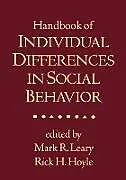
Handbook of Individual Differences in Social Behavior
Beschreibung
Knowledge about personality has the potential to have a major impact on how researchers and therapists understand people’s social lives. This volume is one of the finest examples of how clinical, social, personality, developmental, and biological psychol...Format auswählen
- Fester EinbandCHF 162.00

Wird oft zusammen gekauft
Andere Kunden kauften auch
Beschreibung
Knowledge about personality has the potential to have a major impact on how researchers and therapists understand people’s social lives. This volume is one of the finest examples of how clinical, social, personality, developmental, and biological psychology can be woven together (in nearly every chapter). Extending beyond arbitrary subdisciplinary boundaries, the authors provide an enlightening, scholarly examination of how people differ in the ability to navigate their everyday environments. This book will be a terrific text for courses on personality.--Todd B. Kashdan, PhD, Department of Psychology, George Mason UniversityOne of the more interesting questions in contemporary psychology concerns the interaction of personal dispositions and situational contexts in motivating human behavior. Leary and Hoyle have gathered together a set of creative social scientists who have written compelling chapters on nearly 40 dispositions and their influence on social processes and outcomes. This volume will be stimulating reading for graduate students in personality and social psychology, and it reveals why the boundary between personality and social psychology is not especially meaningful. A wonderfully conceived project!--Peter Salovey, PhD, Chris Argyris Professor of Psychology and Provost, Yale University One of the best, most important contemporary psychological handbooks--thorough, informative, well written, thoughtful, and up to date. The volume offers lively, state-of-the-art coverage of nearly all the major personality traits that have proven useful in predicting how people will act and interact. If you want to know how people differ in ways that matter for social life, this is the book for you.--Roy F. Baumeister, PhD, Francis Eppes Professor of Psychology, Florida State UniversityThis book tackles the thorny and difficult question of whether behavior is determined more by the person or by the situation. Leading scholars present compelling evidence that different types of people respond to their circumstances in vastly different ways, and that assessing personality provides important insights into interpersonal behavior. The chapters serve as excellent summaries and tutorials on numerous aspects of personality, making this a valuable resource for students and faculty alike. Highly recommended for anyone interested in human behavior.--Todd F. Heatherton, PhD, Champion International Professor, Department of Psychological and Brain Sciences, Dartmouth College An exceptional resource. The Handbook covers a large and comprehensive range of important dispositional variables, including the classic dimensions of personality, interpersonal aspects of functioning, and emotional, cognitive, and motivational dispositions, as well as self-related dispositions. Chapters authored by leading scholars in the field provide informed, scholarly, and timely overviews. This book should be very valuable for scholars, students, and professionals interested in individual differences and their role in social and moral behavior, adjustment, and maladjustment.--Nancy Eisenberg, PhD, Regents' Professor of Psychology, Arizona State University This is an unusual and exceptional volume. It provides an authoritative account of the most influential constructs in the field of personality and social psychology. Each chapter defines the relevant construct, traces its historical development, discusses recent findings, entertains controversies, draws connections with other relevant constructs, and points to new research directions. The volume is admirably inventive in the myriad ways--conceptual and methodological--in which it bridges social and personality psychology. It will be invaluable as a reference and a source of inspiration for researchers and graduate students.--Constantine Sedikides, PhD, School of Psychology, University of Southampton, UK-Brilliantly fills an important gap in today's social psychology literatureby reconnecting the inner person with the outer situation....This is a handbook in the true sense of the terma hefty yet handheld reference volume filled with panoramic, research-based chapters....The 39 chapters are impressively uniform in their structureeach authored by a leader on the topic, with definitions of its terms, historical trends, summary tables or charts, and key citations. The authors presume little prior knowledge, yet even expert readers will learn from them....A gem of a handbook that belongs in every academic librarya concise and authoritative source for social-personality research. It is a long-lasting volume that Guilford Press offers at an attractive price that is less than the price of many textbooks today.--PsycCRITIQUES, 6/7/2009This will be an important, widely used scholarly resource not only in psychology but also in such related fields as business, law, medicine, and social policy....Highly recommended. Upper-division undergraduates through faculty and professionals.--Choice, 2/3/2010
Autorentext
Mark R. Leary, PhD, is Professor Emeritus of Psychology and Neuroscience at Duke University. His research focuses on the processes by which people think about and evaluate themselves; the effects of self-reflection on emotion and psychological well-being; and how people are influenced by concerns about how they are perceived and evaluated by others. He is a Fellow of the American Psychological Association, the Association for Psychological Science, and the Society for Personality and Social Psychology, and a recipient of the Lifetime Career Award from the International Society for Self and Identity. Dr. Leary was the founding editor of the journal Self and Identity and is currently Editor of Personality and Social Psychology Review
Rick H. Hoyle, PhD, is Professor of Psychology and Neuroscience at Duke University. The primary focus of his research is the investigation of basic cognitive, affective, and social processes relevant to self-regulation. He is a Fellow of the American Psychological Association, the Association for Psychological Science, the Society for the Psychological Study of Social Issues, and the Division of Evaluation, Measurement, and Statistics of the American Psychological Association.
Klappentext
How do individual differences interact with situational factors to shape social behavior? Are people with certain traits more likely to form lasting marriages; experience test-taking anxiety; break the law; feel optimistic about the future? This handbook provides a comprehensive, authoritative examination of the full range of personality variables associated with interpersonal judgment, behavior, and emotion. The contributors are acknowledged experts who have conducted influential research on the constructs they address. Chapters discuss how each personality attribute is conceptualized and assessed, review the strengths and limitations of available measures (including child and adolescent measures, when available), present important findings related to social behavior, and identify directions for future study.
Zusammenfassung
Presents a comprehensive examination of a range of personality variables associated with interpersonal judgment, behavior, and emotion.
Inhalt
Introduction
Situations, Dispositions, and the Study of Social Behavior, Mark R. Leary and Rick H. Hoyle
Methods for the Study of Individual Differences in Social Behavior, Rick H. Hoyle and Mark R. Leary
II. Interpersonal Dispositions
Extraversion, Joshua Wilt and William Revelle
Agreeableness, William G. Graziano and RenÃ(c)e M. Tobin
Attachment Styles, Phillip R. Shaver and Mario Mikulincer
Interpersonal Dependency, Robert F. Bornstein
Machiavellianism, Daniel N. Jones and Delroy L. Paulhus
Gender Identity, Wendy Wood and Alice H. Eagly
III. Emotional Dispositions
Neuroticism, Thomas A. Widiger
Happiness, *Ed Diener, Pel…