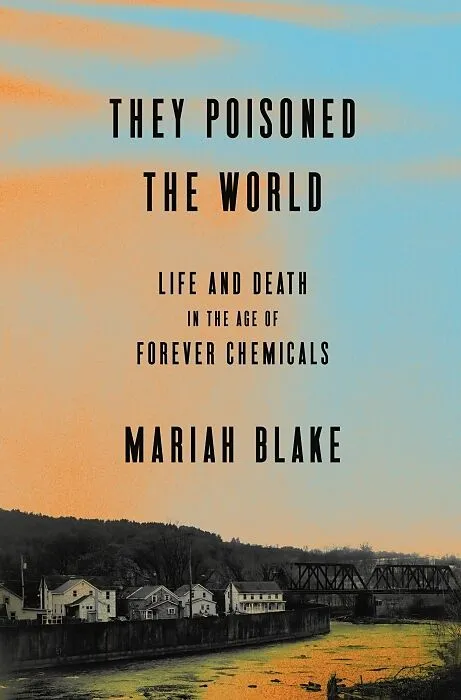
They Poisoned the World
Beschreibung
A landmark investigation of the chemical industry''s decades-long campaign to hide the devastating effects of "forever chemicals," told through the story of a small town on the frontline of an epic public health crisis In 2015, after losing his father and seve...Format auswählen
- Kartonierter EinbandCHF 20.45
- Fester EinbandCHF 29.90

Wird oft zusammen gekauft
Andere Kunden kauften auch
Beschreibung
A landmark investigation of the chemical industry''s decades-long campaign to hide the devastating effects of "forever chemicals," told through the story of a small town on the frontline of an epic public health crisis
In 2015, after losing his father and several friends to cancer, an unassuming insurance underwriter from Hoosick Falls, New York, began to suspect that the local water supply was polluted. He tested his tap water and discovered dangerous levels of forever chemicals. This set off a chain of events that led to 70 million Americans learning their drinking water was tainted, threatening their health and fertility. What most don’t realize is that the U.S. government and the companies that manufacture these chemicals—used in everything from lipstick and food packaging to children’s clothing—have known about their dangers for decades.
In <They Poisoned the World<, investigative journalist Mariah Blake tells the astonishing story of this cover-up, tracing its roots back to the Manhattan Project and through the postwar years, as industry scientists discovered that these toxic chemicals refused to break down and were infusing the blood of virtually every person on the planet. By the 1970s, manufacturers like DuPont had begun clandestinely testing animals and workers, and suppressing the links they found to birth defects, immune system damage, cancer, and other serious diseases. At every step, they were aided by our government’s shockingly lax regulatory system, which DuPont itself helped create—a system that has made us all guinea pigs in a massive, uncontrolled chemistry experiment.
Drawing on years of on-the-ground reporting and tens of thousands of documents, Blake interweaves the secret history of forever chemicals with the moving story of how a small village took on the chemical giants—and won. From the local doctor who diagnosed rare, aggressive cancers in his patients (and then himself) to the young mother who took her fight all the way to Capitol Hill, citizen activists in Hoosick Falls and beyond have birthed the most significant grassroots environmental movement since <Silent Spring<.
Humane and revelatory, this book will provoke outrage—and hopefully inspire the fundamental change we need to protect the health of every American for generations to come....
Autorentext
Mariah Blake is an investigative journalist whose writing has appeared in The New York Times, The Atlantic, Mother Jones, The New Republic, and other publications. She was a Murrey Marder Nieman Fellow in Watchdog Journalism at Harvard University.
Klappentext
“Riveting . . . Blake’s deft chronicle of one of the greatest moral scandals of our time [is] a book that none of us can afford to miss.”—The Washington Post
A gripping investigation of the chemical industry’s decades-long campaign to hide the dangers of forever chemicals, told through the story of a small town on the frontlines of an epic public health crisis.
SHORTLISTED FOR THE J. ANTHONY LUKAS PRIZE • FINALIST FOR THE PEN/E.O WILSON LITERARY SCIENCE WRITING AWARD AND THE LOS ANGELES TIMES BOOK PRIZE • EDGAR AWARD NOMINEE
A BEST BOOK OF THE YEAR: The Washington Post, Scientific American, Booked Up
In 2014, after losing several friends and relatives to cancer, an unassuming insurance underwriter in Hoosick Falls, New York, began to suspect that the local water supply was polluted. When he tested his tap water, he discovered dangerous levels of forever chemicals. This set off a chain of events that led to 100 million Americans learning their drinking water was tainted. Although the discovery came as a shock to most, the U.S. government and the manufacturers of these toxic chemicals—used in everything from lipstick and cookware to children’s clothing—had known about their hazards for decades.
In They Poisoned the World, investigative journalist Mariah Blake tells the astonishing story of this cover-up, tracing its roots back to the Manhattan Project and through the postwar years, as industry scientists discovered that these chemicals refused to break down and were saturating the blood of virtually every human being. By the 1980s, manufacturers were secretly testing their workers and finding links to birth defects, cancer, and other serious diseases. At every step, the industry’s deceptions were aided by our government’s appallingly lax regulatory system—a system that has made us all guinea pigs in a vast, uncontrolled chemistry experiment.
Drawing on years of on-the-ground reporting and tens of thousands of documents, Blake interweaves the secret history of forever chemicals with the moving story of how a lone village took on the chemical giants—and won. From the beloved local doctor to the young mother who took her fight all the way to the nation’s capital, citizen activists in Hoosick Falls and beyond have ignited the most powerful grassroots environmental movement since Silent Spring.
Humane and revelatory, this book will provoke outrage—and hopefully inspire the change we need to protect the health of every American for generations to come.
Leseprobe
1
A Bump in the Road
The morning of October 5, 2010, started as most mornings did in the Hickey household. Ersel Hickey, a sixty-eight-year-old school bus driver in the village of Hoosick Falls, New York, rose before dawn. He pulled on his jeans and baseball cap and dropped by Stewart’s convenience store for some coffee. Then he headed out for his morning shift. Ersel’s bus route wound through the village’s Second Ward, a mix of old brick factories and faded Victorian homes with American flags flapping from their porches, and then into hardscrabble hill country sprinkled with rusty trailers and ramshackle farmhouses. Along the way, Ersel cracked jokes, handed out candy, and let the kids blare music over the bus’s radio.
On this particular day, after delivering the kids to school, Ersel returned to the brown-shingled cottage he shared with his wife, Sue. He grabbed a snack, slipped into the bathroom to relieve himself—and watched the toilet fill with blood. Ersel hollered for Sue, who gasped at the sight of the reddish water, then he headed straight to the office of the family’s longtime doctor, Marcus Martinez.
Marcus examined him, took some X-rays, and decided to put him in the hospital overnight for some tests. The doctor was on the phone making arrangements when Ersel’s youngest son, Michael, dropped by the office to check on him. Marcus cupped his hand over the receiver and told Michael not to worry—Ersel was probably just constipated. After the inevitable quips about what Ersel was full of, Michael drove him to the hospital.
Michael, a thirty-one-year-old insurance underwriter with a firm belief in the power of positive thinking, spent the following day in his cubicle. Afterward, he attended a breastfeeding class with his fiancée, Angela. She was nine months pregnant with their first child, and Michael had been trying to persuade her to name the baby Ersel, so far without success. When he called his mother after class, he could tell from her voice that something was wrong. “I didn’t want to tell you this over the phone,” Sue told him. “But it’s worse than what we thought. It looks like your father has kidney cancer.”
Michael was stunned; it was hard to imagine someone so vigorous being seriously ill. But he was determined not to dwell on worst-case scenarios. The following night, he and Angela took Ersel out to dinner and Michael assured his father that everything would be okay. Ersel would get through the treatment, and then he co…