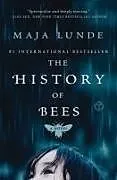
The History of Bees
Beschreibung
"I once sat sheltered while a swarm of bees the size of a house flew over me. I wish readers this same cone of isolated, humming space when they read Maja Lunde’s fine novel The History of Bees. Here is a story that is sweeping in scope but intimate in d...Format auswählen
- Kartonierter EinbandCHF 20.00
Wird oft zusammen gekauft
Andere Kunden kauften auch
Beschreibung
"I once sat sheltered while a swarm of bees the size of a house flew over me. I wish readers this same cone of isolated, humming space when they read Maja Lunde’s fine novel The History of Bees. Here is a story that is sweeping in scope but intimate in detail. Stepping lightly between a 19th century British naturalist, a contemporary Ohio bee farmer, and a determined mother in a dystopian future China, Lunde dares to imagine the chaos our rapidly changing world invites, while finding order and hope in individual acts of care."
Autorentext
Maja Lunde is a Norwegian author and screenwriter. Lunde has written ten books for children and young adults. She has also written scripts for Norwegian television, including for the children’s series Barnas supershow ("The Children’s Super Show"), the drama series Hjem ("Home") and the comedy series Side om Side ("Side by Side"). She lives with her husband and three children in Oslo.
Klappentext
“Imagine The Leftovers, but with honey” (Elle), and in the spirit of Station Eleven and Never Let Me Go, this “spectacular and deeply moving” (Lisa See, New York Times bestselling author) literary novel follows three generations of beekeepers from the past, present, and future, weaving a spellbinding story of their relationship to the bees—and to their children and one another—against the backdrop of an urgent, global crisis.
England, 1852. William is a biologist and seed merchant, who sets out to build a new type of beehive—one that will give both him and his children honor and fame.
United States, 2007. George is a beekeeper fighting an uphill battle against modern farming and the impacts of global warming but hopes that his son can be their salvation.
China, 2098. Tao hand paints pollen onto the fruit trees now that the bees have long since disappeared. When Tao’s young son is taken away by the authorities after a tragic accident, she sets out on a grueling journey to find out what happened to him.
Haunting, illuminating, and deftly written, The History of Bees joins “the past, the present, and a terrifying future in a riveting story as complex as a honeycomb” (Bryn Greenwood, New York Times bestselling author) that is just as much about the powerful bond between children and parents as it is about our fragile relationship to nature and the interconnected fate of humanity and bees.
Leseprobe
The History of Bees
TAO
District 242, Shirong, Sichuan, 2098
Like oversize birds, we balanced on our respective branches, each of us with a plastic container in one hand and a feather brush in the other.
I climbed upwards, very slowly, as carefully as I could. I was not cut out for this, wasn’t like many of the other women on the crew, my movements were often too heavy-handed. I lacked the subtle motor skills and precision required. This wasn’t what I was made for, but all the same I had to be here, every single day, twelve hours a day.
The trees were as old as a lifetime. The branches were as fragile as thin glass, they cracked beneath our weight. I twisted myself carefully, mustn’t damage the tree. I placed my right foot on a branch even further up, and carefully pulled the left up behind it. And finally I found a secure working position, uncomfortable but stable. From here I could reach the uppermost flowers.
The little plastic container was full of the gossamer gold, carefully weighed out. I tried to transfer invisible portions lightly out of the container and over into the trees. Each individual blossom was to be dusted with the tiny brush of hen feathers, from hens scientifically cultivated for precisely this purpose. No feathers of artificial fibers had proven nearly as effective. It had been tested, and then tested again, because we had had plenty of time—in my district the tradition of hand pollination was more than a hundred years old. The bees here had disappeared back in the 1980s, long before The Collapse; pesticides had done away with them. A few years later, when the pesticides were no longer in use, the bees returned, but by then hand pollination had already been implemented. The results were better, even though an incredible number of people, an incredible number of hands were required. And so, when The Collapse came, my district had a competitive edge. It had paid off to be the ones who polluted the most. We were a pioneer nation in pollution and so we became a pioneer nation in pollination. A paradox had saved us.
I stretched as far as I could, but couldn’t quite reach the blossom at the very top. I was about to give up, but knew I might be punished, so I tried once more. Our pay was docked if we used up the pollen too quickly. And our pay was docked if we used too little. The work was invisible. When at the end of the day we climbed down from the trees, there was no evidence of our work except for the red chalk X’s on the tree trunks, ideally up to forty trees each day. It wasn’t until autumn came and the trees were laden with fruit that we would know who among us had actually succeeded in their work. And by then we had usually forgotten which trees had been dusted by whom.
I was assigned to Field 748 today. Out of how many? I didn’t know. My group was one of hundreds. In our beige work uniforms we were just as anonymous as the trees. And just as close together as the flowers. Never alone, always together in a flock, up here in the trees, or wandering down the tire ruts from one field to the next. Only behind the walls of our own small flats could we be alone, a few short hours a day. Our whole lives were out here.
It was quiet. We weren’t allowed to speak while we worked. The only sound to be heard was that of our careful movements in the trees, a faint clearing of the throat, some yawns and the material of our uniforms against the tree trunks. And sometimes the sound we had all learned to dislike—a branch creaking and in the worst case breaking. A broken branch meant less fruit, and yet another reason to dock our pay.
Otherwise only the wind was audible, passing through branches, brushing across the blossoms, slipping through the grass on the ground.
A fly buzzed through the air, a rare sight. It had been several days since I had seen a bird, there were fewer of them as well. They hunted the few insects to be found, and starved, like the rest of the world.
But then an earsplitting sound broke the silence. It was the whistle from the management’s barracks, the signal for the second and final break of the day. I noticed immediately how parched my tongue was.
I climbed down with awkward caution. My workmates and I crept down from the trees to the ground. The other women had already begun chatting, as if their cacophonic prattle was flipped on like a switch the split second they knew that they could.
I said nothing, concentrating on getting down without breaking a branch. I managed it. Pure luck. I was infinitely clumsy, had been working out here long enough to know that I would never be really good at the job.
On the ground beside the tree was a beat-up metal water bottle. I grabbed it and drank quickly. The water was lukewarm and tasted of aluminum, the taste made me drink less than I needed.
Two young boys dressed in white from the Trade Commission rapidly distributed the reusable tin boxes containing the second meal of the day. I sat down by myself with my back against the tree trunk and opened mine. The rice was mixed with corn today. I ate quickly. As usual, a bit too salty, and seasoned with artificially manufactured chili pepper and soy. It had been a long time since I had tasted meat. Animal feed required too much arable land. And a lot of the traditional animal fe…