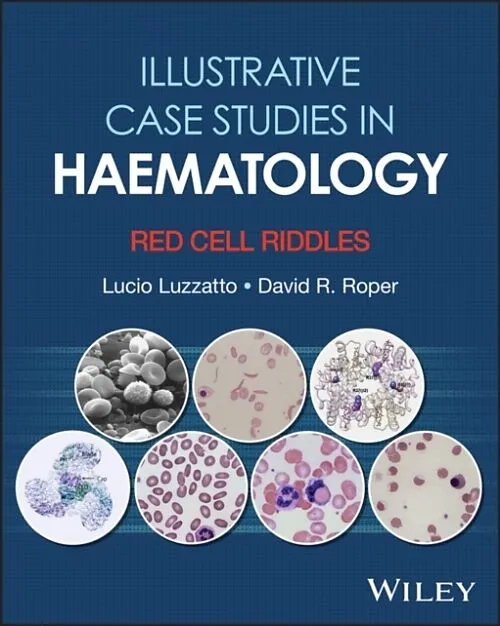
Illustrative Case Studies in Haematology
Beschreibung
Autorentext Lucio Luzzatto received his MD from the University of Genova in 1959 and has held positions at universities in five countries in three continents. He is currently an honorary professor of haematology at the University of Florence; and a Foreign Mem...Format auswählen
- Fester EinbandCHF 125.20
Wird oft zusammen gekauft
Andere Kunden kauften auch
Beschreibung
Autorentext
Lucio Luzzatto received his MD from the University of Genova in 1959 and has held positions at universities in five countries in three continents. He is currently an honorary professor of haematology at the University of Florence; and a Foreign Member of the Accademia dei Lincei. David Roper has now retired from his role as Principal Biomedical Scientist at Hammersmith Hospital, Imperial College, London, UK. He has co-written several chapters in major textbooks.
Klappentext
Case reports illustrating approaches and applications to various haematological problems Illustrative Case Studies in Haematology is an educational book describing haematological, biochemical and molecular approaches to reach a diagnosis of common and rare blood disorders. The book consists of 44 individual real-life case reports. Each case includes a brief clinical history, basic laboratory investigations, and initial impressions, leading to one or more possible diagnoses. Then, through more targeted investigation, the authors reach a final diagnosis, which is frequently at the molecular level. For each case, a brief discussion is included, highlighting critical clinical and/or laboratory features, as well as recent progress in the area. Each individual case illustrates the close connection, in contemporary medicine, between clinical findings, haematological findings, and molecular analysis. Illustrative Case Studies in Haematology discusses:
- Patients with sickle cell disease ranging from nearly symptomless to life-threatening
- Patients with different forms of thalassaemia
- Kernicterus in a G6PD deficient female infant
- Alpha thalassaemia and myelodysplastic syndrome (ATMDS), a rare combination caused by an acquired ATRX somatic mutation
- Paroxysmal nocturnal haemoglobinuria in a G6PD deficient patient
- The first case ever reported of homozigosity for an unstable haemoglobin
- Cases with long-term follow-up spanning decades, demonstrating disease progression, complications and therapeutic outcomes Illustrative Case Studies in Haematology holds enormous value to haematologists throughout the world seeking to diagnose both common and rare disorders with clarity and confidence. The book is also highly appropriate for trainee haematologists, biomedical scientists and medical students.
Inhalt
Brief Table of Contents[CE1]
i Foreword
ii Preface
iii Reference Ranges (adult)
(1) List of Cases
An active professional health worker with a serious genetic disorder
Plot twist from clot missed
Unstable: but stable
Nurture and nature
Patient knows best
Not only males are affected
A levels without haemoglobin A
A hot blood smear
More yellow than sick
A blue baby with a normal heart
Detecting and managing point mutations
A gush of oxygen for the baby
PA: not a Power-Act
Sicily in my blood
A storm of half-ghosts
Honora medicum
Failing to switch
Rosettes without a trophy
Too little beta and too much alpha
Missing something you never knew you ought to have
Two variants walk into a blood cell ...
22 Low GPI, high GPA
Split A2: a cue to Q
A Celtic trait?
Cold may not be cool
When it rains, a microbe makes it pour
Double membranes may prove ineffective
Being less but being dominant
Two enzymes down, still standing
Sickle cell disease at 75
Strong but frail
Troublesome symbiotic relationship
Not letting go
Hellenic class A
When the sickle stabs the kidney
Dry cells, fake potassium, real iron
Hb on target
Too little beta and too little alpha
Salt lake and salt bridges
Small red cells with a difference
Double jeopardy when facing complement
Camden town: not just the market
High on O and mutating again
Epigenetic upheaval can make you alpha-broke
For a few of the titles in this list (only a few) we received help from ChatGPT, that we openly acknowledge. Initially we were surprised that AI could be witty: but of course AI has acquired 'data' from e.g. Terry Pratchett and P G Wodehouse, not just from Dante Alighieri and William Shakespeare.
This brings up a sticky issue: in the realm of science, is it advisable or even allowed to use ChatGPT at all? Our short answer is yes. A more articulate answer includes the following. (1) You can ask simple or complex questions, but you must always check ChatGPT's replies by finding and reading the original sources in the scientific literature. (2) You can broach a topic with ChatGPT just for the purpose of elaborating on your own ideas. (3) If you disagree with ChatGPT, consider it may be wrong: stick to your guns.
Artificial intelligence should stimulate, not thwart natural intelligence.
(2**) Index**
Sickle cell/ß0 thalassaemia disease with +-thalassaemia trait.
Portal hypertension and iron overload in a patient with PNH.
Chronic haemolytic anaemia caused by Hb Bushwick, homozygous state.
Nutritional deficiencies of folate and iron in a patient with beta thalassaemia trait and chronic renal failure.
Sickle cell/ß0 thalassaemia disease, possibly ameliorated by + thalassaemia; and mild iron deficiency.
Kernicterus in a girl heterozygous for G6PD deficiency: G6PD Cairo.
ß-thalassemia (homozygous for IVS II nt 1 mutation), heterozygous for -thalassemia, resulting in NTDT (thalassaemia intermedia phenotype).
Pyropoikilocytosis with bi-allelic PIEZO1 mutation in a heterozygote for G6PD deficiency.
Chronic low grade haemolytic disorder due to heterozygous state for haemoglobin Köln.
Methaemoglobinaemia due to cytochrome b5 reductase (diaphorase) deficiency; associated with G6PD deficiency.
Transfusion-dependent thalassaemia resulting from genetic compound ß0 (IVS 1 nt 1 G A)/ ß+ (IVS 1 nt 6 T A).
Compound heterozygote for two different ß-thalassaemia genes (ß0/ß+), with co-existing heterozygous alpha thalassaemia.
Pernicious anaemia.
Heterozygous for Sicilian ß-thalassaemia.
Acute haemolytic anaemia in an infant with G6PD deficiency.
Homozygous sickle cell anaemia with -thal trait and a rare type of G6PD deficiency; multiple red cell antibodies and hyper-haemolytic syndrome.causing severe haemolytic transfusion reaction.
Homozygous (A ß)0 thalassaemia (thalassaemia intermedia).
Autoimmune haemolytic anaemia with intravascular and extravascular haemolysis manifesting during early pregnancy.
Thalassaemia intermedia, mild, resulting from interaction of triplicated alpha-gene and heterozygous state for the ß-thalassaemia mutation IVS 1 nt 1 (G A).
Infantile pyknocytosis in a child with glutathione peroxidase deficiency secondary to a neonatal deficiency of selenium.
Homozygous Haemoglobin C in combination with alpha G variant.
Glucose-6-phosphate isomerase (GPI) deficiency.
Double heterozygote for ß+ thalassaemia and Hb Q-India.
Acquired iron deficiency in a Celtic heterozygous for haemoglobin D Punjab.
Monoclonal gammopathy (IgM ) with cold agglutinin disease of 21 years duration: now B-cell lymphoma.
Mycoplasma pneumoniae pulmonary infection in a patient with homozygous sickle cell anaemia, + thalassaemia trait and G6PD deficiency.
Congenital dyserythropoetic anaemia: CDA type II.
ß-thalassaemia intermedia (also referred to as "dominant ß-thalassaemia" or inclusion-body ß-thalassaemia trait), due to a single mutant ß-globin allele producing abnormal ß-chains.
Congenital haemolytic anaemia due to pyruvate kinase deficiency, with coexistent glucose-6-phosphate dehydrogenase deficiency.
Sickle cell/ß+ (-29 A G) thalassaemia disease with + thalassaemia.
Heterozygous Haemoglobin Sabine.
Bone marrow-pancreas Pearson's synd…