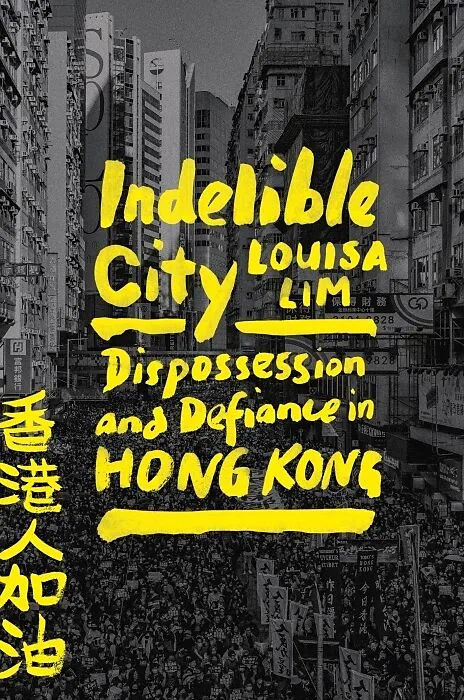
Indelible City
Beschreibung
Advance praise for Indelible City: “Arriving at the exact right moment, Indelible City charts the course of the region by digging deeply into its history. Lim deftly weaves her way through the ages, arriving at our current time, all the while captur...Format auswählen
- Fester EinbandCHF 31.10

Wird oft zusammen gekauft
Andere Kunden kauften auch
Beschreibung
**Advance praise for Indelible City:
**
“Arriving at the exact right moment, Indelible City charts the course of the region by digging deeply into its history. Lim deftly weaves her way through the ages, arriving at our current time, all the while capturing Hong Kong's soul inside the book's pages.” –Newsweek
"Riveting. . . . a vivid and vital contribution to postcolonial history." –Publishers Weekly, starred review
“Beautifully written… A fascinating work that is essential reading for anyone with an interest in Hong Kong." –Library Journal, starred review
“Lim’s outstanding history of Hong Kong is an epic must-read. . . . From the first page, the importance of language and the voices of Hong Kongers are central themes. Yet Indelible City captures much more as it records the struggle of people oppressed. . . yet determined in their pursuit of freedom and cultural identity.” –Booklist, starred review
“The best book about the indelible city to date. Irresistibly real and emotionally authentic, it shines with a shimmering light rarely seen in political narrative. A truly extraordinary elegy.” –Ai Weiwei
“An utterly brilliant and original ode to Hong Kong, throbbing with eccentricity and sense of place. Like Joseph Mitchell’s singular rendering of New York, Lim’s Hong Kong will be read decades from now as an indelible portrait.” –Evan Osnos, author of Age of Ambition, winner of the National Book Award
“I absolutely loved this book. Each page is a revelation about a city whose history I thought I knew well. Lim’s exploration of Hong Kong’s identity is insightful, refreshing and entirely original.” –Barbara Demick, author of Nothing to Envy and *Eat the Buddha
*
“I read Louisa Lim’s book slowly, haunted by memories and stymied by sorrow. An archaeological dig into the disappearing present, her fascinating and heartbreaking account reveals an indelible history hidden in plain sight, and a future that Hong Kong’s unique sensibility promises even as the world’s most powerful autocracy strives to erase it.” –Geremie Barmé, editor of *China Heritage
*
Autorentext
Louisa Lim
Klappentext
An award-winning journalist and longtime Hong Konger indelibly captures the place, its people, and the untold history they are claiming, just as it is being erased.
The story of Hong Kong has long been obscured by competing myths: to Britain, a "barren rock" with no appreciable history before the English arrived; to China, a "borrowed place" at long last returned to the ancestral fold. Even to its own inhabitants, its distinctive origins-as a place of refuge and rebellion, of hybridity as an endlessly adaptive way of life-remained untaught and unknown. As protests erupted across the city in 2019 and were met with escalating suppression from Beijing, Louisa Lim-raised in Hong Kong as a half-Chinese, half-English child and now a reporter who had covered the region for more than a decade-realized that she was uniquely positioned to unearth this untold story before it was too late.
Lim's deeply researched-and deeply personal-account casts often startling new light on key moments: the British takeover in 1842, the negotiations leading to its "return" to China in 1997, the current protests, and the future Beijing seeks to impose. Throughout, it is populated by contemporary figures who, like her, aim to put Hong Kongers at the center of their own story: guerilla calligraphers, amateur historians and archaeologists, and wending through it all, the King of Kowloon, a mentally ill trash collector, descended of royalty, whose iconic street art both embodied and inspired the unique identity Lim unforgettably conveys-Hong Kong as a place of disappearance and reappearance, power and powerlessness, loss and reclamation, silence and voice.
Zusammenfassung
****A NEW YORK TIMES NOTABLE BOOK OF THE YEAR
An award-winning journalist and longtime Hong Konger indelibly captures the place, its people, and the untold history they are claiming, just as it is being erased.****
The story of Hong Kong has long been dominated by competing myths: to Britain, a “barren rock” with no appreciable history; to China, a part of Chinese soil from time immemorial, at last returned to the ancestral fold. For decades, Hong Kong’s history was simply not taught, especially to Hong Kongers, obscuring its origins as a place of refuge and rebellion. When protests erupted in 2019 and were met with escalating suppression from Beijing, Louisa Lim—raised in Hong Kong as a half-Chinese, half-English child, and now a reporter who has covered the region for nearly two decades—realized that she was uniquely positioned to unearth the city’s untold stories.
Lim’s deeply researched and personal account casts startling new light on key moments: the British takeover in 1842, the negotiations over the 1997 return to China, and the future Beijing seeks to impose. Indelible City features guerrilla calligraphers, amateur historians and archaeologists, and others who, like Lim, aim to put Hong Kongers at the center of their own story. Wending through it all is the King of Kowloon, whose iconic street art both embodied and inspired the identity of Hong Kong—a site of disappearance and reappearance, power and powerlessness, loss and reclamation.
Leseprobe
Chapter 1
Words
It was during Hong Kong's steamy, explosive summer of 2019 that walls became weapons. Millions of people marched through the streets to protest against the extradition law they feared would mark the end of the territory's way of life. Armed with Sharpies and Post-it Notes, they feathered the walls with sorbet-colored declarations in black Chinese characters: We love Hong Kong! We are Hong Kong! Hong Kong never give up! These were not only walls of discontent but also walls of community; over and over, the messages asserted a distinct Hong Kong identity, separate from China.
Soon the notes were proliferating across overhead walkways and through underground tunnels, on shop windows and street signs, railings and billboards, like a swarm released into the wild, to pollinate and colonize the city. They evolved into pavement mosaics made up of scores of A4 photocopies glued end to end across the sidewalk near the government headquarters. Pedestrian walkways and underpasses quickly became impromptu galleries of dissent, with anonymous heartfelt pleas jostling for space. Often they were strategically placed. A black-and-white carpet of pictures of Chinese president Xi Jinping forced commuters to stomp on his face. Black-clad teams were deployed to paper footpaths at jogging speed, for kilometers at a time. Their assembly-line efficiency was mesmerizing to behold: an advance crew ran ahead, spraying glue, followed by a second string who threw down posters in a checkerboard pattern, black backgrounds alternating with white as they cantered past, and bringing up the rear, a final crew who used long umbrellas to tamp the posters down onto the glue as they ran. Go, Hong Kong! Some people move on, BUT NOT US. Soon the black-clad protestors had graduated to graffiti slogans spray-painted straight onto roads, highway dividers, and tram shelters. Fuck the police. Chinazi. If we burn, you fucking burn with us. Public surfaces became anonymous repositories for people's deepest and most dangerous sentiments.
The protests sprang out of the massive opposition to proposed changes to Hong Kong's extradition laws that would permit the rendition of alleged criminal suspects to China. This would put anyone, no matter their nationality, in dan…