
IHR WARENKORB IST AKTUELL LEER.
Haben Sie noch nichts passendes gefunden? Stöbern Sie durch unser komplettes Sortiment.
Oder melden Sie sich an bzw. registrieren Sie sich.
- Kostenlose Lieferung
- Kauf auf Rechnung
- Ex Libris Tiefpreis
- Filiallieferung und 650+ Abholorte
- Rabatt-Bons als Club-Mitglied

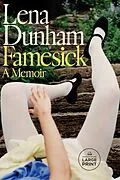
Famesick
Beschreibung
In this rowdy, frank reflection on illness, fame, sex, and everything in between, the remarkable mind behind the hit series For the last decade, as she’s spent countless hours in doctor’s waiting rooms searching for diagnoses, treatments, and relie...Format auswählen
- Kartonierter Einband (Kt)CHF 35.00

Wird oft zusammen gekauft
Andere Kunden kauften auch
Beschreibung
In this rowdy, frank reflection on illness, fame, sex, and everything in between, the remarkable mind behind the hit series For the last decade, as she’s spent countless hours in doctor’s waiting rooms searching for diagnoses, treatments, and relief, being the owner and operator of Lena Dunham’s body has felt, as she puts it, “like towing a wrecked car across town at midnight.” It’s not easy dragging a wrecked car anywhere, much less to the Met Gala while sewn into a gold lamé corset. Or to the set of the hit show that you--as a twenty-five-year-old--are writing, directing, producing, and starring in. Or to the White House, the Golden Globes, or your publicist’s office to discuss the latest internet disaster. But Dunham does it--even if it means interminable hospital stays, vomiting in the bathroom when she’s meant to be meeting Oprah, or terrifying those closest to her--because she can no longer tell the difference between fighting to do what she loves and being a servant to her own ambition. All the while, she is holding out for a love that can withstand her personal and public challenges and, more than anything, yearning to feel like herself again--if only she could remember who that self was. As Dunham takes us through her journey, tracking her rise to fame--from selling the pilot of In <Famesick<, Dunham asks herself what the cost of fulfilling her dreams has really been, and whether it was worth it. What she finds is deeper than physical relief, and more lasting, as she learns to live with what she can’t change and turn her regrets into wisdom that can carry her forward, as she reconnects to what, and who, she loves....
Autorentext
Lena Dunham is an award-winning multi-hyphenate. She is the #1 New York Times bestselling author of the essay collection Not That Kind of Girl, the creator of the HBO series Girls, for which she was nominated for eight Emmy awards and won two Golden Globes, including Best Actress, and the first woman to win the Directors Guild of America award for directorial achievement in comedy. Lena is also the writer, director, and star of Tiny Furniture, which won an Independent Spirit Award for Best First Screenplay; she has since written and directed the films Sharp Stick and Catherine Called Birdy. She’s also a host of the podcast The C-Word, which examines the stories of women that history loves to call “crazy.”
Klappentext
INSTANT #1 NEW YORK TIMES BESTSELLER • In this rowdy, frank reflection on illness, fame, sex, and everything in between, the remarkable mind behind the hit series Girls and the bestselling author of Not That Kind of Girl asks whether fulfilling her creative ambitions has been worth the pain.
For the last decade, as she’s spent countless hours in doctor’s waiting rooms searching for diagnoses, treatments, and relief, being the owner and operator of Lena Dunham’s body has felt, as she puts it, “like towing a wrecked car across town at midnight.” It’s not easy dragging a wrecked car anywhere, much less to the Met Gala while sewn into a gold lamé corset. Or to the set of the hit show that you—as a twenty-five-year-old—are writing, directing, producing, and starring in. Or to the White House, the Golden Globes, or your publicist’s office to discuss the latest internet disaster. But Dunham does it—even if it means interminable hospital stays, vomiting in the bathroom when she’s meant to be meeting Oprah, or terrifying those closest to her—because she can no longer tell the difference between fighting to do what she loves and being a servant to her own ambition. All the while, she is holding out for a love that can withstand her personal and public challenges and, more than anything, yearning to feel like herself again—if only she could remember who that self was.
As Dunham takes us through her journey, tracking her rise to fame—from selling the pilot of Girls to the present—in three acts, it becomes clear that the spotlight casts long shadows, distorting the relationships she once held dear and isolating everyone in its glare. When an endless supply of drugs can’t protect you from pain—and begins to control your every move—being famous doesn’t stand a chance against the darker corners of the human experience.
In Famesick, Dunham asks herself what the cost of fulfilling her dreams has really been, and whether it was worth it. What she finds is deeper than physical relief, and more lasting, as she learns to live with what she can’t change and turn her regrets into wisdom that can carry her forward, as she reconnects to what, and who, she loves.
Leseprobe
Introduction
My name is Lena Dunham. That’s the name my mother gave me—and, as is the case in many of the most successful marriages, my father had little choice in the matter. Lena was the name of my great-grandmother, a woman who had emigrated from Russia with seven children, having already buried two or three depending on who tells it, with burns up and down her chubby arms from taking bread in and out of the oven. My mother’s name, Laurie, shared only the first letter of her grandmother’s—my own grandmother said it was Ashkenazi tradition, but in fact that only applied to living family members, and Lena was dead. In actuality, my grandparents wanted their daughters to have all-American names, untraceable names—Susie, Laurie, Bonnie. “Diminutive names,” my mother had always called them. “They weren’t strong names—they were names for little girls.” Laurie spent her teens irate about this, sure that as a Lena her life would have been full of lust and glamour, whereas a plain old Laurie was relegated to supporting character status, cute at best. My mother loved my father’s surname—loved that it was WASPy, older than America itself—unlike hers, Simmons, which had been changed at least four times over the generations to disguise its origins. There would be no middle name—she considered them vaguely frivolous. Just Lena Dunham. My mother said she chose it because it sounded like the name of someone who could be a movie star or a lawyer with an equal measure of success.
I carried the name through preschool, where I learned to write it early but didn’t understand that an E could only have three lines protruding from it and so insisted on dozens; through lower and middle school, where it took on the hard-to-shake stink of unpopularity, a name usually used in the context of hoping someone would not be joining the social function; and through high school and college, where I used it to sign endless poems about abstract feeling of disease. All these uses were natural, the classic stuff of growing up as oneself. It was only when the name entered the spin cycle of mass media—surprising my early classmates, my family, but no one more than myself—that it started to feel alien, like a character in a film I didn’t write. It became a mark of excellence, then a signifier of a certain kind of millennial absurdity, and—finally—a punch line that felt more like a slur.
By the time I was twenty-six, I trusted few people. I stopped wanting to share my name—one I had proudly offered as a child, announcing to anyone who would listen “I’m Lena Dunham. I have no middle name,” as if the very fact made me interesting. But now, I didn’t trust people to handle it with care, and I didn’t trust myself to protect it.
And so, at various times over the last decade, I have called myself Rose O’Neill, Renata Halpern, Lauri Reynolds, Ruth Stein—dealer’s choice of fake names to use when checking …