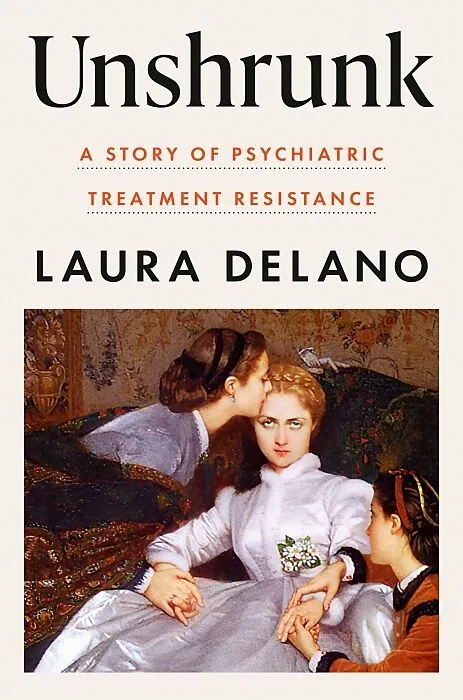
Unshrunk
Beschreibung
The powerful memoir of one woman’s experience with psychiatric diagnoses and medications, and her journey to discover At age fourteen, Laura Delano saw her first psychiatrist who immediately diagnosed her with bipolar disorder and started her on a mood s...Format auswählen
- Fester EinbandCHF 33.20

Wird oft zusammen gekauft
Andere Kunden kauften auch
Beschreibung
The powerful memoir of one woman’s experience with psychiatric diagnoses and medications, and her journey to discover At age fourteen, Laura Delano saw her first psychiatrist who immediately diagnosed her with bipolar disorder and started her on a mood stabilizer and antidepressant. At school, Delano was elected the class president and earned straight-As and a national squash ranking; at home, she unleashed all the rage and despair she felt, lashing out at her family and locking herself in her bedroom, obsessing over death. Delano’s initial diagnosis marked the beginning of a life-altering saga. For the next thirteen years, she sought help from the best psychiatrists and hospitals in the country, accumulating a long list of diagnoses and a prescription cascade of nineteen drugs. After some resistance, Delano accepted her diagnosis and embraced the pharmaceutical regimen that she’d been told was necessary to manage her incurable, lifelong disease. But her symptoms only worsened. Eventually doctors declared her condition so severe as to be "treatment resistant." A disturbing series of events left her demoralized, but sparked a last glimmer of possibility . . . what if her life was falling apart not in spite of her treatment, but because of it? After years of faithful psychiatric patienthood, Delano realized there was one thing she hadn’t tried--leaving behind the drugs and diagnoses . This decision would mean unlearning everything the experts had told her about herself and forging into the terrifying unknown of an unmedicated life. Weaving Delano''s medical records and doctors'' notes from her time in treatment with illuminating research on the drugs she was prescribed, <Unshrunk <questions;the dominant, rarely critiqued role that the American mental health industry, and the pharmaceutical industry in particular, plays in shaping what it means to be human....
Autorentext
Laura Delano is a writer, speaker, and consultant, and the founder of Inner Compass Initiative, a nonprofit organization that helps people make more informed choices about psychiatric diagnoses, drugs, and drug withdrawal. She is a leading voice in the international movement of people who’ve left behind the medicalized, professionalized mental health industry to build something different. Laura works with individuals and families around the world who are seeking guidance and support for the withdrawal journey and life post-psychiatry. She lives in Connecticut with her husband and children.
Klappentext
**One of NPR’s 2025 “Books We Love”
“Delano’s story is compelling, important and even haunting. . . . Her memoir evokes Girl, Interrupted for the age of the prescription pill. . . . In Unshrunk, she tells her own story, and she tells it powerfully.” —Casey Schwartz, The New York Times Book Review
“An unsparing account. . . . What makes Unshrunk so valuable is not that Ms. Delano’s mental-health struggles are unusual. Just the opposite: Her experience is depressingly commonplace in 21st-century America, as are the ‘solutions’ she was offered. Yet only rarely are these struggles described with such insight and self-awareness.” —Carl Elliott, The Wall Street Journal
“A must read for anyone probing the dark side of mental health treatment.” —Anna Lembke, MD, New York Times bestselling author of Dopamine Nation
“A really moving and heart-rending story. Unshrunk will help and empower so many people.” —Johann Hari, New York Times bestselling author of Stolen Focus
The powerful memoir of one woman’s experience with psychiatric diagnoses and medications, and her journey to discover herself outside the mental health industry**
At age fourteen, Laura Delano saw her first psychiatrist, who immediately diagnosed her with bipolar disorder and started her on a mood stabilizer and an antidepressant. At school, Delano was elected the class president and earned straight-As and a national squash ranking; at home, she unleashed all the rage and despair she felt, lashing out at her family and locking herself in her bedroom, obsessing over death.
Delano’s initial diagnosis marked the beginning of a life-altering saga. For the next thirteen years, she sought help from the best psychiatrists and hospitals in the country, accumulating a long list of diagnoses and a prescription cascade of nineteen drugs. After some resistance, Delano accepted her diagnosis and embraced the pharmaceutical regimen that she’d been told was necessary to manage her incurable, lifelong disease. But her symptoms only worsened. Eventually doctors declared her condition so severe as to be “treatment resistant.” A disturbing series of events left her demoralized, but sparked a last glimmer of possibility. . . . What if her life was falling apart not in spite of her treatment, but because of it? After years of faithful psychiatric patienthood, Delano realized there was one thing she hadn’t tried—leaving behind the drugs and diagnoses. This decision would mean unlearning everything the experts had told her about herself and forging into the terrifying unknown of an unmedicated life.
Weaving Delano’s medical records and doctors’ notes with an investigation of modern psychiatry and illuminating research on the drugs she was prescribed, Unshrunk questions the dominant, rarely critiqued role that the American mental health industry, and the pharmaceutical industry in particular, plays in shaping what it means to be human.
Leseprobe
Preface
My youth was shaped by the language of psychiatric diagnosis. Its meticulous symptom lists and tidy categories defined my teens and twenties and determined my future. I believed that my primary condition, bipolar disorder, was an incurable brain disease that would only worsen without medications, therapy, and the occasional stay on a psych ward. This belief was further reinforced each time I heard of the tragic destruction befalling someone who stopped her meds because she thought she could outsmart her disease. I embraced the promises of a psychopharmaceutical solution, welcoming the regimen of pills I ingested in the hope that they’d bring me stability, reliability, functionality. That they’d show me what it felt like to be happy or, at the very least, have some peace of mind. That they’d maybe, one day, even provide me with the chance to feel something close to normal.
I took all of this as objective fact; who was I to question any of it? I wasn’t a doctor. I hadn’t gone to graduate school to become an expert in brain biochemistry. I didn’t know how to interpret scientific research or comprehend dense pharmacological information. Doctors made an oath to, first, do no harm, after all. If there was a better way to resolve my dysfunctional suffering, I surely would have heard about it. My parents had the financial means to get me top-notch care from some of the nation’s best doctors and psychiatric hospitals, and so we dove right in, desperate for answers, eager to get me needed relief. We accepted the grave reality that came with a disease like bipolar disorder: the unpredictable ups and downs, the inability to take on too much stress or responsibility, the many impulsive mistakes and destructive behaviors I’d engage in during unmanageable episodes, the risk I’d kill myself. For fourteen years, I lived tethered to the belief that my brain was broken, and redesigned my entire life around the singular purpose of fixing it.
If you’d told me back then that I’d one day decide to face my agonizing emotions, twisted thoughts, and relief-seeking impulses without translating them into sym…