
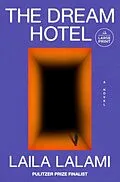
The Dream Hotel: A Read with Jenna Pick
Beschreibung
From Laila Lalami--the Pulitzer Prize and National Book Award finalist and a “maestra of literary fiction” (NPR)--comes a riveting and utterly original novel about one woman’s fight for freedom, set in a near future where even dreams are unde...Format auswählen
- Kartonierter EinbandCHF 33.20

Wird oft zusammen gekauft
Andere Kunden kauften auch
Beschreibung
From Laila Lalami--the Pulitzer Prize and National Book Award finalist and a “maestra of literary fiction” (NPR)--comes a riveting and utterly original novel about one woman’s fight for freedom, set in a near future where even dreams are under surveillance. Sara has just landed at LAX, returning home from a conference abroad, when agents from the Risk Assessment Administration pull her aside and inform her that she will soon commit a crime. Using data from her dreams, the RAA’s algorithm has determined that she is at imminent risk of harming the person she loves most: her husband. For his safety, she must be kept under observation for twenty-one days. The agents transfer Sara to a retention center, where she is held with other dreamers, all of them women trying to prove their innocence from different crimes. With every deviation from the strict and ever-shifting rules of the facility, their stay is extended. Months pass and Sara seems no closer to release. Then one day, a new resident arrives, disrupting the order of the facility and leading Sara on a collision course with the very companies that have deprived her of her freedom. Eerie, urgent, and ceaselessly clear-eyed, <The Dream Hotel <artfully explores;the seductive nature of technology, which puts us in shackles even as it makes our lives easier. Lalami;asks;how much of ourselves must remain private if we are to remain free, and whether even the most invasive forms of surveillance;can ever capture who we really are.
Autorentext
LAILA LALAMI is the author of five books, including The Moor’s Account, which won the American Book Award, the Arab-American Book Award, and the Hurston/Wright Legacy Award; was on the longlist for the Booker Prize; and was a finalist for the Pulitzer Prize. Her most recent novel, The Other Americans, was a national bestseller, won the Simpson/Joyce Carol Oates Prize, and was a finalist for the National Book Award. Her books have been translated into twenty languages. Lalami's writing appears regularly in the Los Angeles Times, The Washington Post, The Nation, Harper’s, The Guardian, and The New York Times. She has been awarded fellowships from the British Council, the Fulbright Program, the Guggenheim Foundation, and the Radcliffe Institute at Harvard University. She lives in Los Angeles.
Klappentext
From Laila Lalami—the Pulitzer Prize and National Book Award finalist and a “maestra of literary fiction” (NPR)—comes a riveting and utterly original novel about one woman’s fight for freedom, set in a near future where even dreams are under surveillance.
Sara has just landed at LAX, returning home from a conference abroad, when agents from the Risk Assessment Administration pull her aside and inform her that she will soon commit a crime. Using data from her dreams, the RAA’s algorithm has determined that she is at imminent risk of harming the person she loves most: her husband. For his safety, she must be kept under observation for twenty-one days.
The agents transfer Sara to a retention center, where she is held with other dreamers, all of them women trying to prove their innocence from different crimes. With every deviation from the strict and ever-shifting rules of the facility, their stay is extended. Months pass and Sara seems no closer to release. Then one day, a new resident arrives, disrupting the order of the facility and leading Sara on a collision course with the very companies that have deprived her of her freedom.
Eerie, urgent, and ceaselessly clear-eyed, The Dream Hotel artfully explores the seductive nature of technology, which puts us in shackles even as it makes our lives easier. Lalami asks how much of ourselves must remain private if we are to remain free, and whether even the most invasive forms of surveillance can ever capture who we really are.
Leseprobe
1
The dream cedes to reality, or perhaps it’s the other way around, and she pulls herself from the tangle of sheets and stumbles out into the hallway. There she waits, barefoot on the cold floor, until the bell stops ringing. She stands still, limbs straight, eyes fixed on a point in the middle distance; if Madison has taught her anything, it is that compliance begins in the body. The trick is to hide any flicker of personality or hint of difference. From white domes on the ceiling, the cameras watch.
The others line up alongside her, rubbing sleep from their eyes, squinting under the chrome-plated lights. The fixtures date back to 1939, when Madison was a public elementary school, enrolling as many as four hundred children every fall. Back then, the town of Ellis had a farming-tool factory, a movie theater, a thriving pool hall, two modest hotels, and natural hot springs that attracted tourists from ninety miles away in Los Angeles. A century later, the factory had shuttered, and the springs were dry. The school sat empty, its walls spotting with mold, until the city council sold it to Safe-X. Because of legal constraints on renovation, Madison’s new owners had to keep the original lighting and metalwork, but they threw away the blackboards, stripped the state maps and alphabet posters from the walls, auctioned off the furniture, and converted the second floor into a ward.
When they brought her to her cot in 208, the smell of industrial floor cleaner made her ill. She wrestled with the window, her knuckles turning white before she noticed that it had been welded shut. But these days the smell of synthetic pine doesn’t bother her as much. Living with strangers in bare rooms, showering next to them in open stalls, standing behind them in line for the comm pods—all these have taught her to be alert to more intimate scents. From four feet away, she can smell the cream her roommate rubs on her skin to treat the rash she developed in the jail.
The attendants bristle when one of the women calls Madison a jail. This is a retention center, they say, it’s not a prison or a jail. You haven’t been convicted, you’re not serving time. You’re being retained only until your forensic observation is complete. How much longer, someone will always ask. Depends, the attendants say. Some retainees stay just twenty-one days; others have to stay a bit longer. The attendants never call the women prisoners. They say retainees, residents, enrollees, and sometimes program participants.
Hinton comes through the gate seven minutes after six. There must’ve been some traffic on the highway, or a delay during the security briefing. This morning his hair looks freshly cut, bringing out his high cheekbones and bright, hungry eyes. But his fine features are muddled by the burn scar that runs along the base of his neck, just above the stiff collar of his uniform. The scar is a frequent subject of gossip at Madison. Some people say Hinton was injured in the Tujunga complex fire, which burned his house to the ground and killed his dog, supposedly a German shepherd. Others point out that the scar looks old, so it must be the mark of a youthful accident, a mishap with a firecracker, say, or a brawl around a campfire. Who knows? But the scar gives him substance, rescues his looks from bland perfection.
Unhurriedly, he makes his way down the hall. At 202 he berates two retainees for a towel lying in a heap on the floor. That it must have slipped from its hook on the wall doesn’t matter; they’re responsible for keeping their quarters tidy. There’s another issue in 205, something about an overflowing wastebasket. But it’s only at 207 that his vigilance pays off. He finds, under a blanket, a battery-powered night-light, smaller than a fingernail. Staying awake past ten is against the rules, everyone knows that. “You people amaze me,” he says, whistl…