
IHR WARENKORB IST AKTUELL LEER.
Haben Sie noch nichts passendes gefunden? Stöbern Sie durch unser komplettes Sortiment.
Oder melden Sie sich an bzw. registrieren Sie sich.
- Kostenlose Lieferung
- Kauf auf Rechnung
- Ex Libris Tiefpreis
- Filiallieferung und 650+ Abholorte
- Rabatt-Bons als Club-Mitglied
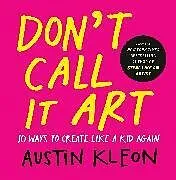
Don't Call It Art
Beschreibung
Autorentext Austin Kleon is the New York Times bestselling author of three previous books about creativity in the digital age: Steal Like an Artist, Show Your Work!, and Keep Going, along with Newspaper Blackout, a collection of poems made by redacting the new...Format auswählen
- Fester EinbandCHF 26.80
Wird oft zusammen gekauft
Andere Kunden kauften auch
Beschreibung
Autorentext
Austin Kleon is the New York Times bestselling author of three previous books about creativity in the digital age: Steal Like an Artist, Show Your Work!, and Keep Going, along with Newspaper Blackout, a collection of poems made by redacting the newspaper with a permanent marker. He’s been featured on NPR’s Morning Edition, PBS Newshour, and in The New York Times and The Wall Street Journal. New York Magazine called his work “brilliant,” and The Atlantic called him “positively one of the most interesting people on the Internet.” He speaks at organizations such as Pixar, Google, Netflix, SXSW, TEDx, Dropbox, Adobe, and The Economist. In previous lives, he worked as a librarian, a web designer, and an advertising copywriter. He lives in Austin, Texas, with his wife and sons.
Klappentext
**NATIONAL BESTSELLER
Rediscover the joy of creating – with kid-inspired insights from the bestselling author of Steal Like an Artist**
Feeling burnt out, distracted, and out of fresh ideas? In every creative person's life, there are times when you lose the energy, joy, and freedom you had when you were first starting out. From the recent art school graduate to the retiree searching for their creative third act, we all need help returning to the excitement, the sense of discovery, and the raw creativity of a child at play. Don't Call It Art is a creative liberation handbook for looking at the world with fresh eyes, unlearning what you've learned, and making new leaps in your life and work.
Since his breakout New York Times bestseller Steal Like an Artist, Austin Kleon has been one of the world's leading teachers of creativity. His books have sold nearly two million copies and translated into 30 languages. Now, in his most encouraging and inspiring book yet, Kleon shares ten rejuvenating lessons he learned from being a studio assistant to the artists closest to his heart: his two young sons. Kleon discovered that nurturing his kids taught him how to create the conditions under which his own – and everyone's creativity – can thrive.
Don't Call It Art offers inspiring advice for readers looking to free their creative spirit including:
• Permission to be bad
• Believe in magic
• Throw out the instructions
• You don’t need a vision
• Think outside your head
Illustrated in Kleon's signature style of illustrations, quotes, stories and examples, Don't Call It Art is a blast of creative energy that will give you permission to play, make a mess, and venture beyond your imagination – and ultimately, to feel the unbridled joy of creating in your own unique way.
Leseprobe
I never went to art school, but being around my kids was more inspiring than any art school I can imagine. By the time my boys were toddlers, they drew like two pint-sized Picassos. They worked the way I dreamed of working: without fear or hesitation, just wild energy, raw passion, and a lightness of touch.
They schooled me, all right--you could even say they unschooled me. I had assumed, as their dad and the author of Steal Like an Artist and other books about creativity that have sold millions of copies around the world, that I would be their teacher and they would be my students. It soon became clear that the opposite was true: I had way more to learn from them than they had to learn from me.
So, I apprenticed myself to beginners. I was the studio assistant now, and things went smoothly as long as I knew my place. My job was to fetch art supplies, fix snacks, and soothe tantrums. Anytime I tried to give them pointers or tell them what to do, it backfired on me. I learned to keep my mouth shut and my eyes open. Occasionally, they let me join the fun, but they certainly didn't need anybody to teach them how to be creative. What they needed was for me to be there when called upon but otherwise stay out of their way.
Whenever I shared the stuff they made online, readers kept asking me when I was going to write a book about creativity for kids.
"Kids don't need a book!" I'd protest. "We need a book so we can be more like them!"
This is that book.
As I was learning to love and care for these little artists in my life, I started wondering why I didn't show myself the same love and care. It was the thought I had when I read parenting books: Why are we doing all this stuff for our kids but not ourselves? Why aren't we all taking time to play? Why aren't we all letting ourselves get bored? Why aren't we all limiting our screen time and going outside?
One day I was listening to an interview with the musician Fiona Apple, and she admitted that she reads a lot of parenting books, not because she plans on having kids but because she wants to learn how to parent herself. "So, you're the parent and the child?" the interviewer asked.
"Well, I mean, you always have to be," Apple said. "Everybody has to be for themselves, I think."
In this book, I'm going to help you learn how to treat yourself with the care of a loving parent so that the wild, creative kid who still lives in you can come out and play.
I want to emphasize here that you do not need to have kids or want to have kids or even like kids to read this book! But if you do have kids in your life, you can think of this book as a parenting book in disguise. All of the lessons here can be used as strategies to help support a kid's creativity. (I hope you'll learn them for yourself first, so you can set a good example.)
At some point in your creative life, you might discover that, in the words of Murray Stein, you are your "own worst enemy, harshest critic, and severest taskmaster." You can lose touch with all that energy, joy, and freedom you felt when you were just starting out. Whether you've failed to achieve your goals or had success beyond your wildest dreams, it's easy to get bored, stuck, or find yourself just going through the motions. You feel washed up. Burned-out. Like you'll never make anything good again.
Being around my kids liberated me from so many of these feelings. These are the lessons I learned. I hope they will help you.
When they were little, my kids were great at making art because they weren't worrying about making art.
Trying to make art is the easiest way to keep yourself from actually making art. When you're trying to make art, your head is full of all kinds of instructions about what is and isn't art and what you should and shouldn't do. But if you don't call it art, you take all the pressure off. Now you can just make stuff.
If you're not worried about making art, then you don't have to worry about any art critics. Little kids don't have a critic in their heads until we put one there. Once an inner critic takes up residence, we say all kinds of horrible things to ourselves that we would never say to others. Our inner art critic asks us who we think we are, what we think we're doing, where we get the nerve, why we even bother, when we are going to get serious and get a real job, how we expect to make a living, when we are going to do something original, and why we expect anyone to ever care about this absolute crap we are producing.
"Were we to meet this figure socially, this accusatory character, this internal critic, this unrelenting fault-finder, we would think there was something wrong with him," writes Adam Phillips. "He would just be boring and cruel. We might think that something terrible had happened to him, that he was living in the aftermath, in the fallout, of some catastrophe. And we would be right."
Luckily, art critics are only interested in art. If you don't call it art, the critics won't care what you're doing, and they'll leave you alone.
Now you can do whatever you want.
In the beginning, we don't know enough to know …