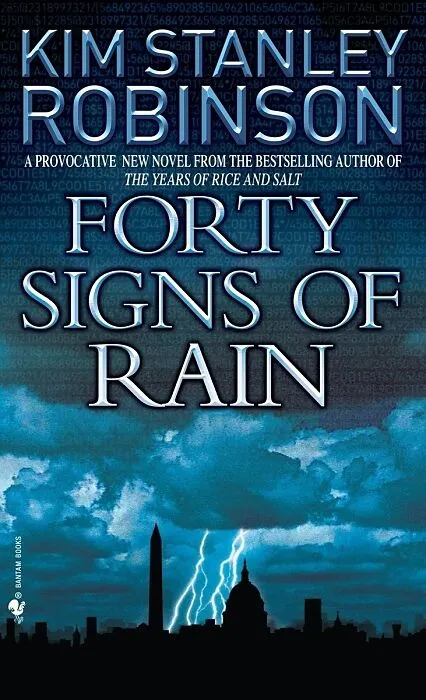
Forty Signs of Rain
Beschreibung
Informationen zum Autor Kim Stanley Robinson Klappentext The bestselling author of the classic Mars trilogy and The Years of Rice and Salt presents a riveting new trilogy of cutting-edge science, international politics, and the real-life ramifications of globa...Format auswählen
- Kartonierter EinbandCHF 15.70
Wird oft zusammen gekauft
Andere Kunden kauften auch
Beschreibung
Informationen zum Autor Kim Stanley Robinson Klappentext The bestselling author of the classic Mars trilogy and The Years of Rice and Salt presents a riveting new trilogy of cutting-edge science, international politics, and the real-life ramifications of global warming as they are played out in our nation's capitaland in the daily lives of those at the center of the action. Hauntingly yet humorously realistic, here is a novel of the near future that is inspired by scientific facts already making headlines. When the Arctic ice pack was first measured in the 1950s, it averaged thirty feet thick in midwinter. By the end of the century it was down to fifteen. One August the ice broke. The next year the breakup started in July. The third year it began in May. That was last year. It's a muggy summer in Washington, D.C., as Senate environmental staffer Charlie Quibler and his scientist wife, Anna, work to call attention to the growing crisis of global warming. But as these everyday heroes fight to align the awesome forces of nature with the extraordinary march of technology, fate puts an unusual twist on their effortsone that will place them at the heart of an unavoidable storm. Leseprobe I The Buddha Arrives The Earth is bathed in a flood of sunlight. A fierce inundation of photonson average, 342 joules per second per square meter. 4185 joules (one calorie) will raise the temperature of one kilogram of water by one degree Celsius. If all this energy were captured by the Earth's atmosphere, its temperature would rise by ten degrees Celsius in one day. Luckily much of it radiates back to space. How much depends on albedo and the chemical composition of the atmosphere, both of which vary over time. A good portion of Earth's albedo, or reflectivity, is created by its polar ice caps. If polar ice and snow were to shrink significantly, more solar energy would stay on Earth. Sunlight would penetrate oceans previously covered by ice, and warm the water. This would add heat and melt more ice, in a positive feedback loop. The Arctic Ocean ice pack reflects back out to space a few percent of the total annual solar energy budget. When the Arctic ice pack was first measured by nuclear submarines in the 1950s, it averaged thirty feet thick in midwinter. By the end of the century it was down to fifteen. Then one August the ice broke up into large tabular bergs, drifting on the currents, colliding and separating, leaving broad lanes of water open to the continuous polar summer sunlight. The next year the breakup started in July, and at times more than half the surface of the Arctic Ocean was open water. The third year, the breakup began in May. That was last year. Weekdays always begin the same. The alarm goes off and you are startled out of dreams that you immediately forget. Predawn light in a dim room. Stagger into a hot shower and try to wake up all the way. Feel the scalding hot water on the back of your neck, ah, the best part of the day, already passing with the inexorable clock. Fragment of a dream, you were deep in some problem set now escaping you, just as you tried to escape it in the dream. Duck down the halls of memorygone. Dreams don't want to be remembered. Evaluate the night's sleep. Anna Quibler decided the previous night had not been so good. She was exhausted already. Joe had cried twice, and though it was Charlie who had gotten up to reassure him, as part of their behavioral conditioning plan which was intended to convey to Joe that he would never again get Mom to visit him at night, Anna had of course woken up too, and vaguely heard Charlie's reassurances: "Hey. Joe. What's up. Go back to sleep, buddy, it's the middle of the night here. Nothing gets to happen until morning, so you might as well. This is pointless this wailing, why do you do this, good night da...
Autorentext
Kim Stanley Robinson
Klappentext
The bestselling author of the classic Mars trilogy and The Years of Rice and Salt presents a riveting new trilogy of cutting-edge science, international politics, and the real-life ramifications of global warming as they are played out in our nation’s capital—and in the daily lives of those at the center of the action. Hauntingly yet humorously realistic, here is a novel of the near future that is inspired by scientific facts already making headlines.
When the Arctic ice pack was first measured in the 1950s, it averaged thirty feet thick in midwinter. By the end of the century it was down to fifteen. One August the ice broke.
The next year the breakup started in July. The third year it began in May.
That was last year.
It’s a muggy summer in Washington, D.C., as Senate environmental staffer Charlie Quibler and his scientist wife, Anna, work to call attention to the growing crisis of global warming. But as these everyday heroes fight to align the awesome forces of nature with the extraordinary march of technology, fate puts an unusual twist on their efforts—one that will place them at the heart of an unavoidable storm.
Leseprobe
I
The
Buddha
Arrives
The Earth is bathed in a flood of sunlight. A fierce inundation of photons—on average, 342 joules per second per square meter. 4185 joules (one calorie) will raise the temperature of one kilogram of water by one degree Celsius. If all this energy were captured by the Earth's atmosphere, its temperature would rise by ten degrees Celsius in one day.
Luckily much of it radiates back to space. How much depends on albedo and the chemical composition of the atmosphere, both of which vary over time.
A good portion of Earth's albedo, or reflectivity, is created by its polar ice caps. If polar ice and snow were to shrink significantly, more solar energy would stay on Earth. Sunlight would penetrate oceans previously covered by ice, and warm the water. This would add heat and melt more ice, in a positive feedback loop.
The Arctic Ocean ice pack reflects back out to space a few percent of the total annual solar energy budget. When the Arctic ice pack was first measured by nuclear submarines in the 1950s, it averaged thirty feet thick in midwinter. By the end of the century it was down to fifteen. Then one August the ice broke up into large tabular bergs, drifting on the currents, colliding and separating, leaving broad lanes of water open to the continuous polar summer sunlight. The next year the breakup started in July, and at times more than half the surface of the Arctic Ocean was open water. The third year, the breakup began in May.
That was last year.
Weekdays always begin the same. The alarm goes off and you are startled out of dreams that you immediately forget. Predawn light in a dim room. Stagger into a hot shower and try to wake up all the way. Feel the scalding hot water on the back of your neck, ah, the best part of the day, already passing with the inexorable clock. Fragment of a dream, you were deep in some problem set now escaping you, just as you tried to escape it in the dream. Duck down the halls of memory—gone. Dreams don't want to be remembered.
Evaluate the night's sleep. Anna Quibler decided the previous night had not been so good. She was exhausted already. Joe had cried twice, and though it was Charlie who had gotten up to reassure him, as part of their behavioral conditioning plan which was intended to convey to Joe that he would never again get Mom to visit him at night, Anna had of course woken up too, and vaguely heard Charlie's reassurances: "Hey. Joe. What's up. Go back to sleep, buddy, it's the middle of the night here. Nothing gets to happen until morning, so you might as well. This is pointless this wailing, why do you do this, good night damn it."
A brusque bedside manner at best, but that was part of the plan. After that she had tossed and turned for long minutes, trying heroically not to think of …