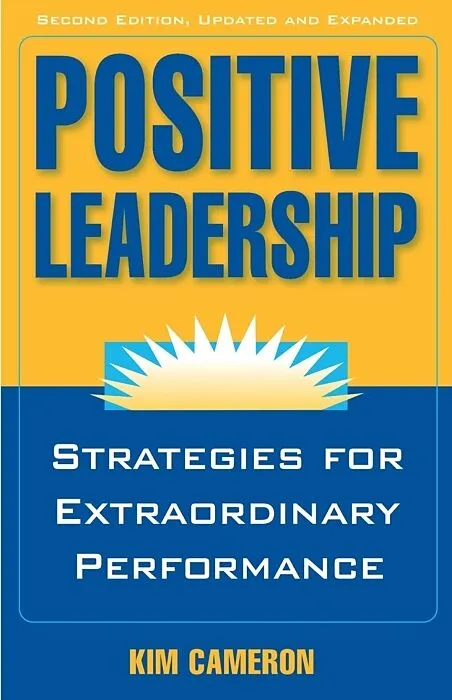
Positive Leadership
Beschreibung
Informationen zum Autor Kim Cameron is William Russell Kelly Professor of Management and Organizations at the University of Michigan and cofounder of the Center for Positive Organizational Scholarship. He is coauthor or co-editor of fourteen books, including D...Format auswählen
- BroschiertCHF 27.10

Wird oft zusammen gekauft
Andere Kunden kauften auch
Beschreibung
Informationen zum Autor Kim Cameron is William Russell Kelly Professor of Management and Organizations at the University of Michigan and cofounder of the Center for Positive Organizational Scholarship. He is coauthor or co-editor of fourteen books, including Developing Management Skills, Positive Organizational Scholarship, and Making the Impossible Possible. Klappentext The first edition introduced the newly emerging field called Positive Organizational Scholarship. Rather than focusing on organizational dysfunction, Positive Organizational Scholarship looks at organizations that are functioning at an unusually high level. Learning from such successful groups about what they did right forms the backbone of the strategy, because strategies that capitalize on the positive tend to produce life-giving, flourishing outcomes in organizations. The four strategies discussed in the first edition included the cultivation of positive climate, positive relationships, positive communication, and positive meaning. Each strategy is explained and illustrated. In this revised edition, the author will add the following materials: Chapter 1: Outlining three outcomes associated with positive leadership and one more example. Chapter 2: Adding some empirical findings linking attributes of climate with physiological benefits. Chapter 3: A brief discussion of temporary encounters with positive or negative outcomes. Chapter 4: Additional research on the results of the positive-to-negative-communication-ratio. Chapter 5: Elaboration on the issue of meaningfulness in work. Chapter 6: More ideas for implementation Zusammenfassung Updated Edition: Translates years of social science research into actionable guidelines for leaders who wish to make a positive difference in the world. Amy C. Edmondson, Novartis Professor of Leadership and Management, Harvard Business School Positive Leadership shows how to reach beyond ordinary success to achieve extraordinary effectiveness, spectacular results, and what Kim Cameron calls positively deviant performanceperformance far above the norm. Citing a wide range of research in organizational behavior, medical science, and psychology as well as real-world examples, Cameron shows that to achieve exceptional success, leaders must emphasize strengths rather than simply focus on weaknesses; foster virtuous actions such as compassion, gratitude, and forgiveness; encourage contribution goals in addition to achievement goals; and enable meaningfulness in work. In this concise, inspiring, and practical guide, Cameron describes four positive leadership strategies, lays out a proven process for implementing them, and includes a self-assessment instrument. This second edition has been updated throughout with new research findings and new ideas for implementing positive leadership. Inhaltsverzeichnis Preface 1 Positive Leadership 2 Positive Climate 3 Positive Relationships 4 Positive Communication 5 Positive Meaning 6 Implementing Positive Strategies 7 Developing Positive Leadership References Index About the Author...
Autorentext
Kim Cameron is William Russell Kelly Professor of Management and Organizations at the University of Michigan and cofounder of the Center for Positive Organizational Scholarship. He is coauthor or co-editor of fourteen books, including Developing Management Skills, Positive Organizational Scholarship, and Making the Impossible Possible.
Klappentext
The first edition introduced the newly emerging field called Positive Organizational Scholarship. Rather than focusing on organizational dysfunction, Positive Organizational Scholarship looks at organizations that are functioning at an unusually high level. Learning from such successful groups about what they did right forms the backbone of the strategy, because strategies that capitalize on the positive tend to produce life-giving, flourishing outcomes in organizations.The four strategies discussed in the first edition included the cultivation of positive climate, positive relationships, positive communication, and positive meaning. Each strategy is explained and illustrated. In this revised edition, the author will add the following materials:
Chapter 1: Outlining three outcomes associated with positive leadership and one more example.
Chapter 2: Adding some empirical findings linking attributes of climate with physiological benefits.
Chapter 3: A brief discussion of temporary encounters with positive or negative outcomes.
Chapter 4: Additional research on the results of the positive-to-negative-communication-ratio.
Chapter 5: Elaboration on the issue of meaningfulness in work.
Chapter 6: More ideas for implementation
Zusammenfassung
Updated Edition: “Translates years of social science research into actionable guidelines for leaders who wish to make a positive difference in the world.” —Amy C. Edmondson, Novartis Professor of Leadership and Management, Harvard Business School
Positive Leadership shows how to reach beyond ordinary success to achieve extraordinary effectiveness, spectacular results, and what Kim Cameron calls “positively deviant performance”—performance far above the norm. Citing a wide range of research in organizational behavior, medical science, and psychology as well as real-world examples, Cameron shows that to achieve exceptional success, leaders must emphasize strengths rather than simply focus on weaknesses; foster virtuous actions such as compassion, gratitude, and forgiveness; encourage contribution goals in addition to achievement goals; and enable meaningfulness in work.
In this concise, inspiring, and practical guide, Cameron describes four positive leadership strategies, lays out a proven process for implementing them, and includes a self-assessment instrument. This second edition has been updated throughout with new research findings and new ideas for implementing positive leadership.
Inhalt
Preface
1 Positive Leadership
2 Positive Climate
3 Positive Relationships
4 Positive Communication
5 Positive Meaning
6 Implementing Positive Strategies
7 Developing Positive Leadership
References
Index
About the Author