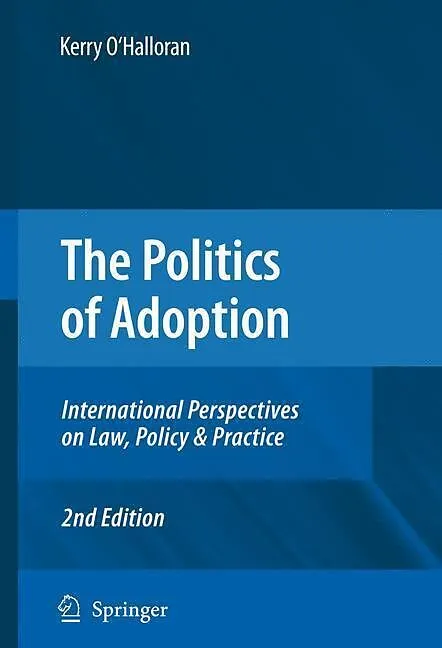

The Politics of Adoption
Beschreibung
Lawyer, academic and social worker Kerry O'Halloran analyses the fundamental social and legal functions of adoption. It is a timely publication, in this, its second edition, as across the world adoption law reform is now giving rise to contentious issues....Format auswählen

Wird oft zusammen gekauft
Andere Kunden kauften auch
Beschreibung
Lawyer, academic and social worker Kerry O'Halloran analyses the fundamental social and legal functions of adoption. It is a timely publication, in this, its second edition, as across the world adoption law reform is now giving rise to contentious issues.
This book updates and significantly extends the first edition published by Springer in 2004. It addresses the social and legal functions of adoption, the changes currently taking place in England & Wales and developments in other common law countries. It identifies themes of commonality and difference in the experience of adoption in a common law context as compared and contrasted with that of civil law countries, other cultures in Asia and with the experience of indigenous peoples. It uses the international Conventions and associated ECtHR case law to benchmark developments in national law, policy and practice and to facilitate a cross-cultural comparative analysis. Like the first edition, this book will fit most comfortably in undergrad & postgrad Law and Social Work courses; also it would be relevant to sociology and politics.
This book aims to provide an analysis of adoption law, policy & practice in a common law context and to compare and contrast this with the equivalent experience of other cultures. It basically -
traces the evolution of adoption law, policy and practice across many centuries within England and Wales and other typical common law nations giving particular attention to conceptual and definitional matters;
identifies and evaluates themes in the contemporary adoption processes of England and Wales and those other common law countries;
identifies relevant international Conventions and related judicial decisions and analyses their capacity to function as benchmarks for national adoption law, policy and practice;
uses those themes and benchmarks to construct a template for comparative analysis purposes;
employs the template to conduct a comparative evaluation of equivalent themes in other cultural contexts, including Sweden, France, Japan and in an Islamic context;
contrasts the highly regulated legal process of modern western society with the traditional practice of indigenous communities such as the Maori;
explores the politics of intercountry adoption;
and concludes with an analysis of the significance of differences in cultural context for adoption law, policy & practice. This book updates and significantly extends the first edition published by Springer in 2005. It addresses the social and legal functions of adoption, the changes currently taking place in England & Wales and developments in other common law countries. It identifies themes of commonality and difference in the experience of adoption in a common law context as compared and contrasted with that of civil law countries, other cultures in Asia and with the experience of indigenous peoples. It uses the international Conventions and associated ECtHR case law to benchmark developments in national law, policy and practice and to facilitate a cross-cultural comparative analysis. Like the first edition, this book will fit most comfortably in undergrad & postgrad Law and Social Work courses; also it would be relevant to sociology and politics.
This book aims to provide an analysis of adoption law, policy & practice in a common law context and to compare and contrast this with the equivalent experience of other cultures. It basically -
traces the evolution of adoption law, policy and practice across many centuries within England and Wales and other typical common law nations giving particular attention to conceptual and definitional matters;
identifies and evaluates themes in the contemporary adoption processes of England and Wales and those other common law countries;
identifies relevant international Conventions and related judicial decisions and analyses their capacity to function as benchmarks for national adoption law, policy and practice;
uses those themes and benchmarks to construct a template for comparative analysis purposes;
employs the template to conduct a comparative evaluation of equivalent themes in other cultural contexts, including Sweden, France, Japan and in an Islamic context;
contrasts the highly regulated legal process of modern western society with the traditional practice of indigenous communities such as the Maori;
explores the politics of intercountry adoption;
and concludes with an analysis of the significance of differences in cultural context for adoption law, policy & practice.
Autorentext
Kerry O'Halloran is a lawyer, social worker and academic who has spent most of his professional life engaged with this subject. The Politics of Adoption is the product of rigorous research, validated by academics in the countries concerned and is written in an accessible manner to appeal not only to academics and practitioners but also to the many whose lives have been touched by adoption.
Klappentext
The Politics of Adoption identifies and analyses the fundamental social and legal functions of adoption. It is a timely publication as across the world adoption law reform is now giving rise to contentious issues. The change process underway in England and Wales offers an opportunity and a perspective to explore areas of commonality and difference in the experience of other nations. It also provides a window through which to examine the presumption that within and between cultures there exists a common understanding of what is meant by adoption. This book offers a comparative analysis of developments in the law, policy and practice of adoption in England and Wales, the US, Australia and Ireland. It explores the global phenomenon of intercountry adoption. The impact of the European Convention and other international legal instruments are assessed and the resulting implications for the future of adoption are considered. It suggests that the more 'open' experience of adoption in indigenous communities such as the Maori of New Zealand, the Aboriginal people of Australia and the Inuit of Canada challenges some of the basic assumptions underpinning adoption law in modern western nations. TOC:Introduction. Part One: Adoption, Society and the Law: the Common Law Context. 1. Adoption: Concept, Principles and Social Construct. 2. The Changing Face of Adoption in the United Kingdom. Part Two: Developing International Benchmarks for Modern Adoption Law. 3. The Legal Functions of Adoption. 4. Adoption, the Conventions and the Impact of the European Court of Human Rights. 5. Intercountry Adoption and the Hague Convention. Part Three: Contemporary Law, Policy and Practice in a Common Law Context. 6. The Adoption Process in England & Wales. 7. The Adoption Process in Ireland. 8. The Adoption Process in the US. 9. The Adoption Process in Australia. Part Four: Contemporary Law, Policy and Practice in a European Civil Law Context. 10. The Adoption Process in Sweden. 11. The Adoption Process in France. Part Five: Contemporary Law, Policy and Practice in Asia. Chap 12. The Adoption Process in Islam. 13. The Adoption Process in Japan. Part Six: Contemporary Law, Policy and Practice in an Indigenous Peoples Context. 14. Intraculture Adoption. Conclusions.
Inhalt
Introduction. Part One: Adoption, Society and the Law: the Common Law Context. 1. Adoption: Concept, Principles and Social Construct. 2. The Changing Face of Adoption in the United Kingdom. Part Two: Developing International Benchmarks for Modern Adoption Law. 3. The Legal Functions of Adoption. 4. Adoption, the Conventions and the Impact of the European Court of Human Rights. 5. Intercountry Adoption and the Hague Convention. Part Three: Contemporary Law, Policy and Practice in a Common Law Context. 6. The Adoption Process in England & Wales. 7. The Adoption Process in Ireland. 8. The Adoption Process in the US. 9. The Adoption Process in …