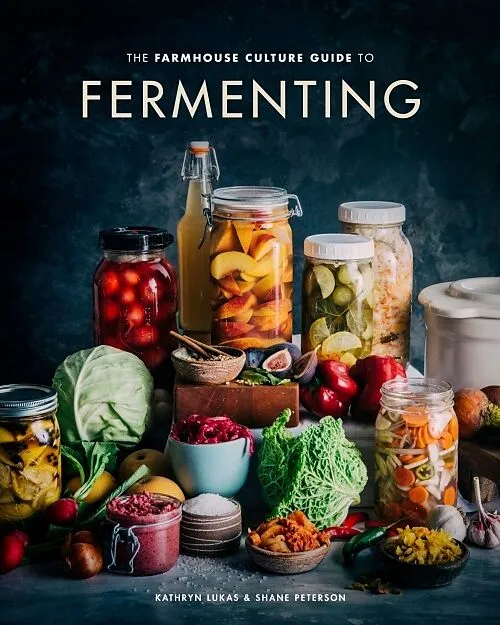
The Farmhouse Culture Guide to Fermenting
Beschreibung
An authoritative and easy-to-use guide to fermentation with 100 recipes for fermented foods and drinks . IACP AWARD FINALIST Fermented and live-culture foods are beloved for their bold and layered flavors as well as their benefits for gut health and boosting i...Format auswählen
- Fester EinbandCHF 41.20

Wird oft zusammen gekauft
Andere Kunden kauften auch
Beschreibung
An authoritative and easy-to-use guide to fermentation with 100 recipes for fermented foods and drinks . IACP AWARD FINALIST Fermented and live-culture foods are beloved for their bold and layered flavors as well as their benefits for gut health and boosting immunity, but until now, there hasn't been a book that is both authoritative and easy to use. The Farmhouse Culture Guide to Fermenting provides you with the history, health information, and safest methods for preserving, along with 100 recipes for krauts, pickles, kimchi, fermented vegetables, hot sauces, preserved fruits and jams, kombucha, and even mead. With trusted authors Kathryn Lukas, founder of mega brand Farmhouse Culture, and master fermenter and best-selling author Shane Peterson and their thoroughly tested recipes, this is the fermentation book that every home fermenter needs--whether you are about to make your first batch of pickles or have been preserving foods for decades.
Autorentext
Kathryn Lukas is a former chef and the founder of Farmhouse Culture, an award-winning fermented food and beverage company based in Santa Cruz, California. A native Californian, Kathryn’s love affair with food started in her grandparents’ farmhouse kitchen where home-grown ingredients were turned into simple, yet delicious meals. Years later, she fell in love with fresh fermented sauerkraut at her restaurant in Stuttgart, Germany. Kathryn returned home to the U.S. in the late 90s and learned how to make live-culture ferments through a Natural Culinary Program in Santa Cruz. Obsessed, she traveled the globe in pursuit of ancient fermentation techniques and in 2008 founded Farmhouse Culture. She now shares her love and knowledge of fermented, live-culture foods and their powerful healing qualities through workshops and retreats worldwide.
Shane Peterson is a master fermenter, product developer, and best-selling cookbook author with over ten years of experience in the fermented food and beverage industry. His first book, Fermentering, was a best-seller in Denmark, and eventually was published throughout Scandinavia. As head Fermentologist for Farmhouse Culture he co-created many award winning product lines. Shane is a passionate advocate for the rewilding of the human microbiome and the human spirit through the craft of fermentation. An ardent lover of nature, he spends much of his time hiking and foraging the trails of the Northern California. Shane consults for fermented food companies and leads fermentation workshops both in the U.S. and abroad.
Klappentext
**IACP AWARD WINNER • An authoritative and easy-to-use guide to fermentation with 100 recipes for fermented foods and drinks.
Fermented and live-culture foods are beloved for their bold and layered flavors as well as their benefits for gut health and boosting immunity, but until now, there hasn't been a book that is both authoritative and easy to use. The Farmhouse Culture Guide to Fermenting provides you with the history, health information, and safest methods for preserving, along with 100 recipes for krauts, pickles, kimchi, fermented vegetables, hot sauces, preserved fruits and jams, kombucha, and even mead.
With trusted authors Kathryn Lukas, founder of mega brand Farmhouse Culture, and master fermenter and best-selling author Shane Peterson and their thoroughly tested recipes, this is the fermentation book that every home fermenter needs—whether you are about to make your first batch of pickles or have been preserving foods for decades.
Leseprobe
The Farmhouse Culture Story
When I reflect back on all the factors leading up to 2008, it seems as though my entire life’s journey had been in preparation for Farmhouse Culture, and it all started with my grandparents’ farmhouse. Grandpa John, who owned the Guadalupe Mines in Los Gatos, California, and a small cattle ranch and walnut orchard in Gridley, California, was a largerthan-life Irishman who loved to eat (and drink), and my grandmother, Lillian, was happy to oblige him. My sister, mother, and I lived with my grandparents in Los Gatos for most of my childhood, but summers were spent at the ranch in Gridley. It was there in our old white farmhouse that I came to understand the connection between Grandpa John’s gardens and animals, and what landed on our plates. Both my grandparents cooked, but it was Grandpa who was the family preservationist. He canned everything, from dilly beans and tomatoes to grape jelly, and the entire family was required to pitch in. With every jar opened throughout the year, the memory of those raucous family gatherings, full of laughter, intense aromas, and sticky fingers, fortified our meals with deep satisfaction.
As I was tossing around names for my budding little sauerkraut company, I kept thinking back to my family’s farmhouse and my memories of how ingredients were lovingly transformed into healthful and delicious foods. Although my first products were sauerkrauts (because it was a familiar food for most Americans), I knew from the beginning that I wanted to eventually introduce many more traditional live-culture foods and beverages, and the name “Farmhouse Culture” provided the girth needed to expand. Yes, I thought, this would be a fine name for my new company, while honoring the care, lessons, and love my grandparents so generously shared with me. And it might even make up for breaking Grandpa John’s heart when I became a vegetarian.
It was my quirky Norwegian grandmother, Roxanne, who was convinced that my fiery teenage energy could be tamed with a vegetarian, macrobiotic diet. A free-spirited nonconformist, she was deeply distrustful of the corporate food system and in the 1960s had found her way to brown rice, whole-wheat bread, and tofu. She swore the new diet helped with her arthritis and might even save the world. It was in her wise care, and with her “hippie” foods, that I not only calmed down, but also fell in love with cooking. Grandma Roxanne taught me that knowing how to cook healthy foods was the ultimate form of rebellion, and that if one was going attempt to make the world a better place, a healthy body and a strong mind were absolute necessities. She lit the fire that still burns strong in my belly today.
Falling in love with a German and moving to Stuttgart, Germany, in my late twenties was another defining moment on the road to sauerkraut. At our restaurant, Das Augustenstüble, I learned to cook the regional Schwäbisch cuisine and to love canned sauerkraut—if it was properly prepared. Rinsed well; braised with apples, onions, and duck fat; and doused with wine, it was a huge improvement over the straight-out-of-the-can stuff Grandpa John served with hot dogs. But it wasn’t until a trip to a farm outside Stuttgart to refill our schnapps bucket for the restaurant that I discovered an even better version. Our visits had become an anticipated and delicious monthly ritual. The farmer, Herr Lutz, was a jolly and boisterous fellow and always eager to share the foods and drinks he and his wife worked so hard to grow and prepare. Normally there were things like apricots and plums and new flavors of schnapps, so I wasn’t totally prepared when Herr Lutz handed me a forkful of sauerkraut from a large wooden barrel. Still assuming that straight sauerkraut tasted like the canned kraut I was familiar with, I was hesitant, but of course I couldn’t refuse. I inhaled deeply and prepared for the onslaught of that intense salty sourness I had come to expect. But instead, I experienced a mild, pleasing tanginess and a slight herbaceousness, followed by just a hint of vegetal sweetness. The briny finish brought all the flavors together into a gorgeous and harmonious taste. This was something entirely different than canned sauerkraut, and I …