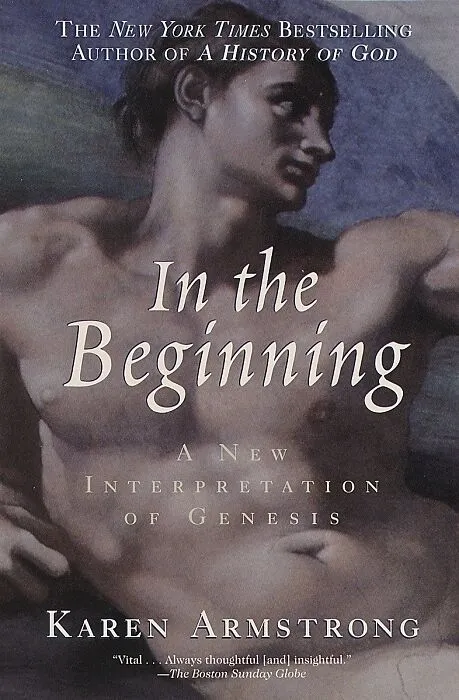
In the Beginning
Beschreibung
Zusatztext Karen Armstrong is a genius. A. N. Wilson A lyrical chronicle of one woman's wrestling with Genesis that can serve as a guide to others . . . As notable for its scholarship as it is for its honesty and vulnerability. Publishers Weekly Armstrong can ...Format auswählen
- Kartonierter EinbandCHF 20.00

Wird oft zusammen gekauft
Andere Kunden kauften auch
Beschreibung
Zusatztext Karen Armstrong is a genius. A. N. Wilson A lyrical chronicle of one woman's wrestling with Genesis that can serve as a guide to others . . . As notable for its scholarship as it is for its honesty and vulnerability. Publishers Weekly Armstrong can simplify complex ideas! but she is never simplistic. The New York Times Book Review Informationen zum Autor Karen Armstrong Klappentext "Karen Armstrong is a genius."-A. N. Wilson As the foundation stone of the Jewish and Christian scriptures, The Book of Genesis unfolds some of the most arresting stories of world literature-the Creation; Adam and Eve; Cain and Abel; the sacrifice of Isaac. Yet the meaning of Genesis remains enigmatic. In this fascinating volume, Karen Armstrong, author of the highly acclaimed bestseller A History of God, brilliantly illuminates the mysteries and profundities of this mystifying work. "A lyrical chronicle of one woman's wrestling with Genesis that can serve as a guide to others . . . As notable for its scholarship as it is for its honesty and vulnerability."-Publishers Weekly "Armstrong can simplify complex ideas, but she is never simplistic."-The New York Times Book ReviewWrestling with God and Scripture ONE OF THE MOST HAUNTING SCENES IN Genesis is surely the occasion when Jacob wrestled all night long with a mysterious stranger and discovered that he had in reality been struggling with God (Genesis 32:2432). It was a moment of crisis. Jacob was returning to his homeland after an absence of twenty years. He feared that his brother, Esau, whom he had gravely wronged, would kill him when they met the next day. He was full of dread and felt inadequate for the task that God had set him. That night Jacob camped alone at the wild gorge of the Jabbok stream on the borders of Canaan. There, the biblical writer tells us laconically, a man wrestled with him until daybreak. When he found that he could not overpower Jacob, his assailant struck him on the hip, dislocating it, just as the dawn was breaking. Still Jacob refused to let him go and, for once in his confused life, was able to rise superbly to the occasion. He knew that this was no ordinary opponent, yet he did not ask for a revelation or a miracle. Instead, he asked for a blessing and was given a new name: You shall no longer be called Jacob, said the stranger, but Israel, for you have striven with God and with humans, and have prevailed. Then Jacob asked him, Please tell me your name. But he said, Why is it that you ask my name? And there he blessed him. So Jacob called the place Peniel, saying, For I have seen God face to face, and yet my life is preserved. (32:2930) It is surprising to find this incident in the Hebrew Bible. Later the descendants of Jacob/Israel would insist that no human being could look upon the face of God and live. They would find it blasphemous to imagine their deity appearing to any mortalhowever augustin human form. Yet the editors who put together the final text of Genesis in about the fifth century BCE felt able to include the tale because it so eloquently described the religious experience of Israel. There would be no final revelation: God would never fully impart his name and nature to his people. The sacred was too great a reality to be contained within a purely human definition or system of thought. Thus, the people of Israel would have only fleeting and frequently ambiguous glimpses of the divine, though they would know that they had been blessed. Their lives had been touched by a reality that transcended mundane existence, and that elusive contact gave them the strength and insight to face the challenge of an uncertain world. After this strange encounter with God, Jacob left Peniel, limping from his damaged hip, just as the sun was rising, fully prepared to face his brother and achieve th...
ldquo;Karen Armstrong is a genius.”—A. N. Wilson
**
“A lyrical chronicle of one woman's wrestling with Genesis that can serve as a guide to others . . . As notable for its scholarship as it is for its honesty and vulnerability.”—Publishers Weekly
**
“Armstrong can simplify complex ideas, but she is never simplistic.”—The New York Times Book Review
Autorentext
Karen Armstrong
Klappentext
"Karen Armstrong is a genius."-A. N. Wilson
As the foundation stone of the Jewish and Christian scriptures, The Book of Genesis unfolds some of the most arresting stories of world literature-the Creation; Adam and Eve; Cain and Abel; the sacrifice of Isaac. Yet the meaning of Genesis remains enigmatic. In this fascinating volume, Karen Armstrong, author of the highly acclaimed bestseller A History of God, brilliantly illuminates the mysteries and profundities of this mystifying work.
"A lyrical chronicle of one woman's wrestling with Genesis that can serve as a guide to others . . . As notable for its scholarship as it is for its honesty and vulnerability."-Publishers Weekly
"Armstrong can simplify complex ideas, but she is never simplistic."-The New York Times Book Review
Zusammenfassung
“Karen Armstrong is a genius.”—A. N. Wilson
As the foundation stone of the Jewish and Christian scriptures, The Book of Genesis unfolds some of the most arresting stories of world literature—the Creation; Adam and Eve; Cain and Abel; the sacrifice of Isaac. Yet the meaning of Genesis remains enigmatic. In this fascinating volume, Karen Armstrong, author of the highly acclaimed bestseller A History of God, brilliantly illuminates the mysteries and profundities of this mystifying work.
**“A lyrical chronicle of one woman's wrestling with Genesis that can serve as a guide to others . . . As notable for its scholarship as it is for its honesty and vulnerability.”—Publishers Weekly
“Armstrong can simplify complex ideas, but she is never simplistic.”—The New York Times Book Review**
Leseprobe
Wrestling with God and Scripture
ONE OF THE MOST HAUNTING SCENES IN Genesis is surely the occasion when Jacob wrestled all night long with a mysterious stranger and discovered that he had in reality been struggling with God (Genesis 32:24–32). It was a moment of crisis. Jacob was returning to his homeland after an absence of twenty years. He feared that his brother, Esau, whom he had gravely wronged, would kill him when they met the next day. He was full of dread and felt inadequate for the task that God had set him. That night Jacob camped alone at the wild gorge of the Jabbok stream on the borders of Canaan. There, the biblical writer tells us laconically, “a man wrestled with him until daybreak.” When he found that he could not overpower Jacob, his assailant struck him on the hip, dislocating it, just as the dawn was breaking. Still Jacob refused to let him go and, for once in his confused life, was able to rise superbly to the occasion. He knew that this was no ordinary opponent, yet he did not ask for a revelation or a miracle. Instead, he asked for a blessing and was given a new name: “You shall no longer be called Jacob,” said the stranger, “but Israel, for you have striven with God and with humans, and have prevailed.”
Then Jacob asked him, “Please tell me your name.” But he said, “Why is it that you ask my name?” And there he blessed him. So Jacob called the place Peniel, saying, “For I have seen God face to face, and yet my life is preserved.” (32:29–30)
It is surprising to find this incident in the Hebrew Bible. Later the descendants of Jacob/Israel would insist that no human being could look upon the face of God and live. They would find it blasphemous to imagine their deity appearing to any mortal—however august—in human form. Yet the editors who put together the final text of…