
IHR WARENKORB IST AKTUELL LEER.
Haben Sie noch nichts passendes gefunden? Stöbern Sie durch unser komplettes Sortiment.
Oder melden Sie sich an bzw. registrieren Sie sich.
- Kostenlose Lieferung
- Kauf auf Rechnung
- Ex Libris Tiefpreis
- Filiallieferung und 650+ Abholorte
- Rabatt-Bons als Club-Mitglied
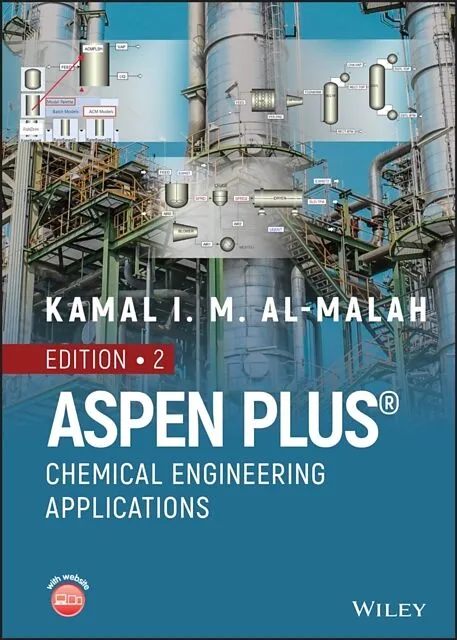
Aspen Plus
Beschreibung
ASPEN PLUS® Comprehensive resource covering Aspen Plus V12.1 and demonstrating how to implement the program in versatile chemical process industries Aspen Plus®: Chemical Engineering Applications facilitates the process of learning and later mastering Aspen Pl...Format auswählen
- Fester EinbandCHF 182.00
Wird oft zusammen gekauft
Andere Kunden kauften auch
Beschreibung
ASPEN PLUS® Comprehensive resource covering Aspen Plus V12.1 and demonstrating how to implement the program in versatile chemical process industries
Aspen Plus®: Chemical Engineering Applications facilitates the process of learning and later mastering Aspen Plus®, the market-leading chemical process modeling software, with step-by-step examples and succinct explanations. The text enables readers to identify solutions to various process engineering problems via screenshots of the Aspen Plus® platforms in parallel with the related text.
To aid in information retention, the text includes end-of-chapter problems and term project problems, online exam and quiz problems for instructors that are parametrized (i.e., adjustable) so that each student will have a standalone version, and extra online material for students, such as Aspen Plus®-related files, that are used in the working tutorials throughout the entire textbook.
The second edition of Aspen Plusreg;: Chemical Engineering Applications includes information on:
- Various new features that were embedded into Aspen Plus V12.1 and existing features which have been modified
- Aspen Custom Modeler (ACM), covering basic features to show how to merge customized models into Aspen Plus simulator
- New updates to process dynamics and control and process economic analysis since the first edition was published
- Vital areas of interest in relation to the software, such as polymerization, drug solubility, solids handling, safety measures, and energy saving
For chemical engineering students and industry professionals, the second edition of Aspen Plus®: Chemical Engineering Applications is a key resource for understanding Aspen Plus and the new features that were added in version 12.1 of the software. Many supplementary learning resources help aid the reader with information retention.
Autorentext
Kamal I. M. Al-Malah received his PhD degree from Oregon State University in 1993. He served as a Professor of Chemical Engineering in Jordan and other Gulf countries, as well as Former Chairman of the Chemical Engineering Department at the University of Hail in Saudi Arabia. Professor Al-Malah is an expert in both Aspen Plus® and MATLAB® applications. He has created a bundle of Windows-based software for engineering applications.
Klappentext
ASPEN PLUS® Comprehensive resource covering Aspen Plus V12.1 and demonstrating how to implement the program in versatile chemical process industries
Aspen Plus®: Chemical Engineering Applications facilitates the process of learning and later mastering Aspen Plus®, the market-leading chemical process modeling software, with step-by-step examples and succinct explanations. The text enables readers to identify solutions to various process engineering problems via screenshots of the Aspen Plus® platforms in parallel with the related text.
To aid in information retention, the text includes end-of-chapter problems and term project problems, online exam and quiz problems for instructors that are parametrized (i.e., adjustable) so that each student will have a standalone version, and extra online material for students, such as Aspen Plus®-related files, that are used in the working tutorials throughout the entire textbook.
The second edition of Aspen Plusreg;: Chemical Engineering Applications includes information on:
- Various new features that were embedded into Aspen Plus V12.1 and existing features which have been modified
- Aspen Custom Modeler (ACM), covering basic features to show how to merge customized models into Aspen Plus simulator
- New updates to process dynamics and control and process economic analysis since the first edition was published
- Vital areas of interest in relation to the software, such as polymerization, drug solubility, solids handling, safety measures, and energy saving
For chemical engineering students and industry professionals, the second edition of Aspen Plus®: Chemical Engineering Applications is a key resource for understanding Aspen Plus and the new features that were added in version 12.1 of the software. Many supplementary learning resources help aid the reader with information retention.
Inhalt
Ch1. Introducing Aspen Plus
1.1 What does ASPEN stand for?
1.2 What is Aspen Plus Process Simulation Model?
1.3 Launching Aspen Plus V12.0
1.4 Beginning a Simulation
1.5 Entering Components
1.6 Specifying the Property Method
1.7 Improvement of the Property Method Accuracy
1.8 File Saving
1.9 Exercise 1.1
1.10 Good Flowsheeting Practice
1.11 Aspen Plus Built-in Help
1.12 For More Information
1.13 Home/Class Work 1.1 (Pxy)
1.14 Home/Class Work 1.2 ( Gmix)
1.15 Home/Class Work 1.3 (Likes Dissolve Likes) as Envisaged by NRTL Property Method
1.16 Home/Class Work 1.4 (The Mixing Rule)
Ch2. More on Aspen Plus Flowsheet Features (1)
2.1 Problem Description
2.2 Entering and Naming Compounds
2.3 Binary Interactions
2.4 The "Simulation" Environment: Activation Dashboard
2.5 Placing a Block and Material Stream from Model Palette
2.6 Block and Stream Manipulation
2.7 Data Input, Project Title, & Report Options
2.8 Running the Simulation
2.9 The Difference among Recommended Property Methods
2.10 NIST/TDE Experimental Data
2.11 Home-/Class-Work 2.1 (Water-Alcohol System)
2.12 Home-/Class-Work 2.2 (Water-Acetone-EIPK System with NIST/DTE Data)
2.13 Home-/Class-Work 2.3 (Water-Acetone-EIPK System without NIST/DTE Data)
Ch3. More on Aspen Plus Flowsheet Features (2)
3.1 Problem Description: Continuation to Chapter Two Problem
3.2 The Clean Parameters Step
3.3 Simulation Results Convergence
3.4 Adding Stream Table
3.5 Property Sets
3.6 Adding Stream Conditions
3.7 Printing from Aspen Plus
3.8 Viewing the Input Summary
3.9 Report Generation
3.10 Stream Properties
3.11 Adding a Flash Separation Unit
3.12 The Required Input for "Flash3"-Type Separator
3.13 Running the Simulation and Checking the Results
3.14 Home-/Class-Work 3.1 (Output of Input Data & Results)
3.15 Home-/Class-Work 3.2 (Output of Input Data & Results)
3.16 Home-/Class-Work 3.3 (Output of Input Data & Results)
3.17 Home-/Class-Work 3.4 (The Partition Coefficient of a Solute)
Ch4. Flash Separation & Distillation Columns
4.1 Problem Description
4.2 Adding a Second Mixer and Flash
4.3 Design Specifications Study
4.4 Exercise 4.1 (Design Spec)
4.5 Aspen Plus Distillation Column Options
4.6 "DSTWU" Distillation Column
4.7 "Distl" Distillation column
4.8 "RadFrac" Distillation Column
4.9 Home/Class Work 4.1 (Water-Alcohol System)
4.10 Home/Class Work 4.2 (Water-Acetone-EIPK System with NIST/DTE Data)
4.11 Home/Class Work 4.2 (Water-Acetone-EIPK System without NIST/DTE Data)
4.12 Home/Class Work 4.4 (Scrubber)
Ch5. Liquid-Liquid Extraction Process
5.1 Problem Description
5.2 The Proper Selection for Property Method for Extraction Processes
5.3 Defining New Property Sets
5.4 Property Method Validation versus Experimental Data Using Sensitivity Analysis
5.5 A Multi-Stage Extraction Column
5.6 The Triangle Diagram
5.7 References
5.8 Home/Class Work 5.1 (Separation of MEK from Octanol)
5.9 Home/Class Work 5.2 (Separation of MEK from Water Using Octane)
5.10 Home/Class Work 5.3 (Separation of Acetic Acid from Water Using Iso-Propyl Butyl Ether)
5.11 Home/Class Work 5.4 (Separation of Acetone from Water Using Tri-Chloro-Ethane)
5.12 Home/Class Work 5.5 (Separation of Propionic Acid from Water Using MEK)
Ch6. Reactors with Simple Reaction Kinetic Forms
6.1 Problem Description
6.2 Defining Reaction Rate Constant to Aspen Plus Environment
6.3 Entering Components and Method of Property
6.4 The Rigorous Plug Flow Reactor (RPLUG)
6.5 Reactor and Reaction Specifications for RPLUG (PFR)
6.6 Running the Simulation (PFR Only)
6.7 Ex…