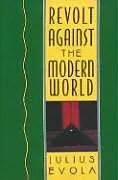
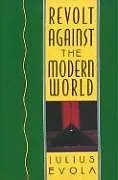
Revolt Against the Modern World
Beschreibung
"Evola does not write in abstract philosophical language but in lively prose, filled with fascinating and concrete details. Given a basic grounding in history and culture, one can dip into the book anywhere and find new twists and reinterpretations. Such an en...Format auswählen
- Fester EinbandCHF 39.90
Wird oft zusammen gekauft
Andere Kunden kauften auch
Beschreibung
"Evola does not write in abstract philosophical language but in lively prose, filled with fascinating and concrete details. Given a basic grounding in history and culture, one can dip into the book anywhere and find new twists and reinterpretations. Such an encounter with a totally original mind is a rarity in these days of bland consensus, and a thrilling one whether one agrees with Evola or not."
Autorentext
A controversial philosopher and critic of modern Western civilization, Julius Evola (1898-1974) wrote widely on Eastern religions, alchemy, sexuality, politics, and mythology. Inner Traditions has published his Eros and the Mysteries of Love: The Metaphysics of Sex, The Yoga of Power, The Hermetic Tradition, Revolt Against the Modern World, The Mystery of the Grail and Ride The Tiger.
Zusammenfassung
In what many consider to be his masterwork, Evola contrasts the characteristics of the modern world with those of traditional societies, from politics and institutions to views on life and death.
Leseprobe
No idea is as absurd as the idea of progress, which together with its corollary notion of the superiority of modern civilization, has created its own “positive” alibis by falsifying history, by insinuating harmful myths in people’s minds, and by proclaiming itself sovereign at the crossroads of the plebeian ideology from which it originated. *
*In order to understand both the spirit of Tradition and its antithesis, modern civilization, it is necessary to begin with the fundamental doctrine of the two natures. According to this doctrine there is a physical order of things and a metaphysical one; there is a mortal nature and an immortal one; there is the superior realm of “being” and the inferior realm of “becoming.” Generally speaking, there is a visible and tangible dimension and, prior to and beyond it, an invisible and intangible dimension that is the support, the source, and the true life of the former.
--from chapter one
This present “civilization” . . . has brought to all strata of society and to all races the following “gifts”: restlessness, dissatisfaction, resentment, the need to go further and faster, and the inability to possess one’s life in simplicity, independence, and balance. Modern civilization has pushed man onward; it has generated in him the need for an increasingly greater number of things; it has made him more and more insufficient to himself and powerless.
--from chapter thirty‑five
Even though it may be destined to disappear, modern civilization is certainly not the first to become extinct, nor is it the one after which none will follow. In the life of what is conditioned by space and time, lights are continually being put out and kindled again; cycles end and new ones begin. As I have said, the doctrine of the cycles was known to traditional man, and only the ignorance of modern man has induced him to believe that his civilization, which is characterized by the deepest roots in the temporal and contingent element, will enjoy a different and privileged fate.
--from the conclusion
Inhalt
Revolt Against the Modern World
Politics, Religion, and Social Order in the Kali Yuga
A Short Introduction to Julius Evola
Translator's Preface
Foreword
Part One - The World of Tradition
- The Beginning
- Regality
- Polar Symbolism; the Lord of Peace and Justice
- The Law, the State, the Empire
- The Mystery of the Rite
- On the Primordial Nature of the Patriciate
- Spiritual Virility
- The Two Paths in the Afterlife
- Life and Death of Civilizations
- Initiation and Consecration
- On the Hierarchical Relationship Between Royalty and Priesthood
- Universality and Centralism
- The Soul of Chivalry
- The Doctrine of the Castes
- Professional Associations and the Arts; Slavery
- Bipartition of the Traditional Spirit; Asceticism
- The Greater and the Lesser Holy War
- Games and Victory
- Space, Time, the Earth
- Man and Woman
- The Decline of Superior Races
Part Two - Genesis and Face of the Modern World
Introduction - The Doctrine of the Four Ages
- The Golden Age
- The Pole and the Hyperborean Region
- The Northern-Atlantic Cycle
- North and South
- The Civilization of the Mother
- The Cycles of Decadence and the Heroic Cycle
- Tradition and Antitradition
- The Heroic-Uranian Western Cycle
- Syncope of the Western Tradition
- The Revival of the Empire and the Ghibelline Middle Ages
- Decline of the Medieval World and the birth of Nations
- Unrealism and Individualism
- The Regression of the Castes
- Nationalism and Collectivism
- The End of the Cycle
Conclusion
Appendix: On The Dark Age
Index