
IHR WARENKORB IST AKTUELL LEER.
Haben Sie noch nichts passendes gefunden? Stöbern Sie durch unser komplettes Sortiment.
Oder melden Sie sich an bzw. registrieren Sie sich.
- Kostenlose Lieferung
- Kauf auf Rechnung
- Ex Libris Tiefpreis
- Filiallieferung und 650+ Abholorte
- Rabatt-Bons als Club-Mitglied
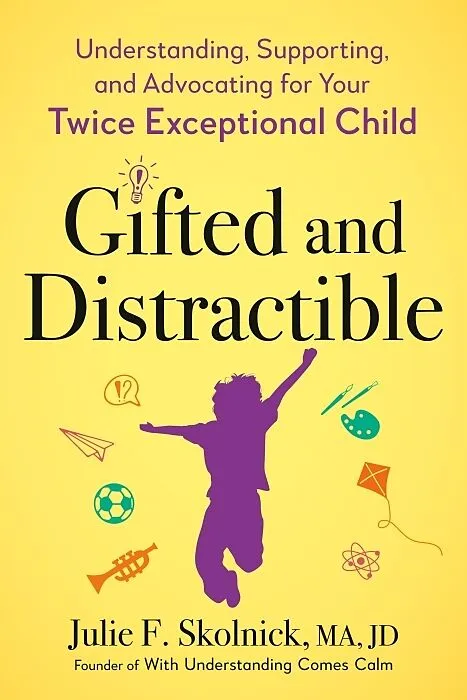
Gifted and Distractable
Beschreibung
Informationen zum Autor Julie Skolnick, M.A., J.D. , founder of With Understanding Comes Calm LLC, has passionately guided thousands of parents of gifted and distractible children around the world, mentors twice exceptional adults, and advises educators and pr...Format auswählen
- Kartonierter EinbandCHF 27.90

Wird oft zusammen gekauft
Andere Kunden kauften auch
Beschreibung
Informationen zum Autor Julie Skolnick, M.A., J.D. , founder of With Understanding Comes Calm LLC, has passionately guided thousands of parents of gifted and distractible children around the world, mentors twice exceptional adults, and advises educators and professionals on how to bring out the best and raise self-confidence in their twice-exceptional students and clients. She serves as secretary to the Maryland superintendent's State Advisory Council for Gifted and Talented Students, and produces virtual conferences and other engagement opportunities for the twice exceptional community. Klappentext "Does your child exhibit giftedness and behavioral issues like meltdowns, power struggles, and difficulty relating to their peers? Are they out-of-the-box thinkers requiring different teaching and learning methods? It's a widely held misconception that intellectual ability and social and emotional success go hand in hand. In fact, "twice exceptional" kids-those who are gifted and have simultaneous learning differences like ADHD, high-functioning autism, or dyslexia-are often misunderstood by parents, teachers, and themselves. This much-needed and empowering guide reveals the unique challenges these remarkable kids face, and offers strength-based, hands-on strategies for understanding, supporting, and advocating for twice exceptional kids. In a world that labels them lazy, scattered, attention-seeking, and a problem that can't be solved, these tools will help you reimagine the world through your child's unique perspective-so you can help them thrive"-- Leseprobe 1 Gifted and Distractible What Do the Labels Mean? The Cycle for Success begins with the extraordinarily important step of gaining a deep understanding of the 2e child's true inner experience and complexity. Frequently described as "gifted with a learning difference or learning disability," the twice exceptional child elicits misunderstandings and incorrect assumptions. The disability piece refers to learning differences and disabilities that are well researched and understood. Some of these conditions include ADD, ADHD, dyslexia, dysgraphia, dyscalculia, Autism, auditory processing disorder, and sensory processing differences. By no means is this an exhaustive list. The twice exceptional profile can also include more nuanced exceptionalities, such as working memory issues, "slow" processing speed, anxiety, executive functioning challenges, or social/emotional difficulties. It's imperative to note that 2e children's neurological wiring works against their ability to engage according to neurotypical norms, encourages negative self-concept, and undermines the strengths and gifts that are attendant to their profile. Surprisingly intense reactions to unseen triggers often elicit reactive responses from parents, teachers, and peers. Having their own nervous system triggered by what seems like out-of-place and over-the-top behavior, parents often find themselves matching their 2e child's intensity. Understanding the inner experience of gifted and twice exceptional children is necessary for parents to shift from an intensely reactionary model of parenting to an informed, responsive parenting model. Who Is the "Typical" 2e Child? Even though each 2e child demonstrates her own cocktail of characteristics and symptoms, there are similarities. The "typical" 2e child's experience is one of intensity from birth. She has a rage to learn and master whatever is put in front of her. She feels intense emotions, literally from infanthood, and has sleepless nights, long bouts of crying, or incredibly deep sleep. Perhaps the child demonstrates an ability to focus and concentrate on highly stimulating input. Think of the child who watches the world unfold around her, who stares at a sunbeam rippling through the trees outside a window and casting shadows on the floor... the child wh...
Autorentext
Julie Skolnick, M.A., J.D., founder of With Understanding Comes Calm LLC, has passionately guided thousands of parents of gifted and distractible children around the world, mentors twice exceptional adults, and advises educators and professionals on how to bring out the best and raise self-confidence in their twice-exceptional students and clients. She serves as secretary to the Maryland superintendent’s State Advisory Council for Gifted and Talented Students, and produces virtual conferences and other engagement opportunities for the twice exceptional community.
Klappentext
A practical, research-based guide that demystifies giftedness and learning differences in order to help “twice exceptional” children thrive.
Does your child exhibit giftedness and behavioral issues like meltdowns, power struggles, and difficulty relating to their peers? Are they out-of-the-box thinkers requiring different teaching and learning methods? It’s a widely held misconception that intellectual ability and social and emotional success go hand in hand. In fact, “twice exceptional” kids—those who are gifted and have simultaneous learning differences like ADHD, Autism, or dyslexia—are often misunderstood by parents, teachers, and themselves.
This much-needed and empowering guide reveals the unique challenges these remarkable kids face, and offers strength-based, hands-on strategies for understanding, supporting, and advocating for twice exceptional kids. In a world that labels them lazy, scattered, attention-seeking, and a problem that can’t be solved, these tools will help you reimagine the world through your child’s unique perspective—so you can help them thrive.
Leseprobe
1
Gifted and Distractible
What Do the Labels Mean?
The Cycle for Success begins with the extraordinarily important step of gaining a deep understanding of the 2e child's true inner experience and complexity. Frequently described as "gifted with a learning difference or learning disability," the twice exceptional child elicits misunderstandings and incorrect assumptions. The disability piece refers to learning differences and disabilities that are well researched and understood. Some of these conditions include ADD, ADHD, dyslexia, dysgraphia, dyscalculia, Autism, auditory processing disorder, and sensory processing differences. By no means is this an exhaustive list. The twice exceptional profile can also include more nuanced exceptionalities, such as working memory issues, "slow" processing speed, anxiety, executive functioning challenges, or social/emotional difficulties. It's imperative to note that 2e children's neurological wiring works against their ability to engage according to neurotypical norms, encourages negative self-concept, and undermines the strengths and gifts that are attendant to their profile.
Surprisingly intense reactions to unseen triggers often elicit reactive responses from parents, teachers, and peers. Having their own nervous system triggered by what seems like out-of-place and over-the-top behavior, parents often find themselves matching their 2e child's intensity. Understanding the inner experience of gifted and twice exceptional children is necessary for parents to shift from an intensely reactionary model of parenting to an informed, responsive parenting model.
Who Is the "Typical" 2e Child?
Even though each 2e child demonstrates her own cocktail of characteristics and symptoms, there are similarities. The "typical" 2e child's experience is one of intensity from birth. She has a rage to learn and master whatever is put in front of her. She feels intense emotions, literally from infanthood, and has sleepless nights, long bouts of crying, or incredibly deep sleep. Perhaps the child demonstrates an ability to focus and concentrate on highly stimulating input. Think of the child who watches the world unfold around her, who stares at a sunbeam rippling through the tree…